A purchase and renovation loan from the council lets a first time buyer in Cork borrow to buy a derelict or vacant house and pay for the works, when two banks have said no, and it carries the Vacant Property Refurbishment Grant as a separate bridging loan until the grant is paid at the end of the job. For Cork city and county the house may be worth up to €375,000 when the works are done, the mortgage part is fixed at 4.00% or 4.05%, the bridging part is 3.5% interest only, and a derelict cottage needs a deposit of 20% of the price plus 10% of the works.
West Cork is full of roofless cottages, and what stops a first time buyer taking one on is usually not the grant but the gap before it: the grant pays out once the council has inspected the finished house, which can be a year and a half after you bought it. The Local Authority Purchase and Renovation Loan exists to bridge that gap. This guide takes it the way a Cork application actually runs, from the survey that decides whether the project is viable, through the deposit and the two loans, to the day the grant clears the bridging loan, with the parts of Ivy Cottage, the Roscommon cottage our founder rebuilt, that bear on each stage. The figures were read on 21 November 2026 on citizensinformation.ie (edited 7 May 2026 for the April increases), on the scheme's own site and on gov.ie.
Start with the survey, not the mortgage
Every other mortgage starts with your income. This one starts with the building. Before the council looks at your figures you must have identified a house that qualifies for the refurbishment grant, vacant for at least two years and built before 2008, and shown the project is viable with professional analysis: a Stage 1 building survey and scope of works, a Stage 1 cost plan, a valuation of the house as it stands and an estimate of its value when the works are finished. The survey and cost plan come from a Registered Construction Professional, a quantity surveyor or building surveyor on the Building Control Act 2007 registers or a chartered engineer on the Engineers Ireland register, with that professional's indemnity insurance in place. If the project passes Stage 1, a Stage 2 scope and cost plan follow.
That survey also decides which of the three project types you are in, and the type decides the deposit and the loan. Vacant with minor works. Vacant with major works, which the scheme takes from the Building Regulations as a renovation of more than a quarter of the building envelope. Derelict, meaning a house that qualifies for the €20,000 derelict top up because an independent report says it is structurally unsound and dangerous, or it is on the Derelict Sites Register. A stone cottage with the roof gone is in the third group; a bungalow that needs a kitchen, rewiring and windows is probably in the first.
The purchase and renovation loan in numbers for Cork
The cap is not on the price you pay but on the value of the finished house, and from 1 April 2026 it is €375,000 in Cork, Galway city and Meath. That covers Cork city and the whole county, from Youghal to the Beara peninsula. Dublin, Kildare and Wicklow sit at €415,000, a middle band of eight counties at €345,000, and the remaining thirteen, Roscommon among them, at €310,000. The most the council will lend in the Cork band is €337,500, and the scheme says it may be lower depending on the project type.
| Project type | Deposit | Loan to value of the mortgage part |
|---|---|---|
| Vacant, minor works | 10% of the price plus 10% of the works | Up to 90% of the end of works value |
| Vacant, major works | 10% of the price plus 10% of the works | Up to 85% of the end of works value |
| Derelict | 20% of the price plus 10% of the works | Up to 80% of the end of works value |
The bridging loan sits on top of the mortgage part, equal to the grant you have been approved for, as long as the two together stay under the €337,500 maximum. Repayments are capped at 35% of your net disposable income, and the mortgage term runs to 30 years at most or to the oldest applicant's seventieth birthday, so a 45 year old gets 25 years. At least 3% of the deposit must be savings built up over twelve months and shown on statements, up to 7% can be a gift, and nothing can be borrowed. Help to Buy does not count, because it is for new builds only.
Two loans, two rates, one house
The mortgage part is a fixed rate annuity loan: 4.00% for terms up to 25 years (APR 4.07%) and 4.05% for terms over 25 and up to 30 years (APR 4.13%), fixed for the whole term, set on the day you draw down, with a possible breakage fee if you clear it early. The bridging part is a variable rate loan at 3.5% (APR 3.56%), interest only, for at most two years; it must be repaid once the grant is paid out, so in practice the term is shorter, and there is no charge for clearing it early. Both parts carry the council's group Mortgage Protection Insurance, paid monthly and compulsory.
Why two loans rather than one? Because the council assesses your repayment capacity on what will be outstanding once the bridging loan is gone. The scheme's own explanation is that this increases your borrowing capacity and improves the viability of the project, since the cost is taken net of the Vacant Property Refurbishment Grant of up to €50,000 and the derelict top up that brings it to €70,000. Citizens Information puts it simply: you pay the bridging loan back as soon as you get the grant.
Who can apply in Cork
A first time buyer, or a Fresh Start applicant: someone who owned a home before but is divorced, separated or out of the relationship and has given up their interest in the family home, or who lost a home through insolvency or bankruptcy; Fresh Start cannot be used to buy out a former partner's share. Income of not more than €80,000 gross for one applicant or €85,000 for more than one in the year before you apply, two years of continuous employment for the main earner and one for a second earner, the right to reside in the State, and a house you will live in yourself, not let. And you must show you could not borrow enough elsewhere: insufficient offers from two regulated mortgage providers dated within twelve months, a refusal for project specific reasons, or a broker's letter with the attempts attached.
Two Cork situations come up often. The inherited farmhouse: you can apply, and if there is no mortgage on it and you have not bought a home before, it is a renovation only loan with the council taking the first charge. The cottage you have already started on: funding is never given for works already done, and a project under way is not normally considered, although a council may use its discretion on a renovation only project where the early work has made the job less risky. Get the approval before the first skip arrives.
How the application runs, and how long you have
You apply to the council where the house is, Cork City Council or Cork County Council, on the scheme's form, by post or in person, naming a loan amount. An Approval in Principle for the Local Authority Home Loan from the last six months carries your personal assessment across, so only the project is examined. The answer comes in writing as a Decision to Decline, which you can appeal, or an Approval in Principle valid for six months. You can apply before the grant is approved, but the council must verify the grant approval before any money is drawn down, and if the house proves not to qualify the loan is withdrawn. Once the grant is approved you have 18 months to finish the works, so the two year bridging limit and the grant's deadline are meant to line up: works done inside eighteen months, council inspection, grant paid, bridging loan cleared. The other rural grants fit around the loan on works the refurbishment grant does not cover: the SEAI grants for insulation and the heat pump, the well grant and the septic tank grant, each in its own column of the cost plan so nothing is claimed twice.
Ivy Cottage: the shell a surveyor has to stand over
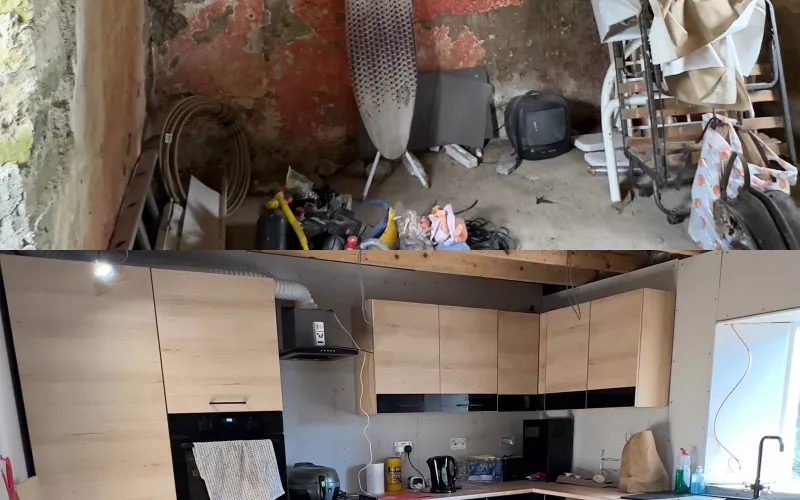
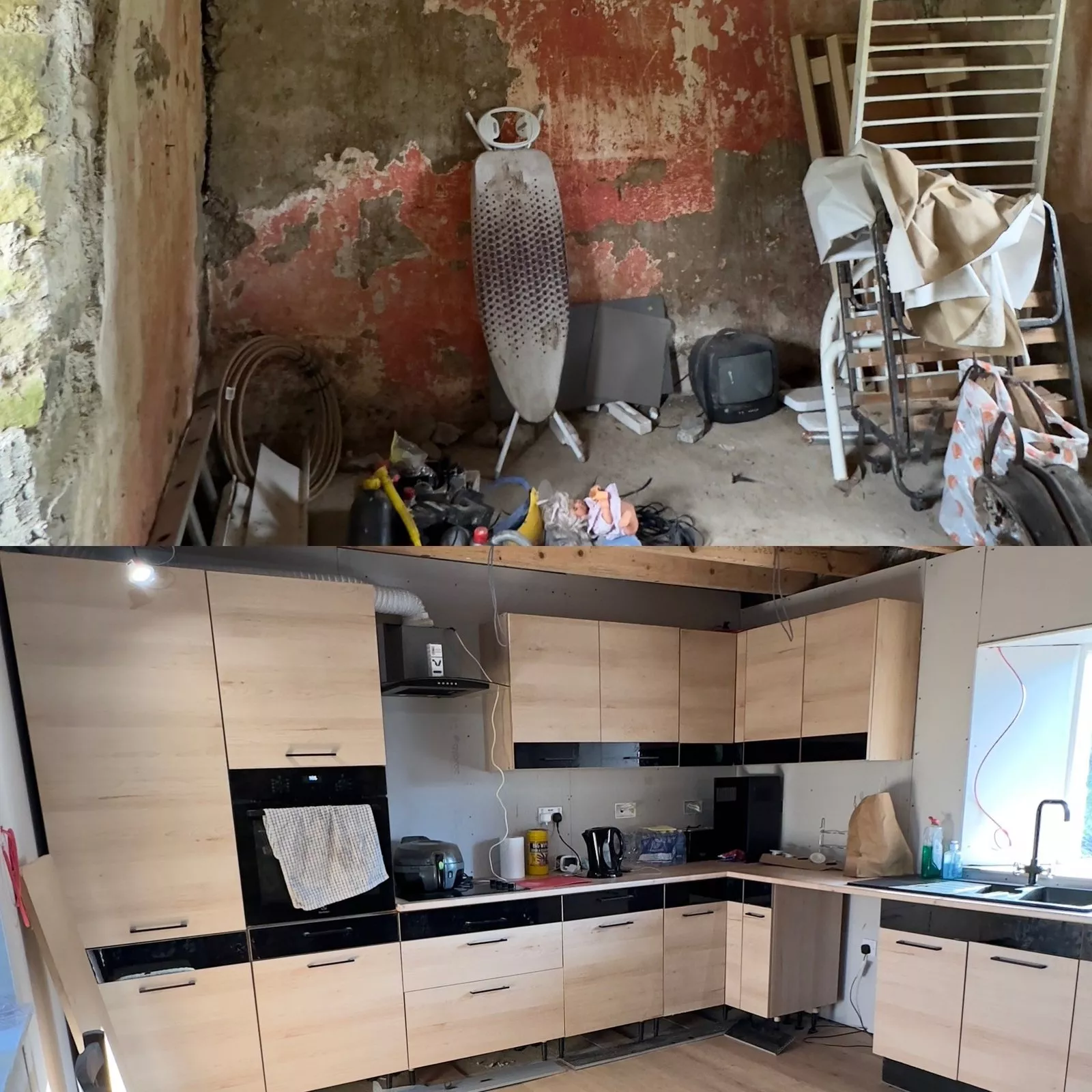
Ivy Cottage is the derelict stone cottage in Roscommon that Kieran McGuire, our founder, bought as a personal project and turned into a home. He posts it on Instagram as @myhomestead.ie; the photos are his own.


The lower half of that first picture is what a Stage 1 survey has to describe: bare stone, a floor that had given way and daylight through the rafters. Kieran did not borrow for it. He paid from his savings and, in place of a lender's cost plan, kept a spreadsheet built around the categories on the grant form with a line for every receipt, which became the free Ivy Cottage renovation tracker. For a loan applicant the lesson is the sequence the pictures show: new joists and roof timbers overhead, then the timber frame and the staircase, then the stud walls, insulation and first fix cabling together while the walls were open, then the floor, the plaster and the paint. A surveyor can cost that order with confidence and a valuer can see the end of works value in it.


Because the house is his own, it is where we try things first. Ivy Cottage runs on Crestron: lighting, heating, audio, CCTV and the alarm on one system, and the water pump and the septic tank too, since a rural house stands on its own services; the pump turned out to feed three farms, the story on our rural property automation page. A cost plan that includes the heating controls, the wiring and the security at Stage 1 is cheaper than any retrofit: our guide to heat pump controls covers the zoning a cottage needs, what to wire at first fix lists the cable runs, and smart home cost in Ireland gives figures you can put in the plan. Kieran's next project is a new build in Cork.
Questions we are often asked
Is Cork county in the same band as Cork city for the purchase and renovation loan?
Yes. The scheme lists Cork as one area, with Galway city and Meath, at a maximum end of works value of €375,000 and a maximum loan of €337,500 from 1 April 2026.
How much deposit do I need for a derelict cottage?
A fifth of the purchase price plus a tenth of the renovation cost. At least 3% of the deposit must be your own savings over twelve months or more, up to 7% can be a gift, and none of it can be borrowed.
Can I apply for the loan without the grant approval?
You can, and the scheme accepts an estimate of the grant in the application, but the council must verify the grant approval or approval in principle before you draw down, and if the house does not qualify for the grant the loan is withdrawn. Getting the grant approval first fixes the figure the loan is built around.
Can I use it on a farmhouse I inherited?
Yes, if it qualifies for the grant, there is no mortgage on it and you have not bought a home before. You apply for a renovation only loan and the council takes the first charge on the property.
What happens to the bridging loan if the grant is less than I expected?
The scheme warns that if the approved grant is less than the amount in your application, your ability to repay may have to be reassessed, because the bridging loan equals the grant and the grant is what repays it. That is a reason to apply for the grant first.
Can I pay off the fixed rate early?
Yes, in full or in part, but an early repayment charge may apply during the fixed period. The bridging loan can be cleared early at no charge.
Sources, all read on 21 November 2026: Citizens Information's page on the Local Authority Purchase and Renovation Loan (edited 7 May 2026); the scheme's own pages on eligibility, interest rates and borrowing and its FAQ; and the Department of Housing's Vacant Property Refurbishment Grant page on gov.ie (last updated 22 October 2026).
If you have a cottage in Cork in your sights and a cost plan to write, and you want the heating, the pump and the security on the plan before the surveyor prices it, we would be glad to walk the house with you.
Book a consultation or call our Cork office on 021 202 8107.
- Log in to post comments