If the Cork cottage you are viewing is on its own well, the private well grant can pay 85% of a new well up to €5,000, or 85% of putting the old well right up to €3,000, plus the full cost of a treatment unit up to €1,000. The council must approve the work before anyone touches the well, the water must be tested by an accredited laboratory, and the house has to be your home, which makes the order you do things in as important as the money.
West Cork, north Cork and the hills behind the city are full of houses that were never near a public main. When one of them has been empty long enough to qualify for the refurbishment grant, the well has usually been idle too: the pump has sat unused, the pipe has frozen a few winters, and nobody has tested the water in years. This post is the checklist we would hand a friend before they went sale agreed on such a house: what to find out about the well before you buy, what the private well grant pays and the small print that decides it, the test and the certificate the council will ask for, how to run it beside the Vacant Property Refurbishment Grant, and how the well pump at Ivy Cottage, our founder's own cottage in Roscommon, ended up with a camera, a meter and a remote switch.
The figures were checked on 24 October 2026 against Cork City Council's terms and conditions for the grant, which follow the national regulations, so they are the same in the county. Treat the rural water section of the council as the final word.
Before you buy: three things to find out about the well
- Is it a private well at all? The grant is for a supply that serves one house. If the cottage shares a source with the farm next door, or draws from a common well through its own pipe, this grant does not apply and you are looking at the group water scheme grants instead. Ask the vendor and the auctioneer in writing.
- Could the house connect to a main or a group scheme? A house that is connected to Uisce Éireann or a group scheme, could reasonably be connected, or sits in an area about to be served by one, is not eligible. On the edge of a Cork town that is a real possibility, and the rural water section can tell you in a phone call.
- What is the water like today? The grant exists for water that fails the drinking water standards or runs short. An abandoned well often does both, but the council decides that at its own pre works visit, not from a story about brown water.
How much the private well grant pays
The amounts are set by the Housing (Private Water Supply Financial Assistance) Regulations 2020 and have not changed since the scheme was revised in June 2020.
| If the council agrees that... | The grant is |
|---|---|
| The existing well can be rehabilitated (deepened, relined, cleared of silt, re equipped) | 85% of the approved cost, up to €3,000 |
| A new well is the most appropriate solution | 85% of the approved cost, up to €5,000 |
| Treatment is needed to meet the drinking water standards (filtration or ultraviolet, for example) | 100% of the approved cost, up to €1,000 |
You cannot have both a rehabilitation grant and a new well grant on the same house, but treatment can go with either, so the practical ceiling is €6,000 for a new well with a treatment unit, or €4,000 for a repaired one. Jobs under €750 in total get nothing. The approved cost is the council's estimate or the real bill, whichever is lower. Water softeners, and the equipment that strips sodium back out of softened water, are specifically excluded, as is any plumbing inside the house and any part of the supply that serves land, stock or a business.
The rules that decide whether you qualify
The council has to be satisfied on five points: the water fails the standards or the quantity is insufficient; the house cannot reasonably be connected to a public or group supply; the house has been fully built for more than seven years; no grant has been paid on its water supply, treatment included, in the previous seven years; and you occupy the house as your normal place of residence. Long term rentals count. Holiday homes, short lets, self catering lets, caravans and mobile homes do not, and neither do houses owned by a council, a housing body or the HSE.
For a vacant cottage the residence rule is the awkward one, because on the day you buy it nobody lives there. The regulations also bar any work that starts before the council's written approval; Cork City Council's terms put it bluntly: if work begins earlier, the application will not be considered and payment will be refused. So the sequence is: buy, ask the rural water section when they want the application, let them inspect the well, get the approval letter, and only then let the driller or the pump man near it. A second application inside seven years is possible only for something unforeseen, such as contamination, subsidence or weather damage.
The paperwork, from form PWS 1a to the payment
| Stage | What the council needs |
|---|---|
| Application | Form PWS 1a and three quotes for all of the proposed work, treatment included |
| Before the work | A pre works inspection by the council, then written approval naming the works that will be paid for |
| Testing | A sample taken by a competent, independent, INAB accredited laboratory (not by you); for treatment, one sample before the unit goes in and one after it has run for about two weeks |
| Well works | A pumping test by the driller and a signed Certificate of Water Quantity on the council's form |
| Claim | Form PWS 1b with every contractor's receipt showing the work and the cost, a current Revenue tax clearance certificate for each contractor, the Certificate of Analysis and, for well works, the Certificate of Water Quantity |
| Payment | A post works inspection, then the grant |
| Refusal | An appeal within three weeks, decided within four weeks and notified within two |
In Cork city the applications go to Rural Water Services at City Hall; in the county, to Cork County Council's water services section, which lists the individual domestic well grant under its water services pages.
Running it beside the Vacant Property Refurbishment Grant
A Cork cottage empty for two years or more and built before 2008 can also draw the Vacant Property Refurbishment Grant, up to €50,000 and up to €70,000 when it is derelict. The well grant is separate money, and the one rule is that nothing is paid for twice. In practice the well, the pump, the pipe to the house and the treatment unit go on the well grant's claim, and the plumbing inside the house, the heating and the wiring go on the refurbishment grant's Services category. The caps on each category of work and the 18 month works deadline are in our complete guide to the Vacant Property Refurbishment Grant; what counts as derelict, and how the extra €20,000 is proved, is in our derelict property grant guide.
Because both grants are paid at the end against receipts, the bookkeeping is the job. Kieran's free renovation tracker, built around the refurbishment grant's own categories, gives the well its own lines under Services, with a note of which grant each receipt belongs to.
Ivy Cottage: a well, a pump and three farms
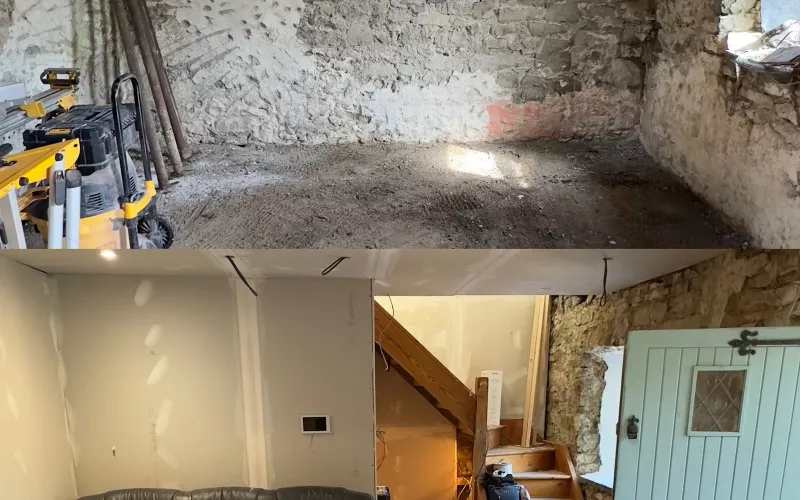
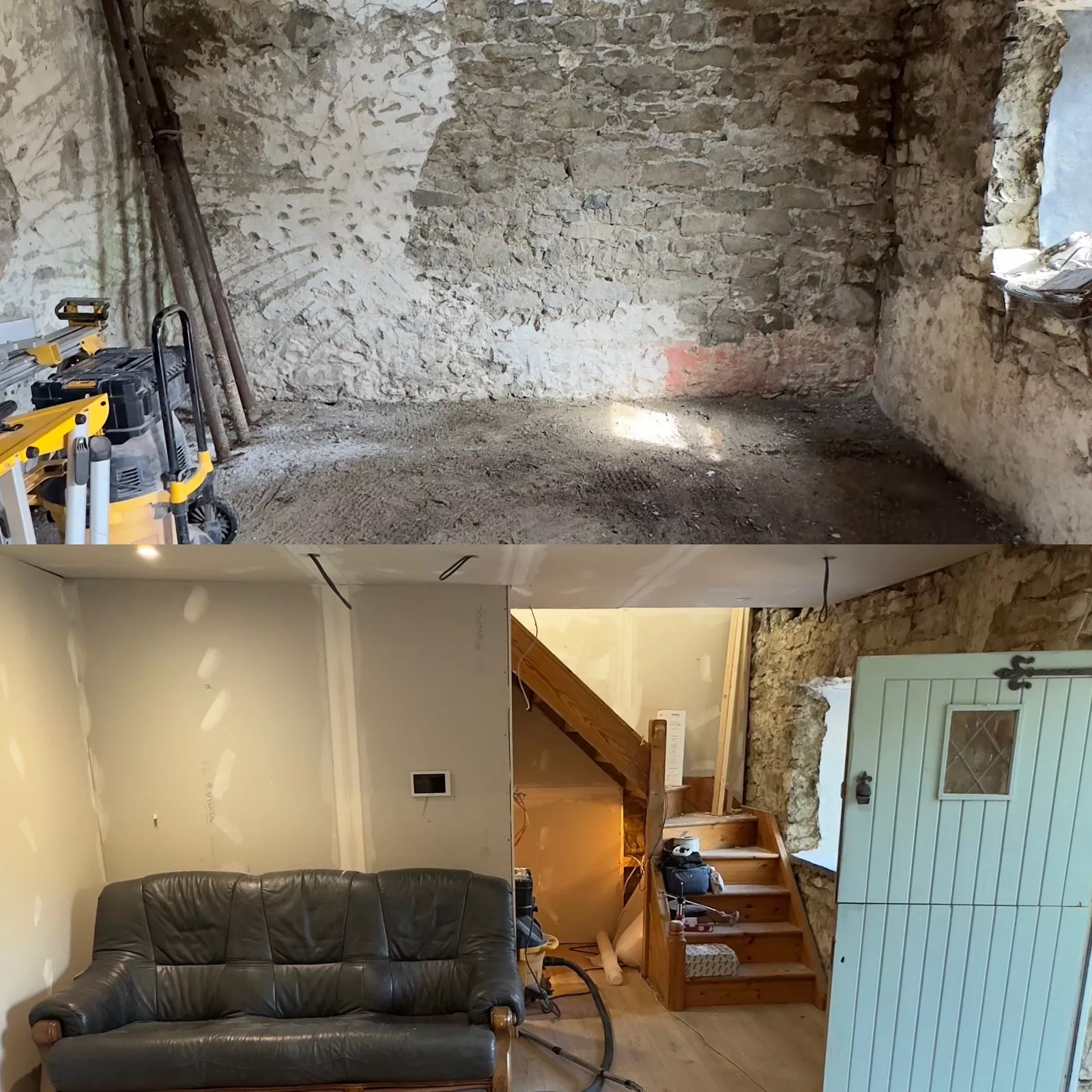
Ivy Cottage is the stone cottage in Roscommon that Kieran McGuire, our founder, bought derelict and restored as a personal project. It stands on its own water supply with its own septic tank. The photographs are his, and the whole story runs on Instagram at @myhomestead.ie.


The water lesson is the one that turned into a service we now offer. In Kieran's own words on our rural automation page, the pump was not just supplying his house but also servicing three separate farms. Rather than argue with the geography he put the supply on the Crestron system that already ran the lighting, heating, audio, CCTV and alarm: remote pump control, shut off valves, water usage metering, a camera on the pump and leak detection, and the septic tank is automated the same way. He describes the cottage as possibly the first fully automated cottage in Ireland.


For the record, Kieran did not apply for a grant on Ivy Cottage; he funded the work from his own savings and kept the accounts in the spreadsheet he now gives away. His next project is a new build house in Cork.
A Cork cottage on a well: what a smart system should watch
A well grant buys you clean water on the day the council signs off. Keeping it that way is a monitoring job, and on a Cork hillside with no neighbour in sight it is worth doing properly. Flow metering shows a leak as a pump that never rests; a level sensor on the storage tank gives warning before the taps run dry; voltage monitoring and an outage alert matter because a well pump without power is a house without water; and a camera at the pump house answers the question of who else is drawing from it. All of that is on one screen on our rural property automation page, and the cables for it cost next to nothing while the walls are open, which our guide to first fix wiring goes through room by room.
The same system runs the rest of the house: our Crestron installer Cork page shows what a Crestron home looks like in the county, lighting control Cork covers the lights, and smart home cost in Ireland gives the numbers plainly. A survey and a design come first on every job, as described on our process page. Whatever you fit, take the EPA's advice and have the well water tested at least once a year.
Questions we are often asked
Is the well grant different in Cork?
No. The rates and caps come from the national regulations: €3,000 for rehabilitation, €5,000 for a new well, both at 85%, and €1,000 at 100% for treatment. Cork City Council and Cork County Council each run their own applications and inspections under the same rules.
Can I apply before I have moved into the cottage?
The applicant must occupy the house as their normal residence, so ask the rural water section how they handle a house you are about to move into. Whatever they say, do not start any work on the well until you hold their written approval.
What if the driller says the old well cannot be saved?
Then the council may agree that a new well is the most appropriate solution and the €5,000 cap applies instead of €3,000. You cannot claim both. The driller's pumping test and Certificate of Water Quantity are part of the claim either way.
Does the grant pay for a water softener?
No. Softeners and sodium removal equipment are excluded. Treatment needed to meet the drinking water standards, such as filtration or ultraviolet disinfection, is covered at 100% up to €1,000.
Can the well grant and the Vacant Property Refurbishment Grant overlap?
They can be held together but no single item can be claimed from both. The usual split is the well, pump, supply pipe and treatment on the well grant, and the internal plumbing, heating and electrics under the refurbishment grant.
Sources: Cork City Council, Private Water Supply Grant terms and conditions, version 2, October 2020; Cork County Council, individual domestic well grants; the Housing (Private Water Supply Financial Assistance) Regulations 2020; the EPA on household wells; and the Vacant Property Refurbishment Grant on gov.ie; every one of them read on 24 October 2026.
If you are taking on a Cork cottage on its own well and want the pump, the water and the rest of the house watched from your phone, we would be glad to help.
Book a consultation or call our Cork office on 021 202 8107.
- Log in to post comments