
1Install is Ireland's only LED wall installer approved by Hisense for its LED video walls, and we install Samsung and Philips LED walls as well. We take every LED wall installation from the first survey to the final calibration, for receptions, boardrooms, retail, hospitality and event spaces across Ireland.
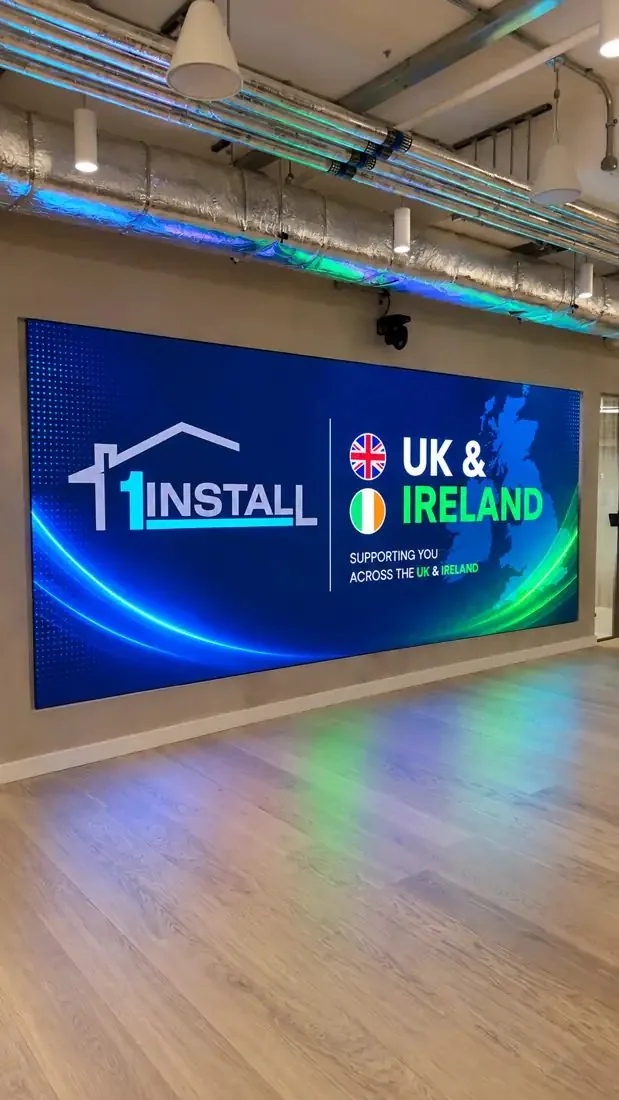 An LED wall, also called a direct view LED display, builds the picture from thousands of tiny red, green and blue LEDs on panels that lock together with no visible join. The LEDs make their own light, so the wall stays bright and vivid in a sunlit foyer, can be built to almost any size or shape, and shows true black wherever the LEDs are switched off. That is why LED walls are now chosen for so many showpiece spaces, where a projector or a wall of screens used to go.
Why choose an LED wall
- No joins in the picture. A video wall built from LCD screens always shows the bezels between the panels. An LED wall is one continuous image, so text and faces never cross a black line.
- Bright enough for daylight. Glass fronted receptions and shop windows defeat most projectors. An LED wall is made for bright rooms, and its brightness is turned down for darker spaces.
- Any size, any shape. Panels are added in rows and columns, so the wall can fill a recess, run as an ultra wide strip above a reception desk or cover a whole wall in a venue.
- A long working life. Philips rates its Unite LED 3000 panels at 100,000 hours to half brightness, and Hisense quotes the same typical LED lifetime for its 136 inch all in one.
- Serviced from the front. Many current panels, including the Hisense and Philips models we fit, are serviced from the front, so the wall can sit tight to the building and a faulty module comes out without moving the wall.
Hisense, Samsung and Philips LED walls
Hisense: the only approved installer in Ireland
We are the only installer in Ireland approved by Hisense for its LED walls. Hisense makes LED all in one displays in 108 inch (with touch), 136 inch and 163 inch sizes. The 136 inch model uses flip chip COB LEDs at a 1.5625 mm pixel pitch, is serviced from the front and weighs 110 kg, as the Hisense 136 inch LED all in one specification sets out. For walls built to a custom size, Hisense also makes indoor LED cabinets.
Samsung The Wall
The Wall is Samsung's MicroLED display, built from modules that join into walls of almost any size. The models sold in Ireland go below 1 mm, such as the P0.9 version at 0.945 mm, which suits boardrooms and executive spaces where people sit close to the picture.
Philips Unite LED
The Philips professional range, made by PPDS, includes the Unite LED panels, such as the 1.25 mm Unite LED 3000 with flip chip COB LEDs, and 135 inch all in one walls, among them a Unite LED 6000 model with a foldable frame.
We specify the wall around the room, the content and the budget first, then recommend the brand and model that fit, rather than pushing one maker.
Choosing the pixel pitch
Pixel pitch is the distance in millimetres from the centre of one pixel to the centre of the next. A smaller pitch packs in more pixels, so the picture stays sharp from closer up, but it costs more per square metre. Planar's guide to pixel pitch gives a simple rule: the pitch multiplied by 10 is an approximate viewing distance in feet, which works out at roughly 3 metres for every millimetre. Some manufacturers use a closer figure, so we treat it as a starting point for the survey rather than a limit.
| Pixel pitch | Viewing distance from about | Width of a 4K picture | Typical spaces |
|---|---|---|---|
| 0.9375 mm | 2.9 m | 3.6 m | Boardrooms and executive suites |
| 1.25 mm | 3.8 m | 4.8 m | Meeting rooms, town hall spaces and receptions |
| 1.5625 mm | 4.8 m | 6.0 m | Receptions, foyers and showrooms |
| 1.875 mm | 5.7 m | 7.2 m | Atriums, auditoriums and retail |
| 2.5 mm | 7.6 m | 9.6 m | Large venues and walls seen from far away |
The distances use Planar's rule of 10, and the widths are simple arithmetic: a 4K picture is 3,840 pixels across, multiplied by the pitch. A wall smaller than that shows a lower resolution, which is often fine for signage seen from further away.
How an LED wall installation runs
- Survey. We check the wall structure, the power supply, ventilation, sight lines and where the content will come from, and measure the viewing distances that set the pixel pitch.
- Design. We size the wall, choose the brand and pitch, and draw the mounting frame and the power and data routes, with the control system, sources and any cameras or speakers around it.
- Preparation. Your builder or our team prepares a flat, strong wall with power and data in place, and we agree any recess, trim or bulkhead with your architect or designer.
- Installation. We fit and level the frame, install the panels and processors, and connect the sources, from a signage player to a meeting room system.
- Calibration and handover. We set brightness and colour for the room, test every source, train your team and leave the documentation in your client portal.
- Support. We look after the wall afterwards through 1Install Care, with remote help for most questions.
Where LED walls work best
- Receptions and foyers: brand content that holds up in daylight, on a wall seen from across the room.
- Boardrooms and town halls: one large, seamless picture for presentations and video calls, with the camera above or below the wall. Our video conferencing and Microsoft Teams Rooms work covers the rest of the room, as it did across the 80 meeting spaces of a pharmaceutical company.
- Retail and showrooms: window and feature walls bright enough to compete with the street.
- Hospitality and venues: bars, restaurants, hotels and event spaces, showing sport, menus and events from one system.
- Education and auditoriums: large rooms where a projector struggles once the lights are on.
LED wall, LCD video wall or projector?
| LED wall | LCD video wall | Projector and screen | |
|---|---|---|---|
| Joins in the picture | None | Thin bezels between screens | None |
| Bright rooms | Excellent | Good | Room light washes out the black |
| Size and shape | Almost any, in panel steps | Set by the screen size | Large, limited by the throw and screen |
| Close viewing | Needs a fine pitch | Sharp up close | Fine |
| Upfront cost | Highest | Middle | Lowest for a big image |
For smaller rooms, our flat panel displays and projectors and projection screens may be the better buy, and an LED wall often runs alongside digital signage across a building. We will tell you plainly which one suits the space.
Why 1Install for your LED wall installation
We have nearly two decades of experience in professional AV. Alongside our Hisense approval, 1Install is a Crestron Elite Partner, and our founder, Kieran McGuire, holds every Crestron certification, so the LED wall can sit within one control system with the lighting, blinds, sound and video conferencing. Every project gets drawings, an itemised online proposal and a named contact, and for a quick budget you can use our commercial Quote Builder. For homes, see our home cinema LED walls, and for every other service, our commercial AV page.
Questions we are often asked
How much does an LED wall cost?
It depends on the size, the pixel pitch, the brand and the work around the wall: the structure, power, finishing and sources. A fine pitch costs much more per square metre than a coarser one, so matching the pitch to the viewing distance is the biggest saving. After a site survey we give you a fixed, itemised quote. A consultation or site survey is €440 plus VAT and covers up to 4 hours with an engineer.
What pixel pitch do I need?
Measure from the closest seat or standing point to the wall. As a starting point, allow about 3 metres for every millimetre of pitch, so a wall seen from 4 metres suits a pitch of about 1.25 mm or finer. We confirm it on site with the content you plan to show, because small text needs a finer pitch than video.
How long does an LED wall last?
LED life is rated in hours to half brightness: Philips quotes 100,000 hours for its Unite LED 3000 panels, and Hisense quotes 100,000 hours as typical for its 136 inch all in one. In a reception running 12 hours a day, that is more than 20 years before the LEDs reach half their starting brightness, although processors and power supplies may need attention sooner.
Does an LED wall need special power and cooling?
A large wall needs dedicated circuits and somewhere for its heat to go. Samsung lists a maximum of 355 W per square metre for one of its The Wall models, so a 10 square metre wall could draw around 3.5 kW at full white, though everyday content uses less. We plan the circuits with your electrician and check the ventilation at the survey.
Can we use an LED wall for video calls?
Yes. We fit the camera above or below the wall, add microphones and speakers sized for the room, and set it up for Microsoft Teams or Zoom with one touch to join. When the room is free, the same wall can show company news or signage.
How long does the installation take?
An LED all in one can go up in a day once the wall and power are ready. A larger modular wall takes longer, because the frame is built and levelled on site before the panels go on, followed by calibration. We give you a programme at the survey and plan the work around your opening hours.
Book a consultation or call Dublin on 01 906 9326 or Cork on 021 202 8107.