The Vacant Property Refurbishment Grant pays up to €50,000 towards refurbishing a home in Ireland that has been empty for two years or more, and up to €70,000 if the property is derelict. It is paid by your local authority after the work is done, and in 2026 it is still open, extended to 2030, with about 390 applications arriving every month.
This guide is written for anyone looking at an empty house, a tired farmhouse or a roofless cottage and wondering whether the grant could make it a home. It covers who qualifies, what the grant pays for and the caps on each type of work, how to apply step by step, when the money arrives, the clawback rules, and the other grants and loans you can add on top: the well grant, the septic tank grant, the SEAI energy grants and the council purchase and renovation loan.
It also tells the story of Ivy Cottage, the derelict stone cottage in Roscommon that our founder Kieran McGuire bought and brought back to life as a personal project, and gives you the free renovation cost and timeline tracker he built along the way. The tracker uses the same categories of work as the grant application, so your figures line up with the form from day one.
Figures below come from the Department of Housing's scheme outline published in August 2026 and the March 2026 FAQs, checked on 11 October 2026. The scheme changes, so confirm the current terms with your council's Vacant Homes Officer before you commit to a purchase.
Vacant Property Refurbishment Grant at a glance
| Situation | Maximum grant (VAT included) |
|---|---|
| Vacant home, empty two years or more | €50,000 |
| Derelict home (the derelict top up adds €20,000) | €70,000 |
| Vacant home on an offshore island | €60,000 |
| Derelict home on an offshore island | €84,000 |
| Former commercial or public building converted into two homes (applications from 31 March 2026) | €70,000 vacant, €90,000 derelict |
| Former commercial or public building converted into three or more homes | €90,000 vacant, €110,000 derelict |
The grant is funded by the Croí Cónaithe (Towns) Fund and administered by the 31 local authorities. By the end of March 2026 about €285 million had been paid to 5,330 people since the scheme opened in July 2022, and in the first three months of 2026 alone councils received 1,329 applications and approved 1,065. Costs above the grant are yours, and many derelict jobs cost well above €70,000, so the grant is a contribution rather than a full budget.
Who qualifies for the Vacant Property Refurbishment Grant
- The property must be a house or apartment built before 2008 (up to and including 2007), or a former commercial or public building that was never used as a home. It must have been vacant for at least two years when you apply. Agricultural sheds and barns do not qualify, and neither does a demolish and rebuild that ends up classed as a new build.
- You must own it or be actively buying it. If you are sale agreed, the council can give approval in principle on the strength of a letter from the estate agent or owner, and the grant becomes payable once the property is in your name. Only individuals and sole traders qualify: companies, developers and investors do not.
- Your plan must be to live in it as your principal private residence or to rent it out on a tenancy registered with the Residential Tenancies Board. Holiday lets and short term lets are not allowed.
- How many times: up to two grants in your lifetime, one for the home you live in and one for a rental property.
- Tax: your tax affairs must be in order, Local Property Tax must be paid where it applies, and you need a tax clearance certificate for a grant over €10,000.
Proof of vacancy is usually two years of electricity or water bills showing zero or very low usage, or evidence that the supply was disconnected. Where no bills exist the council may accept a sworn affidavit. Proof of ownership can be the title deed, a Local Property Tax record or a mortgage statement dated within the last 12 months. You cannot leave a house empty on purpose to qualify.
What the grant pays for: the schedule of works and its caps
The application form breaks the job into categories of work, each with a maximum the grant will contribute. The structural categories are limited only by the overall grant, which is why a roofless cottage can draw the full €70,000. The finishing categories are capped individually. These are the caps for a single home in the August 2026 outline (island properties get 20% more in each category).
| Category of works | Maximum grant contribution |
|---|---|
| Demolition and strip out, substructure, superstructure, services, extension | Up to the overall grant limit |
| External doors, windows, sills and railings | €21,000 |
| Roof completions (flashings, verges, ridge, downpipes) | €14,000 |
| Fascias, soffits and rainwater goods | €4,200 |
| Roof lights and flashings | €1,000 |
| External painting | €2,500 |
| Internal doors, frames, architraves and ironmongery | €7,000 |
| Skirting boards | €3,500 |
| Tiling and waterproofing to wet areas | €2,800 |
| Internal painting and decorating | €8,000 |
| Floor finishes | €5,000 |
| Kitchen units | €7,700 |
| Sanitary ware | €2,800 |
| External and site works | €7,000 |
| Professional fees (architect, engineer, surveyor) | 10% plus VAT of the net construction cost, or €14,000, whichever is lower |
Two points trip people up. The council runs its own cost assessment, so the approved figure can be lower than the quotes you submit. And since 1 December 2024 the grant no longer pays for a standalone fossil fuel boiler, so plan the heating around a heat pump or another system that qualifies; our guide to heat pump controls explains how the controls side works.
How to apply, step by step
- Talk to the Vacant Homes Officer in the county or city council where the property is. Every local authority has one, and they will tell you whether the house is likely to qualify before you spend money on reports.
- Gather the paperwork: the application form from gov.ie, proof of ownership or of the sale in progress, proof of two years of vacancy, evidence of the build date, quotations for the work broken into the categories above, planning permission or a Section 5 exemption declaration where the work needs it, and for the derelict top up an independent report from a registered building surveyor, engineer or architect, unless the property is already on the Derelict Sites Register.
- Council assessment. Technical staff inspect the property, check the costs and assess the application against the scheme. You then get a letter of approval, or approval in principle if the purchase or planning is still in train. A refusal can be appealed in writing within three weeks.
- Do not start before the letter. Work that begins before approval is not eligible. Once approved you have 18 months to finish the works, with extensions only in exceptional cases. Many older guides still say 13 months; the current FAQs say 18.
- Finish, then claim. Send in the invoices and receipts, your tax clearance, the contractors' tax clearance for any job over €650, your bank details and the signed charge document. The council inspects the finished work and pays the grant. For a rental, payment waits until the tenancy is registered with the RTB.
When you get paid, and the clawback
The grant is paid in one payment at the end, after the final inspection. There are no stage payments, so you need the money to do the work first, which is exactly the gap the Local Authority Purchase and Renovation Loan was designed to fill (more on that below).
In return the council registers a charge against the property for ten years, ranking behind your mortgage. You must live in the home, or keep it rented, for at least five years. If you sell it, stop living in it or stop renting it within five years of payment, you repay the whole grant; between five and ten years you repay 75%; after ten years nothing is owed. Tell your lender early, because the charge needs their consent, and the main banks have already signed a priority agreement with the Department.
The derelict top up in brief
The extra €20,000 is for homes that are structurally unsound and dangerous. You qualify in one of two ways: the property is on your council's Derelict Sites Register, or a registered building surveyor, engineer or architect inspects it and reports that it is derelict. The refurbishment cost must also exceed the standard €50,000. If you are weighing up a roofless shell, that report is the first thing to commission, because it decides whether you are working with €50,000 or €70,000. Our derelict property grant guide goes through the report, the Derelict Sites Register, the timeline and the costs in detail.
Ivy Cottage: a derelict cottage, a boyhood dream and a Crestron system
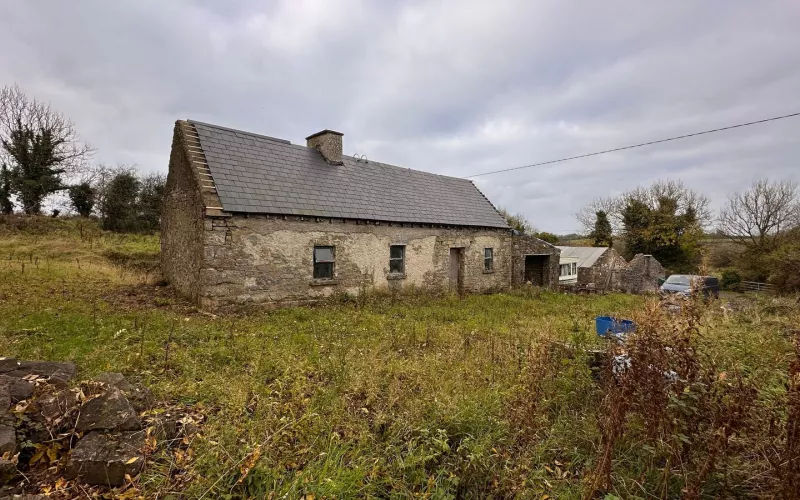
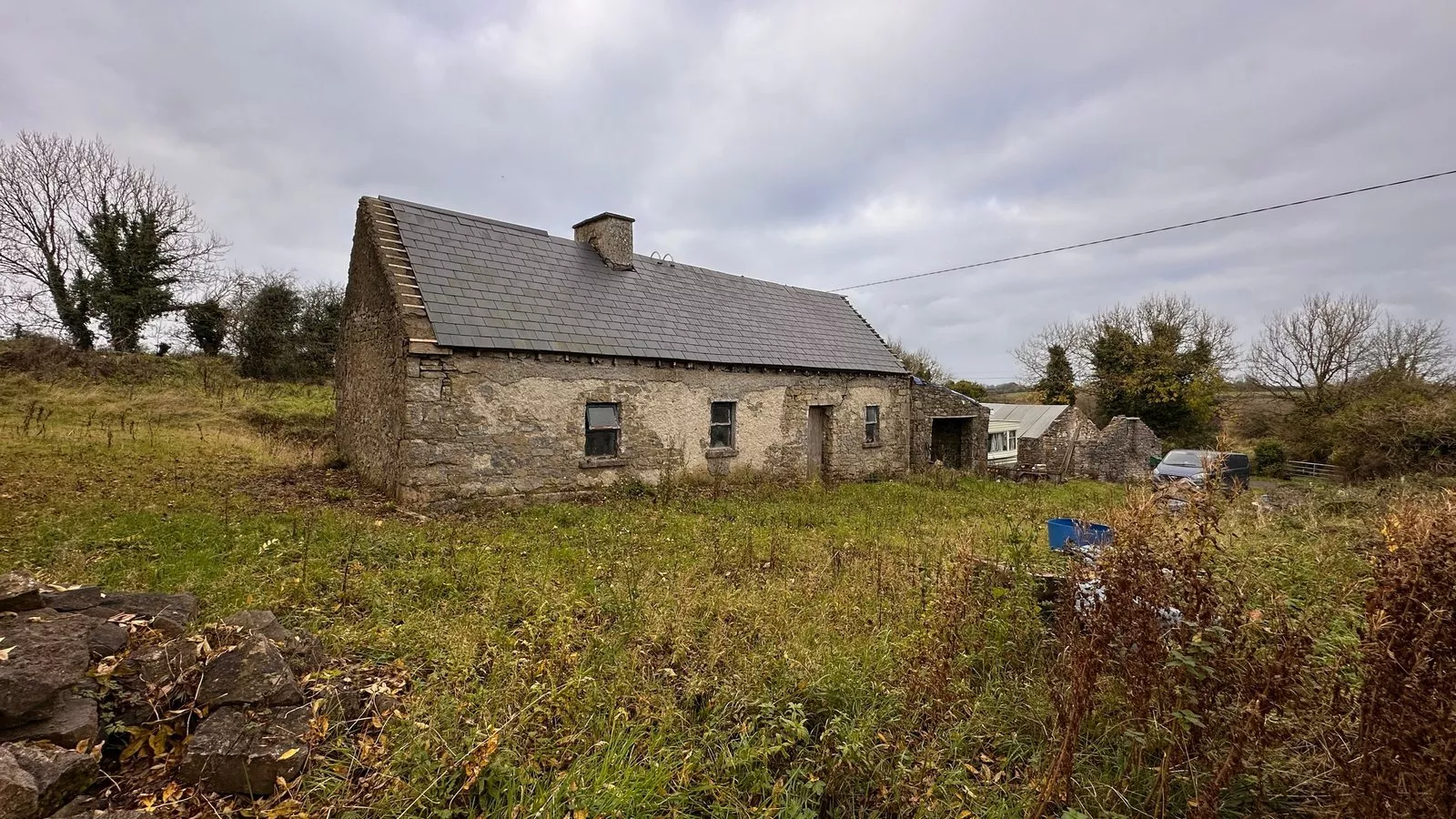
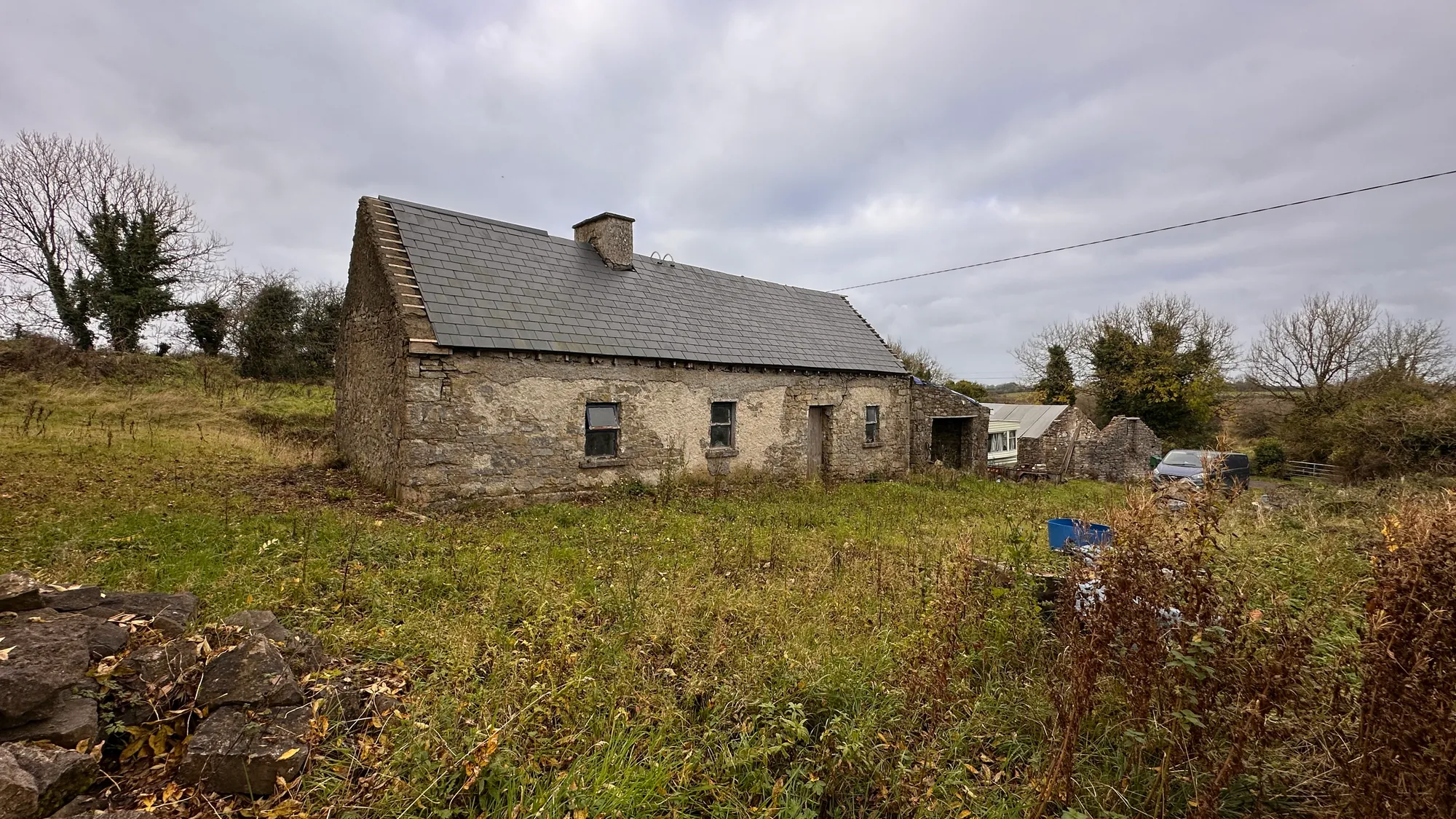
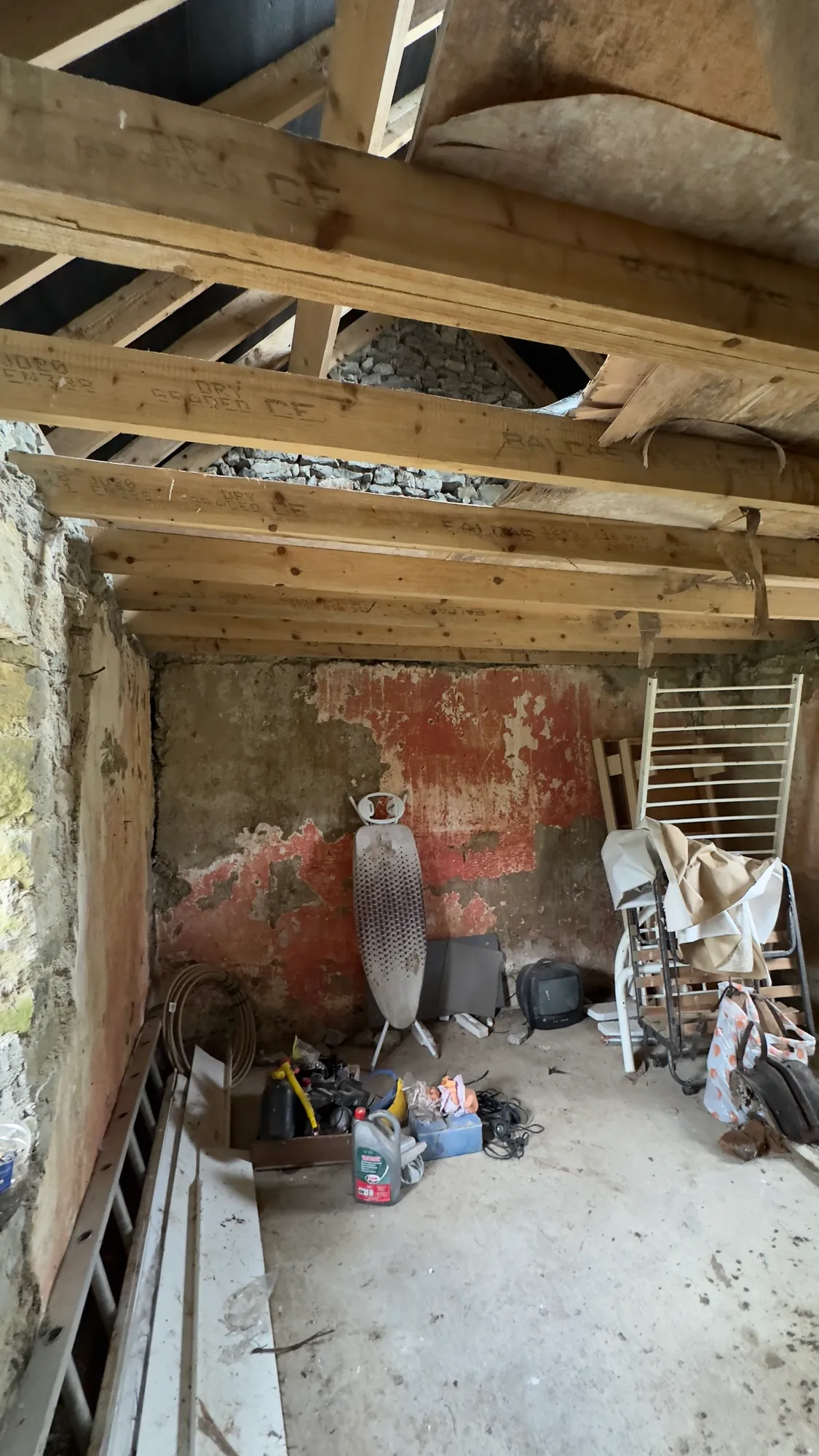
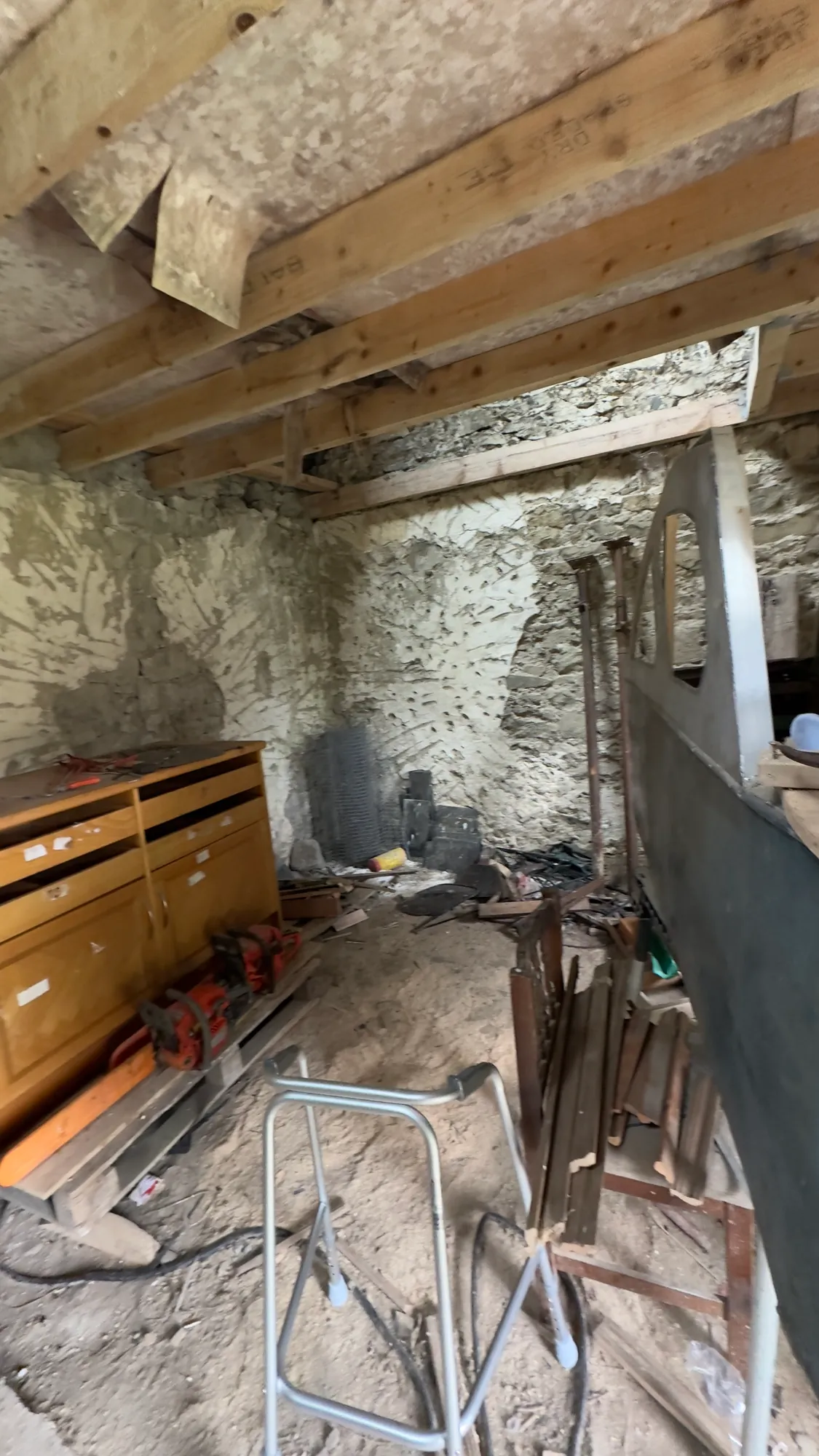
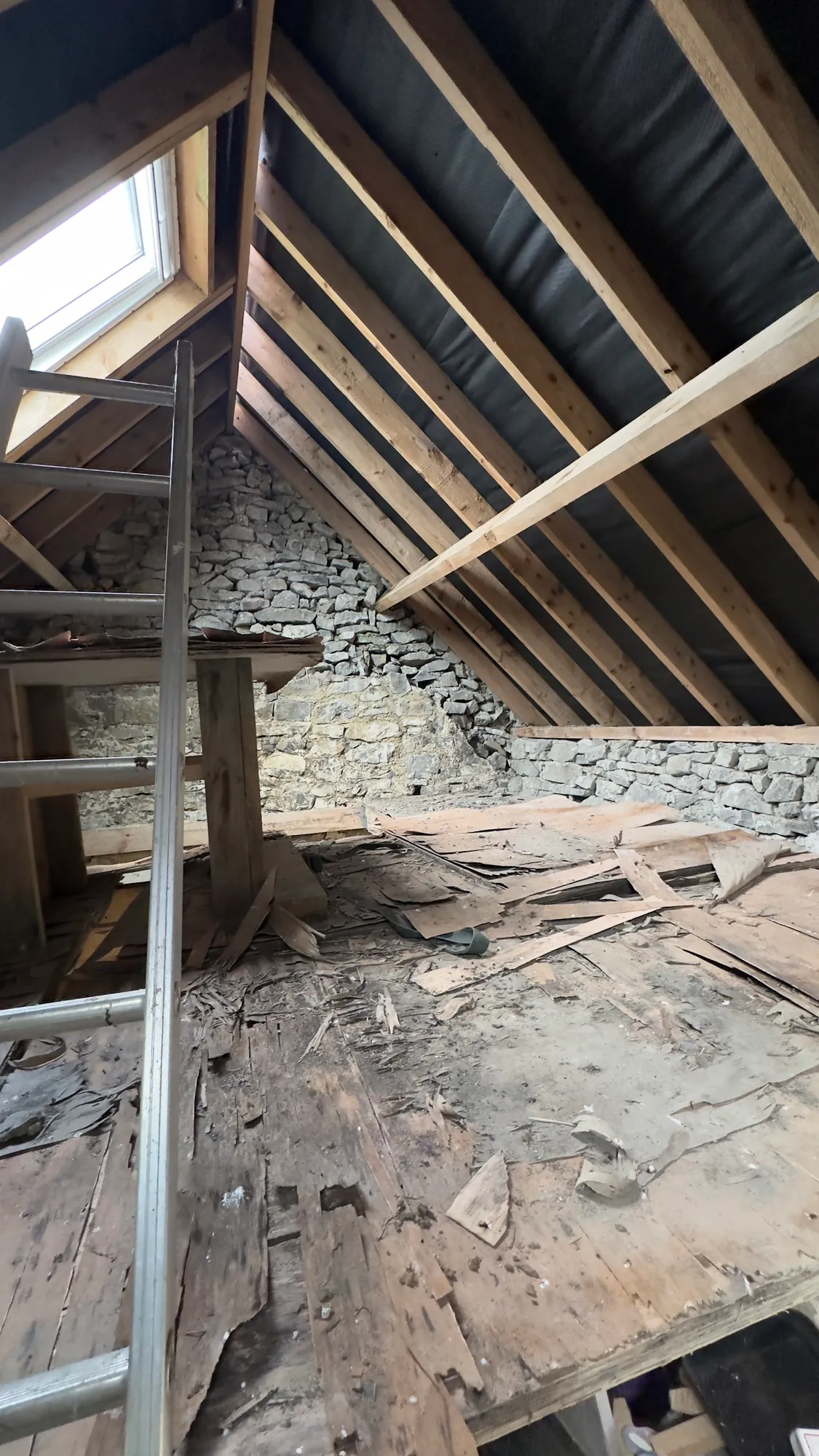
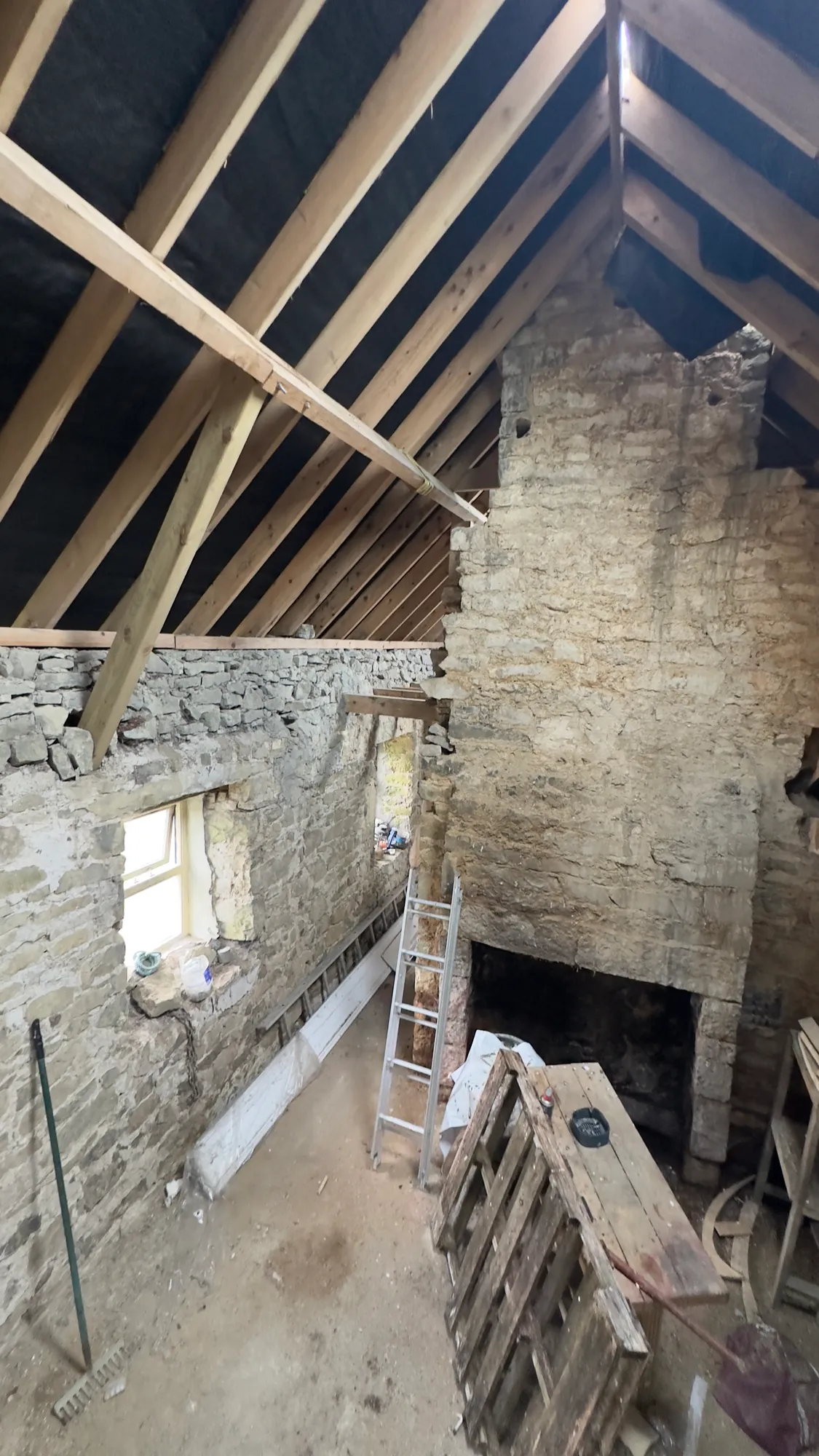
Kieran had always wanted a little cottage in the country. When Ivy Cottage came up, a stone cottage in Roscommon with bare stone walls, a floor that had given way and daylight showing through the roof timbers, he bought it as a personal project rather than a 1Install job, and set about turning it into a home.
Follow Ivy Cottage on Instagram: @myhomestead.ie
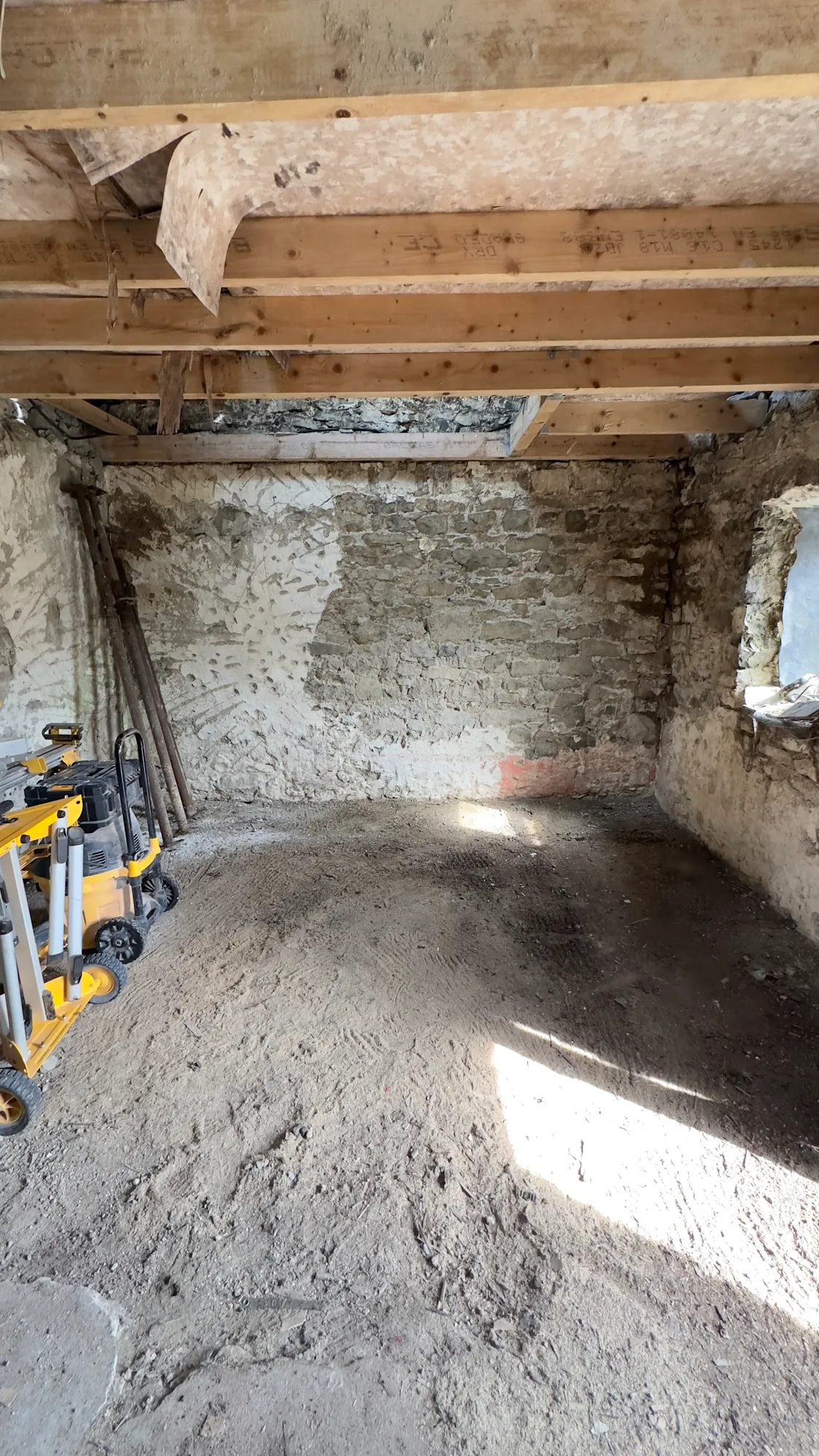
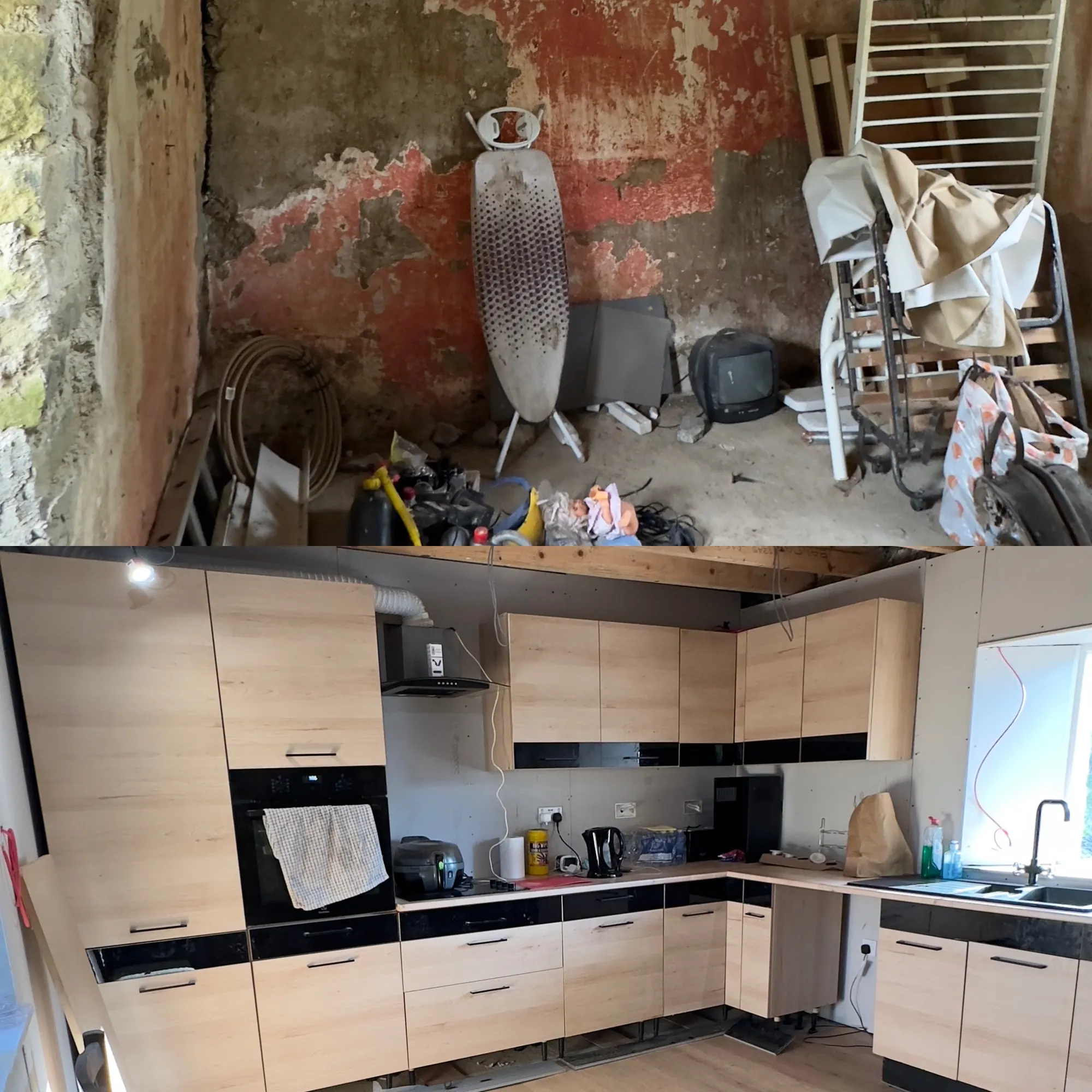
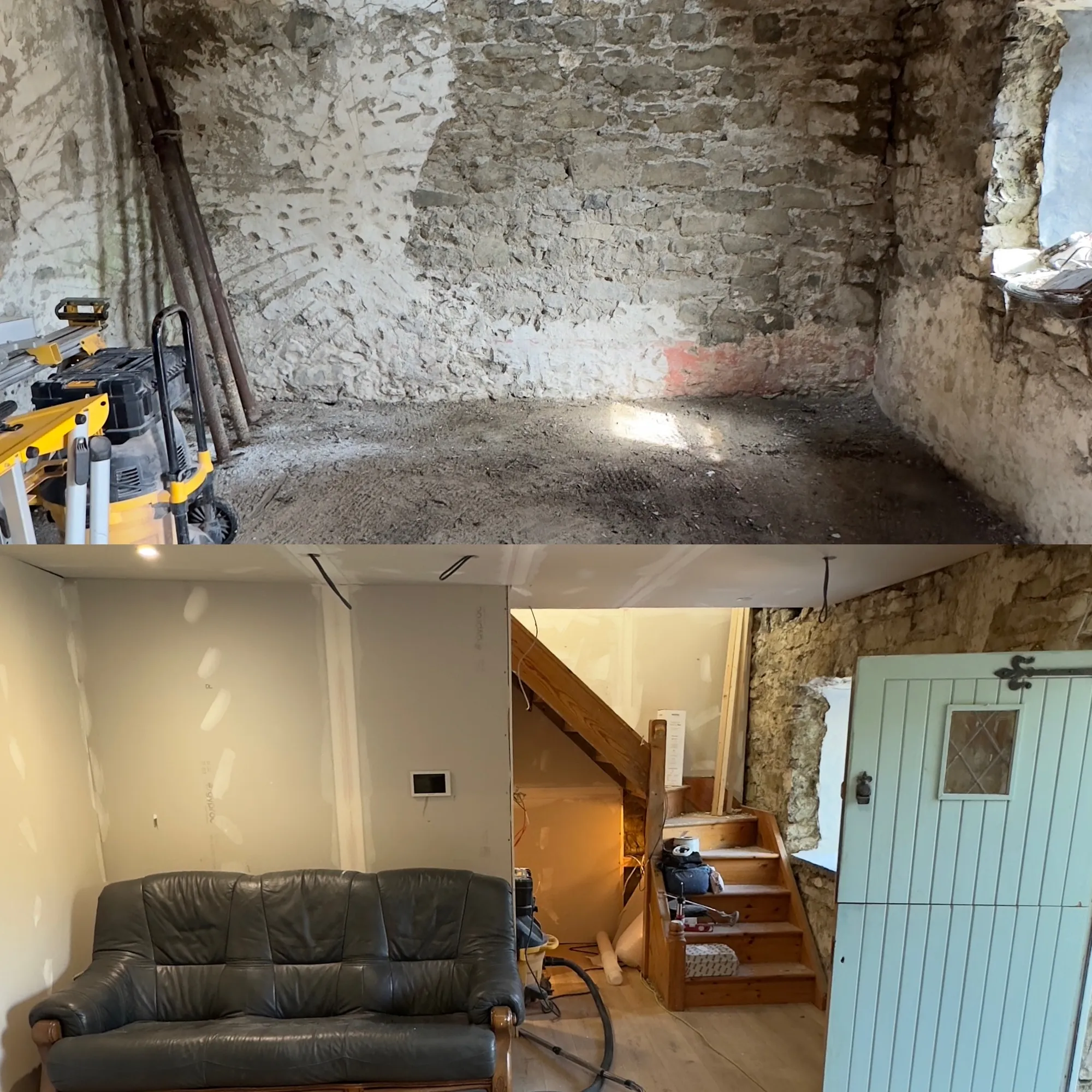
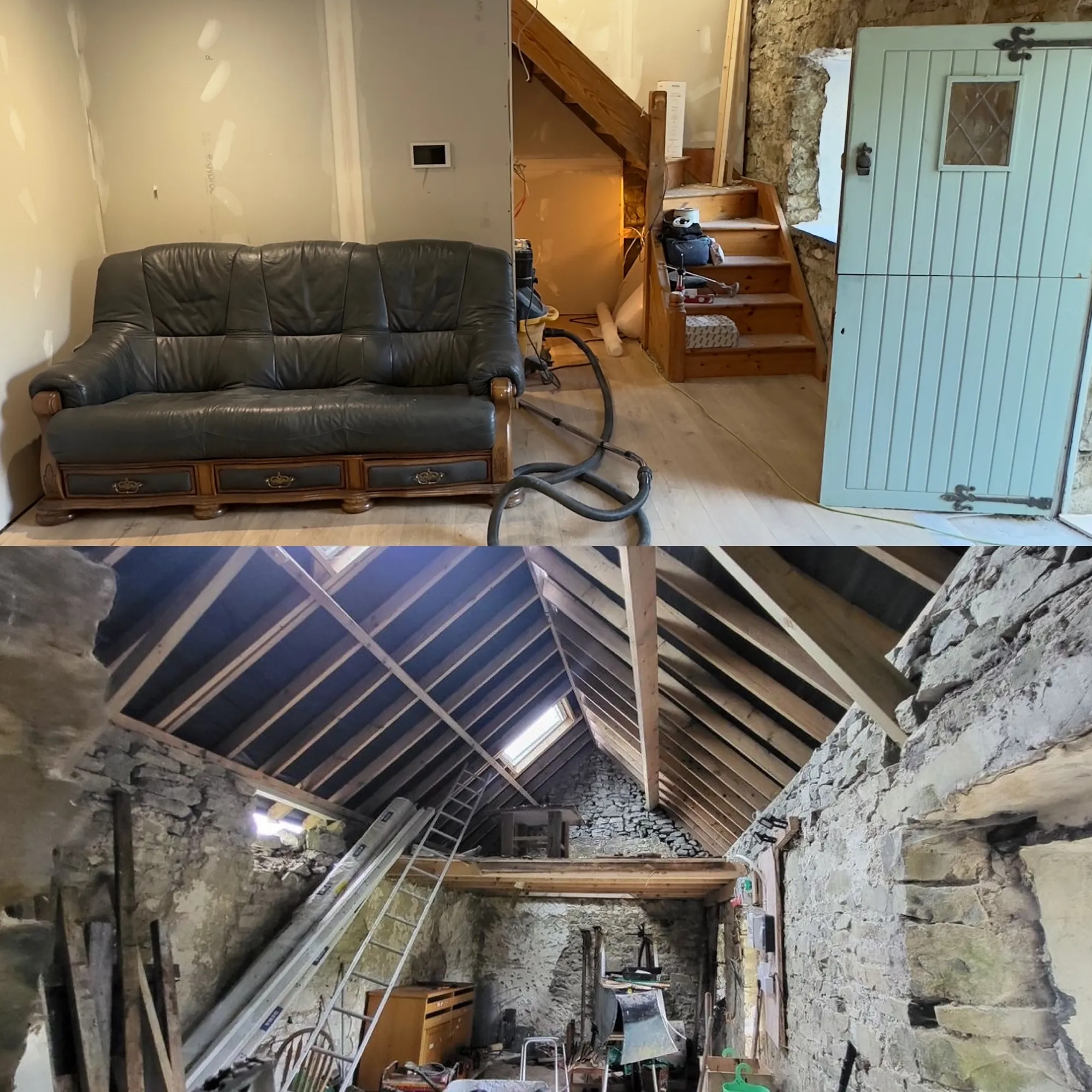
Every photo below is one of Kieran's own, in the order the job happened, from the first look around in the summer of 2024 to the finished rooms in the autumn of 2025. Click any photo to see it full size and use the arrows to click through the whole set.
As we found it
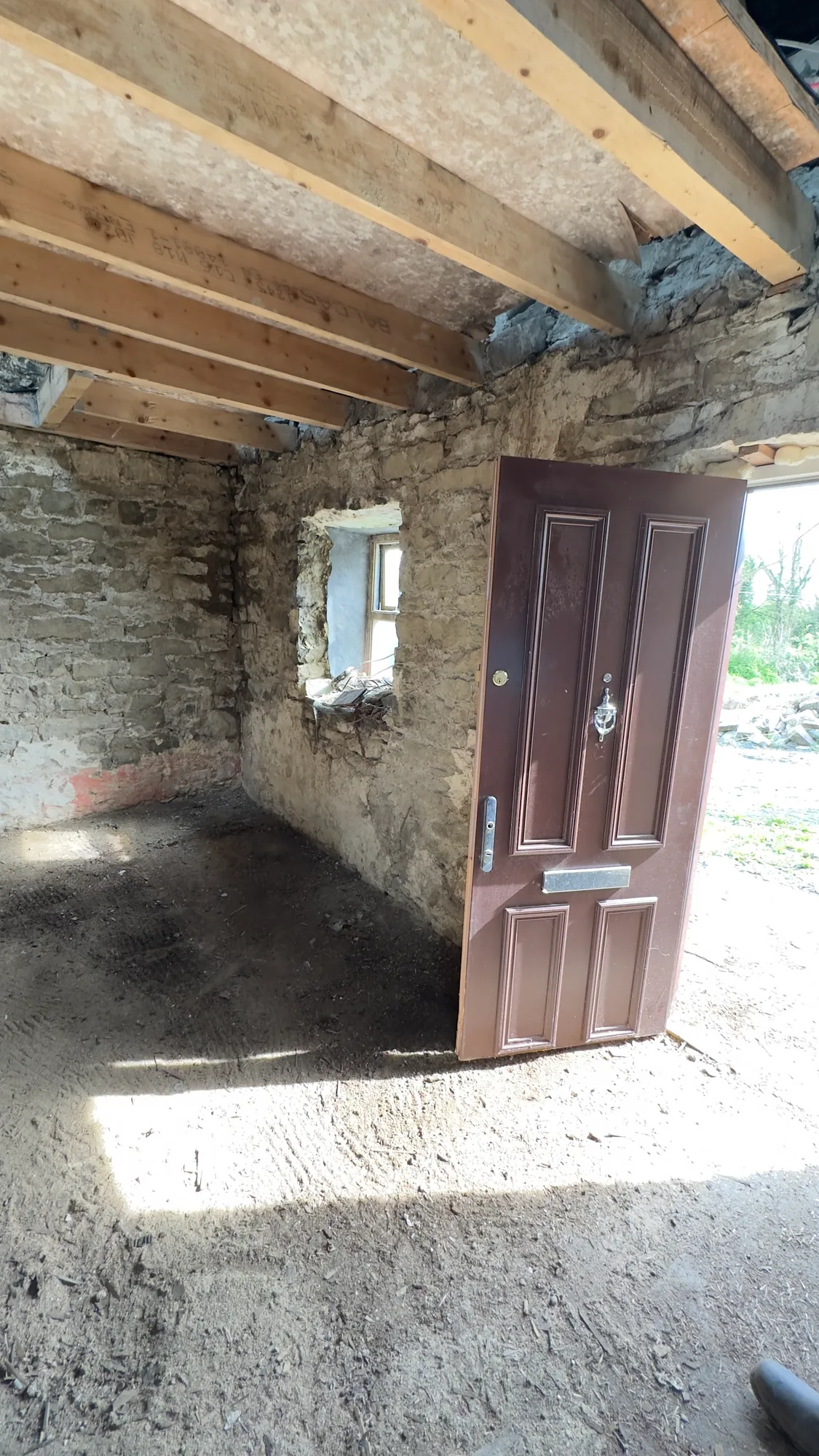
A slate roof that looked sound enough from the field. Inside: bare stone, a floor that had given way, red paint peeling off the old plaster and daylight through the rafters.
Strip out and new structure
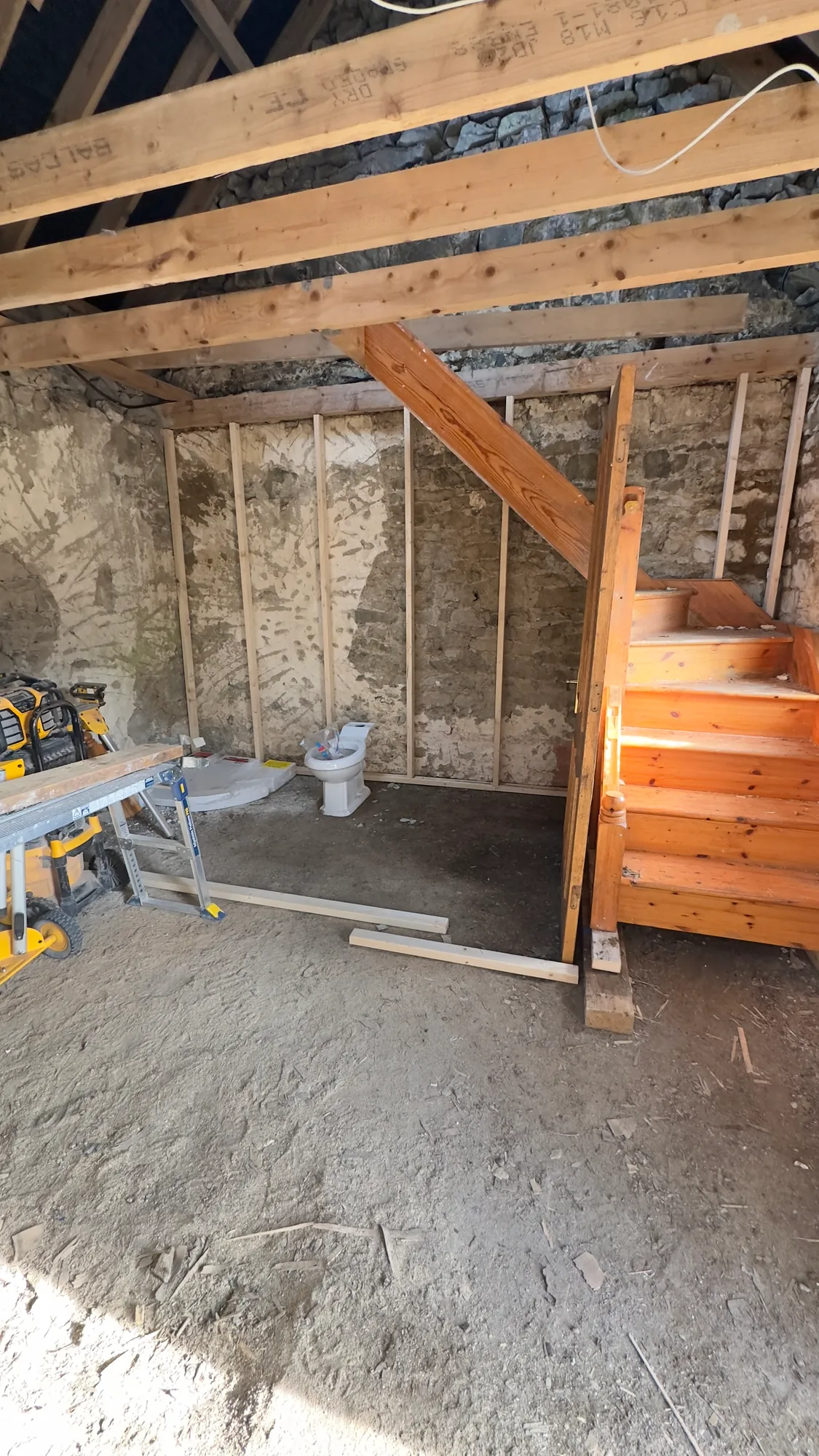
Everything that could not be saved came out. New joists went in overhead, and the first timber frame and the new staircase started to give the shell a shape.
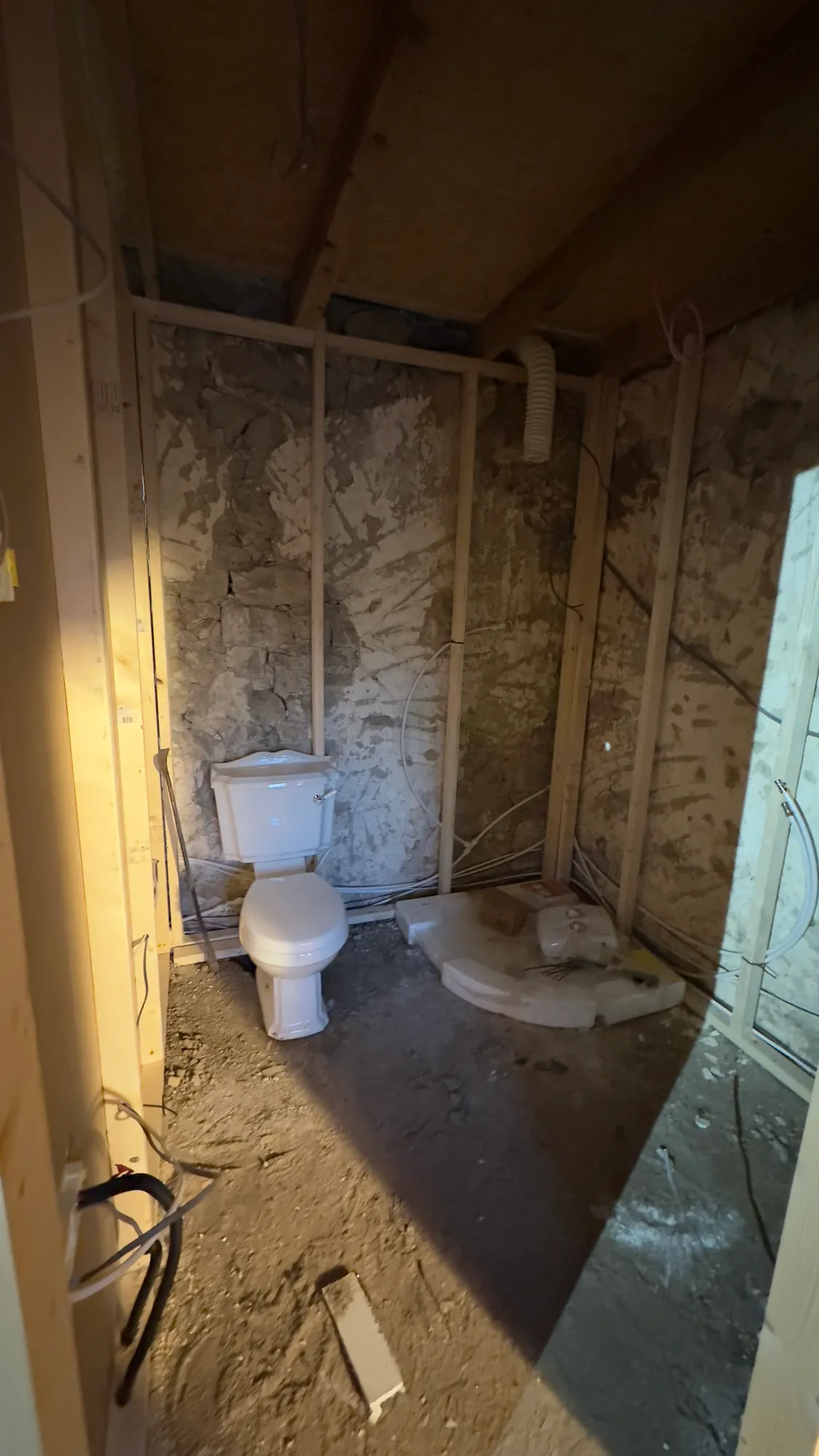
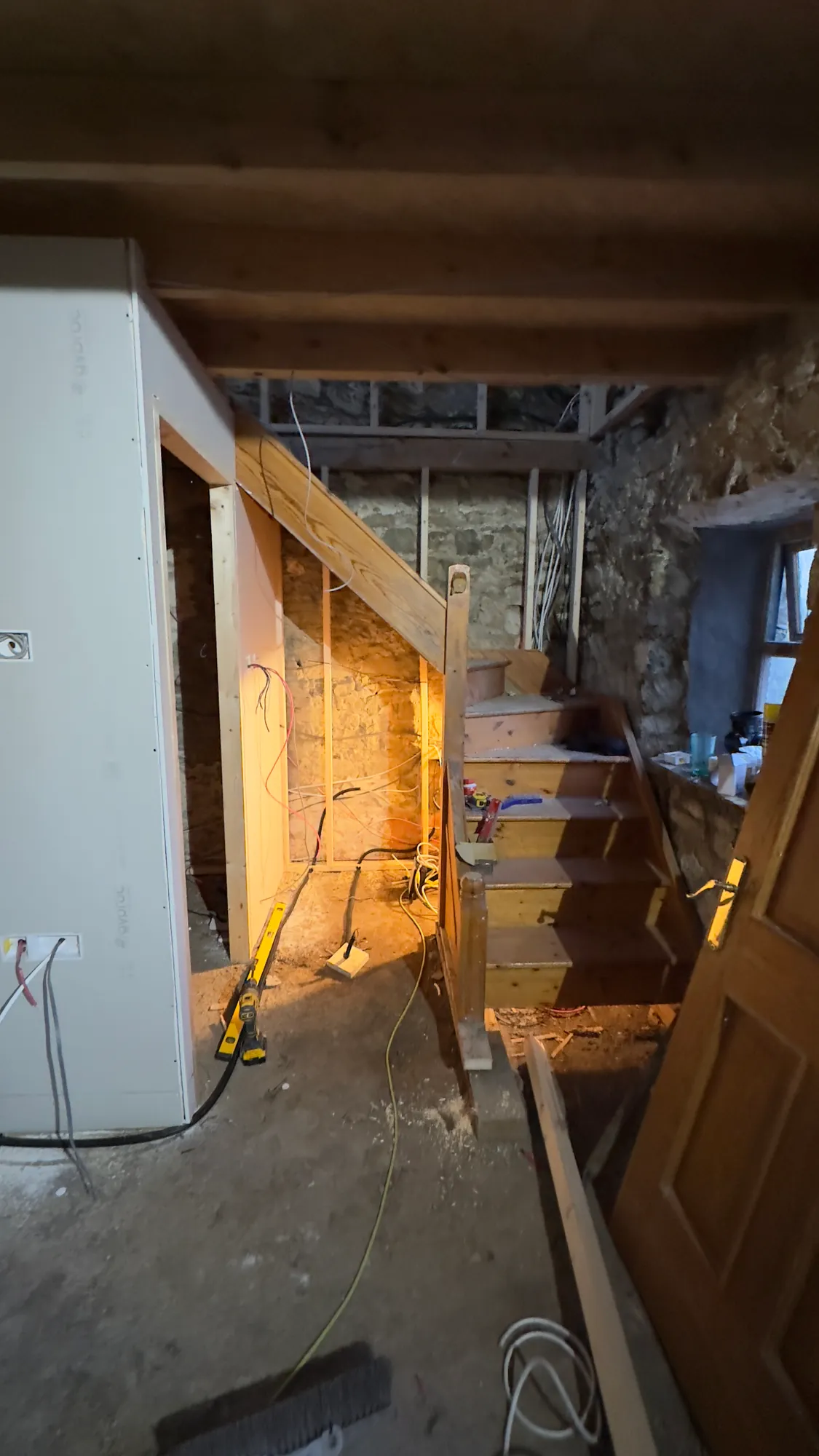
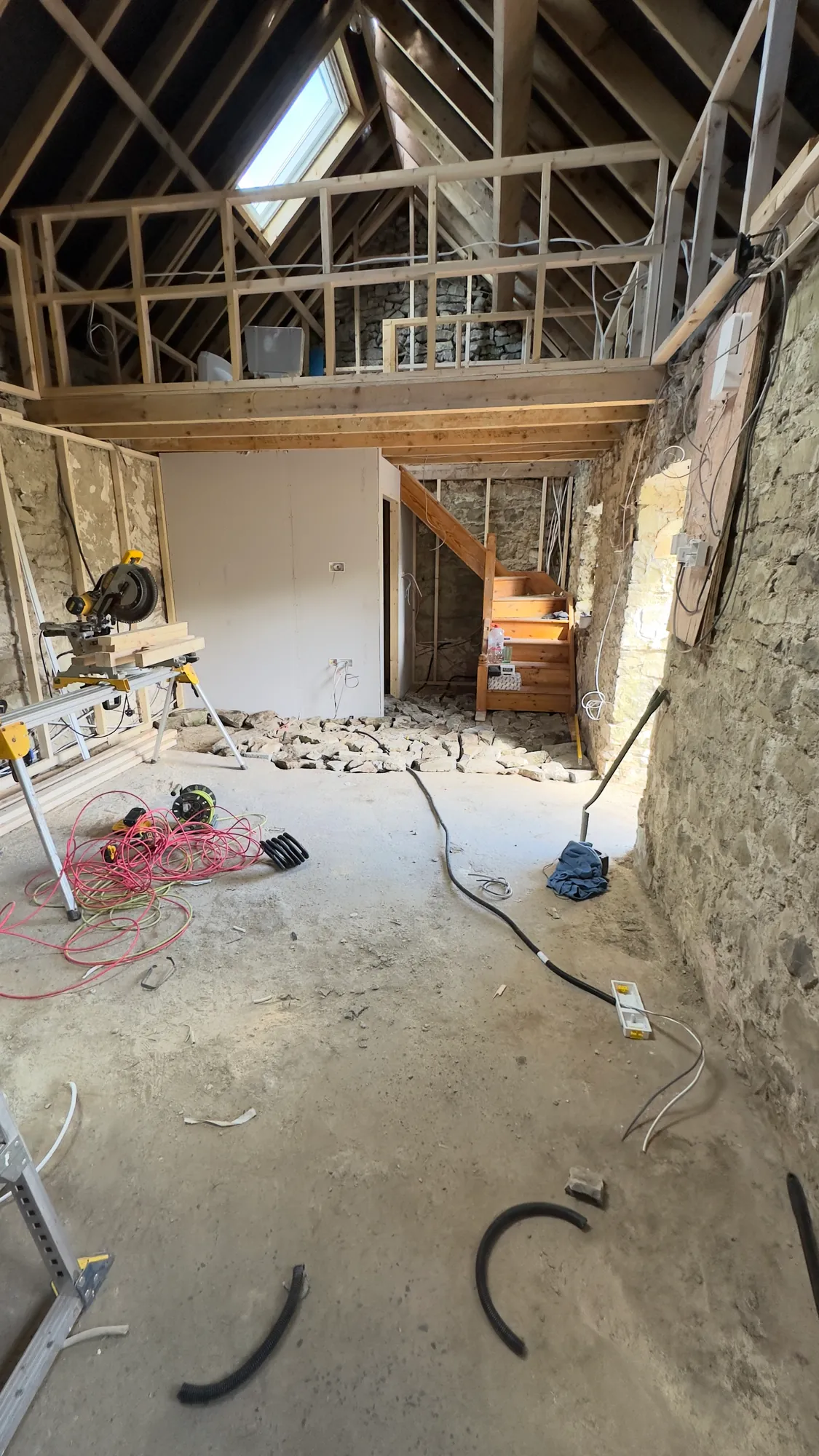
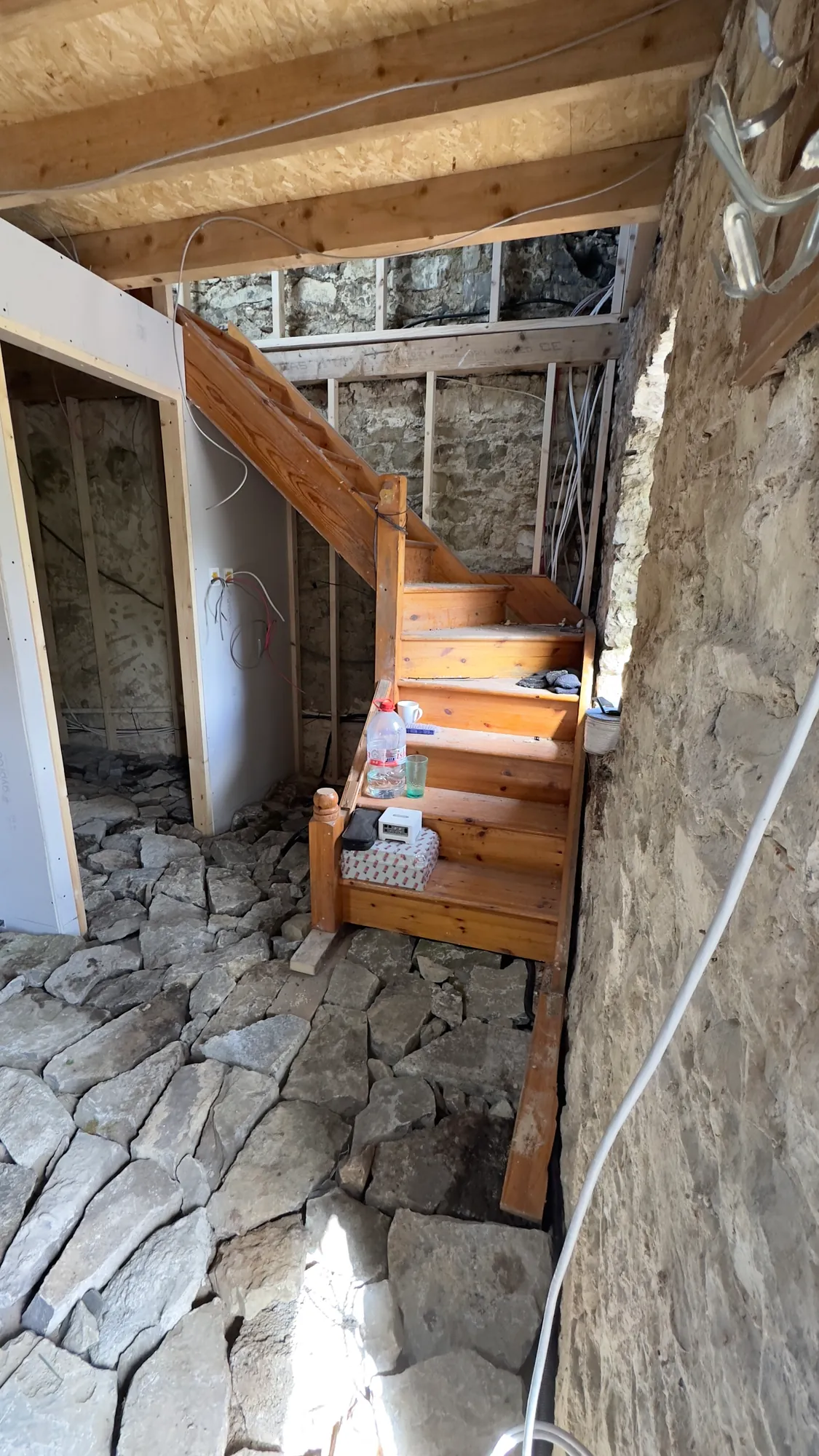
First fix: stud walls, insulation and cables
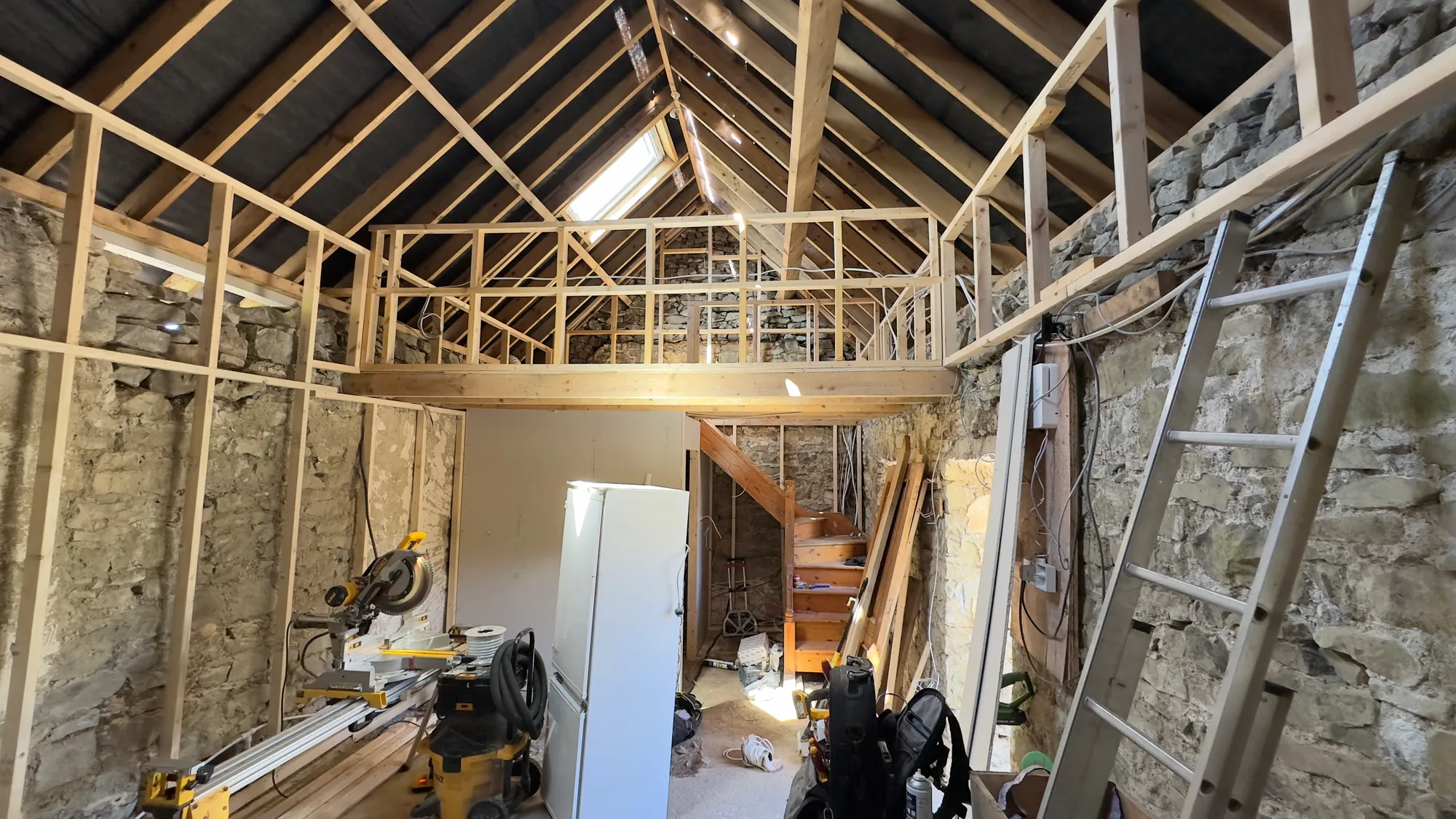
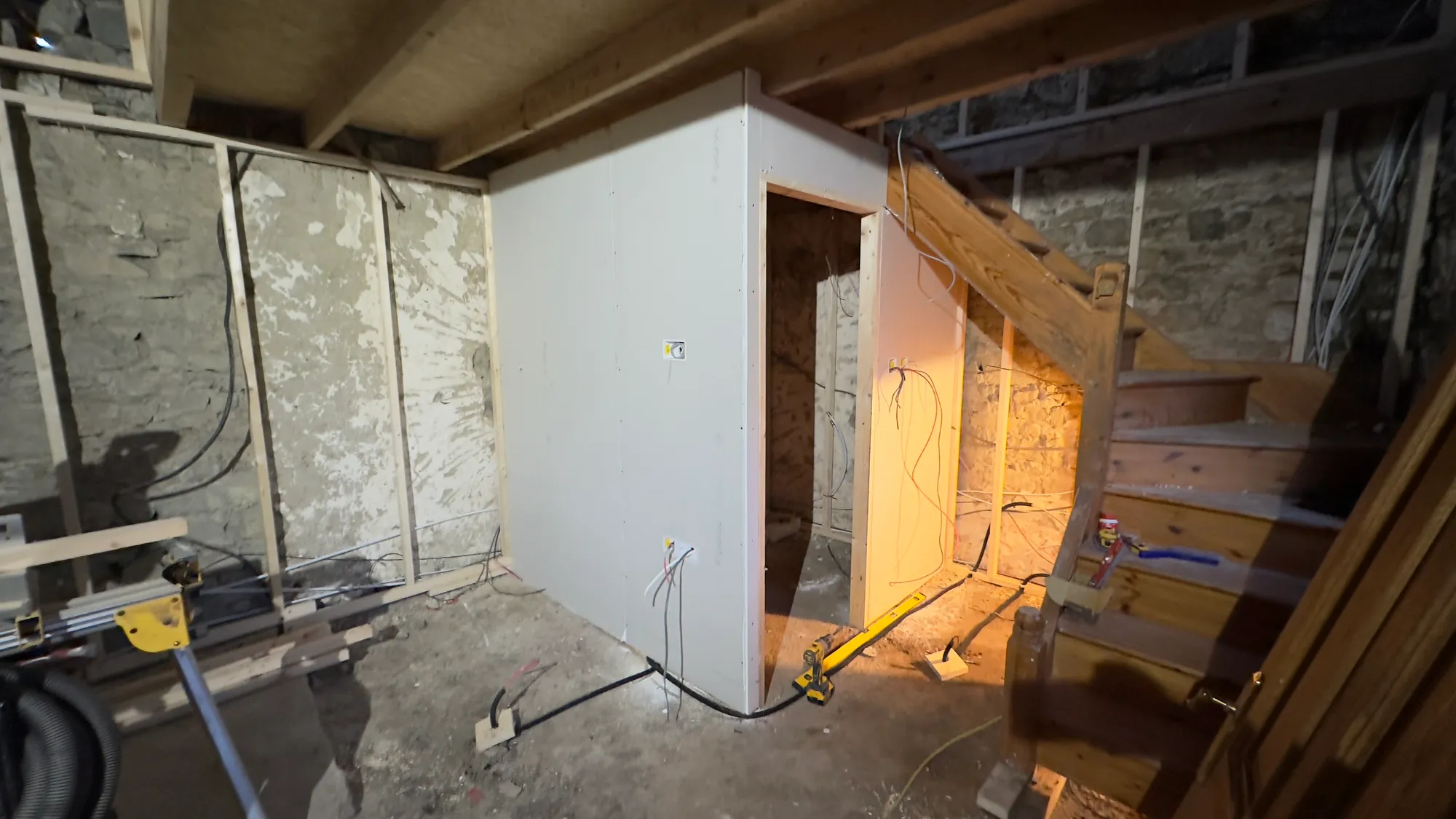
With the walls open, the insulation, the stud partitions and the cabling all went in at once. This is the stage the Services category of the grant pays for, and the stage where a smart home is cheap to wire and expensive to retrofit.
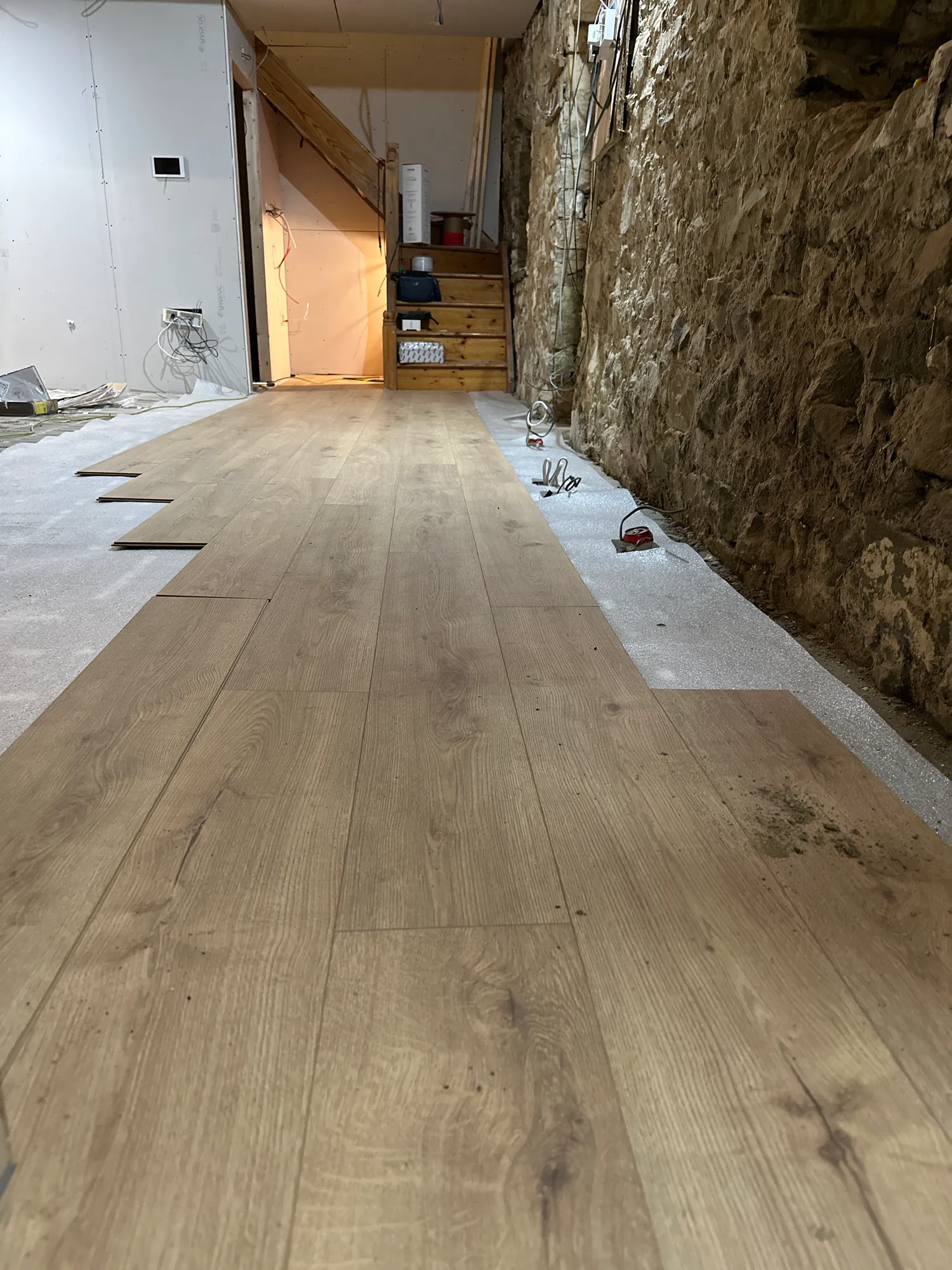
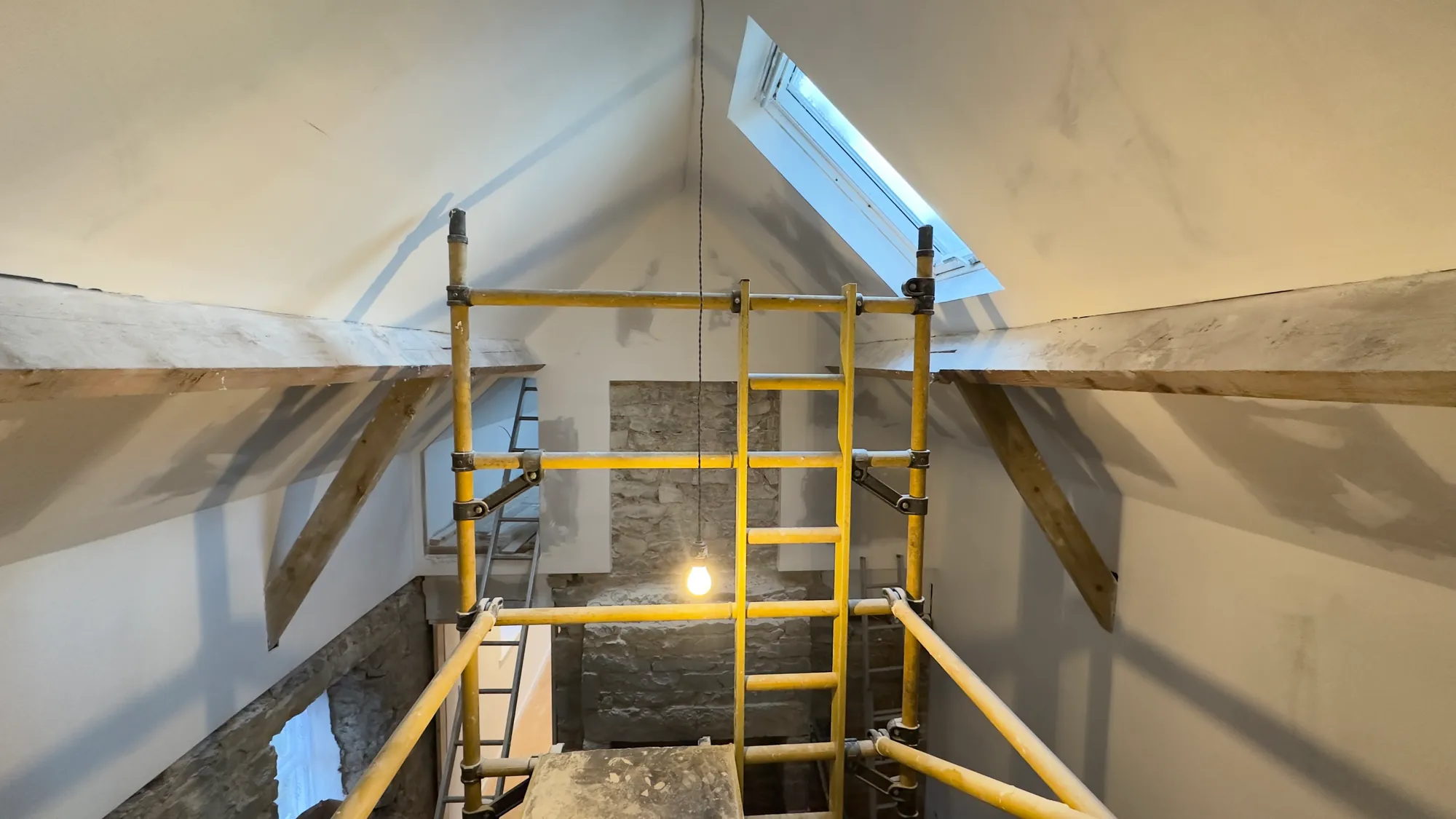
Floors, paint and the view from the field
The new timber floor went down along the length of the cottage, the vaulted ceiling was plastered and painted, and the neighbours kept an eye on progress.

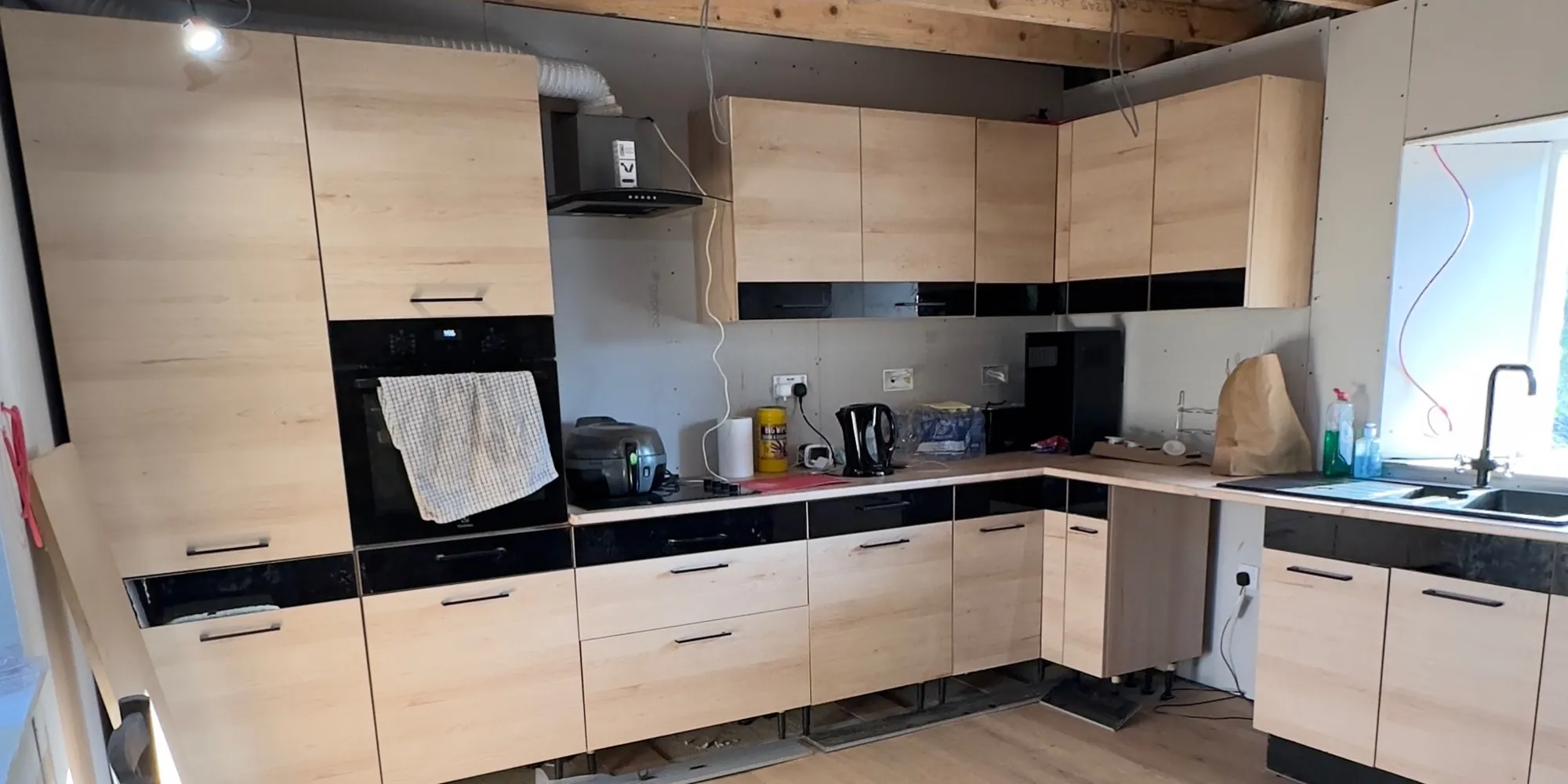
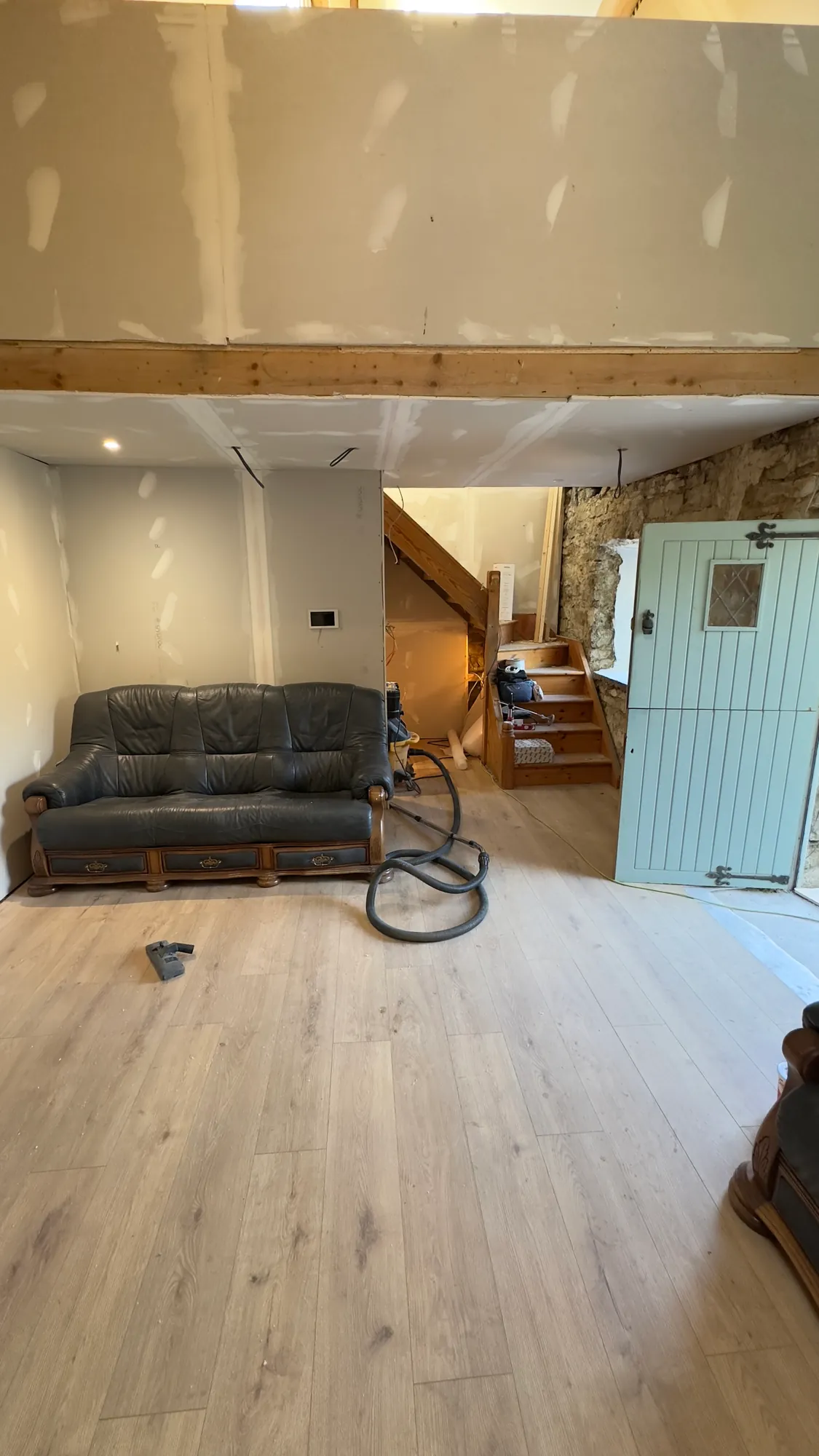
Finished rooms
The kitchen, the living room with the stable door, and the bedroom tucked under the eaves.
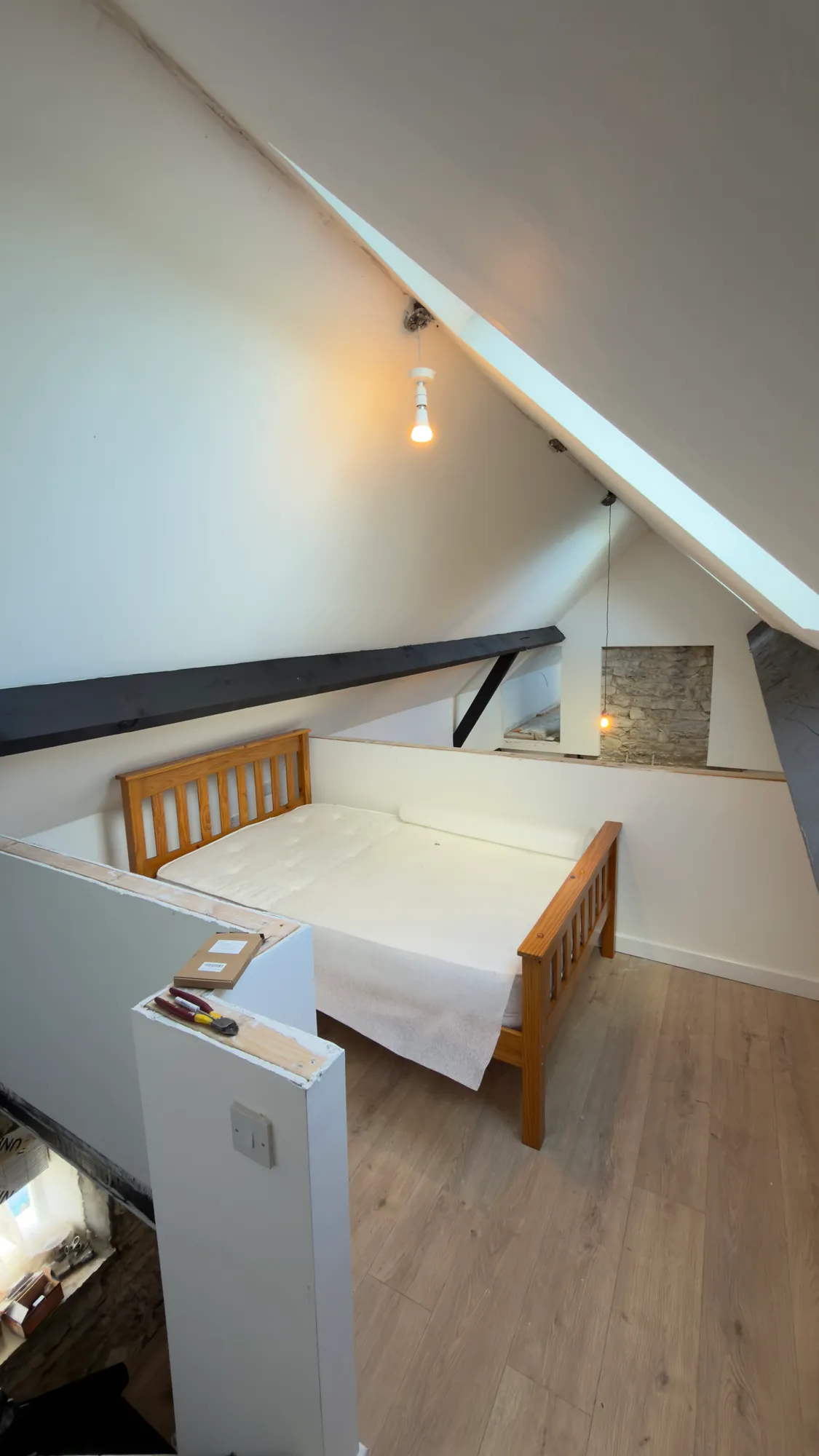
Before and after
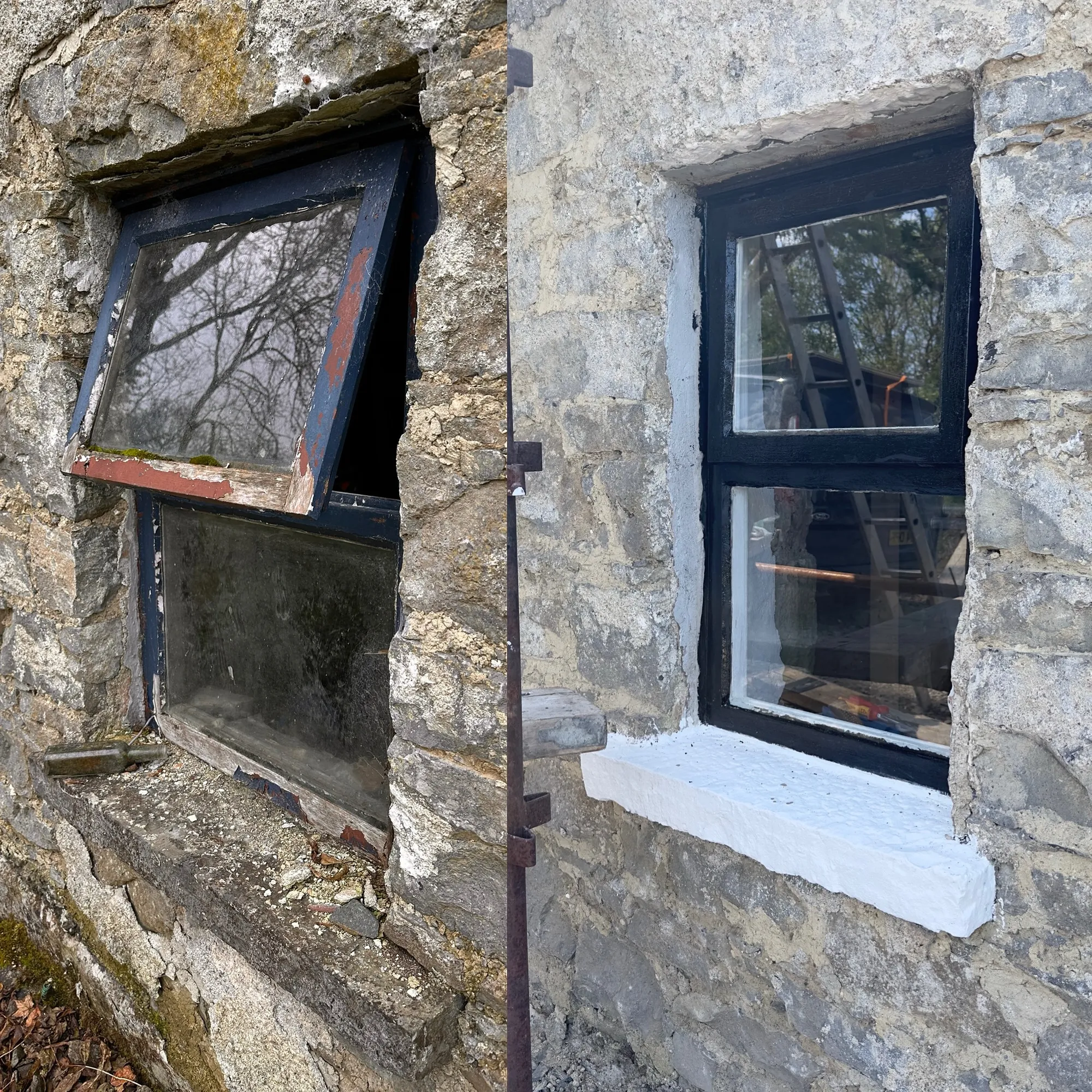
Because this is Kieran's own house, it is also the house where we try things first. Ivy Cottage is fully automated on Crestron: lighting, heating, audio, CCTV and the alarm all run from one system, and so do two things most smart homes never touch, the water pump and the septic tank. The pump story, and how the automation watches water and power on a rural property, is on our rural property automation page. Kieran posts the renovation as it happens on Instagram as @myhomestead.ie, and the next project is already lined up: a new build house in Cork.
One honest note: Kieran did not apply for the Vacant Property Refurbishment Grant on Ivy Cottage. He decided to pay for the work from his own savings, and he tracked every euro in a spreadsheet built around the grant's own categories, which made it plain how much of the work the scheme is designed to cover. This guide, and the tracker below, exist so that the next person can make that choice with the full picture in front of them.
Download the free renovation cost and timeline tracker
Download the Ivy Cottage renovation tracker (Excel). It is free (the download page asks for your name and email, then the file is yours), it opens in Excel, Google Sheets and Numbers, and it is the file Kieran used on his own cottage, tidied up for sharing. Here is how it works.
- Put in your start date and it tracks everything from there. On the Overview tab you type your project name, your start date and your target completion date into the yellow cells. The sheet then counts the days elapsed and the days remaining, works out what percentage of your timeline has passed, and sets the first week of the Gantt chart on the Timeline tab to your start date, so every bar lines up with your real calendar.
- 18 category tabs that mirror the grant form. Demolition, Substructure, Superstructure, External, Internal, Skirtings, Fascias and Soffits, Roof Completions, Tiling, Painting, Floor Finishes, Roof Finishes, Services, Kitchen, Sanitary ware, Land Work, Extensions and Professional Services: the same groupings the council uses, so your receipts are already sorted the way the application and the final claim want them. Each tab shows the grant cap for that category beside your own budget.
- One line per receipt. On each category tab you enter the date, the supplier or trade, a description, the type of cost (labour, materials, fees), the quantity and the unit price. The total works itself out (leave the quantity blank and it counts as one, so an invoice is just the invoice amount), you mark it paid or unpaid, and you paste a link to the receipt. Paid lines turn green and outstanding lines turn amber, which matters when the council asks for every invoice at the end.
- The Overview adds it all up. Budget, spent, remaining, percentage used, paid and unpaid for every category and for the whole project, with a bar chart of budget against spend and a second chart of what is paid and what is still owed. Overspent categories turn red.
- The Timeline tab is a weekly Gantt chart. The 18 categories are listed as tasks. Enter a start and end date for each and a bar draws itself across the weeks; set the percentage done and the finished part of the bar shades darker; end dates turn amber a week before they are due and red when they slip. Add your own tasks (planning, snag list, moving in) in the blank rows, pick the category from the dropdown, and the Overview picks up the start, end and progress of every category automatically.
- Built to be shared. The header rows on every tab are locked so the structure survives being passed around; every cell you need to type into is open, and you can still insert rows, sort and filter. A Read Me tab explains each column, where the categories come from and the grant caps behind them.
Fill it in from the first skip hire onwards and, when the council asks for the breakdown, you will have it by category, by supplier and by date, with every receipt one click away.
Other grants you can add to it
The Vacant Property Refurbishment Grant can be combined with several other schemes, provided no single piece of work is claimed twice.
- Private well grant. If the house cannot be connected to Uisce Éireann or a group water scheme, the council's rural water section pays 85% of the cost of a new well up to €5,000, 85% of the cost of rehabilitating an existing well up to €3,000, and 100% of water treatment up to €1,000. The house must be at least seven years old and your normal home, and no well grant can have been paid on it in the previous seven years.
- Septic tank grant. Up to €12,000, covering 85% of the cost of repairing, upgrading or replacing a domestic waste water treatment system. It is not open to everyone: the system must have failed an inspection under the National Inspection Plan, or the house must sit in a Prioritised Area for Action or a High Status Objective catchment, confirmed by a letter from the council or the Local Authority Waters Programme, and the system must be registered.
- SEAI home energy grants. Attic insulation up to €2,000, wall insulation up to €8,000, windows up to €4,000, doors up to €1,600, a heat pump up to €14,500, heating controls up to €700, solar panels up to €1,800 and a home battery at €600. Age rules apply to the house, so check each grant on seai.ie. The SEAI pays for the energy measures and the refurbishment grant pays for the rest, which is a common and sensible split on a derelict cottage.
- Local Authority Purchase and Renovation Loan. A council mortgage for first time buyers and Fresh Start applicants who cannot get enough finance from a bank, covering both the purchase and the renovation of a vacant or derelict home. It is designed around this grant: the loan includes a two year bridging element equal to your grant, at a variable 3.5% (APR 3.56%), which is cleared when the grant is paid. Income limits are €80,000 for a single applicant and €85,000 joint, and the finished value of the home must sit under the county ceiling: €375,000 in Cork city and county, €415,000 in Dublin, Kildare and Wicklow, and €310,000 or €345,000 across the other counties.
- Conservation Advice Scheme for Traditional Houses. For a cottage or farmhouse built the old way, the Department pays 67% of a conservation expert's report, up to €5,000, telling you how to repair it without losing its character. The 2026 round closed on 8 May 2026; watch for the next one if your house has thick stone walls, lime render or a slate roof worth keeping.
- Living City Initiative. Tax relief on refurbishing older homes in the designated historic centres of Cork, Dublin, Galway, Kilkenny, Limerick and Waterford. It can be used alongside the grant, with the grant deducted from the qualifying cost.
- If you end up building new instead: the Ready to Build scheme sells council serviced sites in towns and villages at a discount of up to €30,000, and the Help to Buy scheme refunds tax of up to €30,000 to first time buyers of a new build or self build. Neither applies to a refurbishment.
Mistakes that cost people the grant
- Starting the work before the approval letter arrives. Nothing done before approval is paid for.
- Buying without proof of vacancy. Ask the vendor for the utility history before you go sale agreed.
- Letting a derelict job become a demolish and rebuild. If the council classes the result as a new build, the grant is gone.
- Counting your own labour. If you do the work yourself, only materials are covered.
- Missing the 18 month deadline, or the three week window to appeal a refusal.
- Forgetting the lender. The council's charge needs your bank's consent.
- Planning to let it on Airbnb. Only RTB registered tenancies keep the grant.
Where smart home wiring fits in a grant funded renovation
Services is one of the categories limited only by the overall grant, and first fix is the one moment when cabling costs almost nothing extra. Lighting control, network cabling, speaker cable, CCTV and alarm runs, and the containment for a future heat pump or EV charger all go in while the walls are open. Our first fix guide, what to wire at first fix, and our security wiring guide list what to run. For a renovation in the capital or the south, our lighting control Dublin and lighting control Cork pages explain the options, and smart home cost in Ireland gives honest numbers. Every job starts with a survey and a design, described on our process page.
Questions we are often asked
What is the difference between the vacant property grant and the derelict property grant?
They are the same scheme. Every eligible empty home can get up to €50,000. A home that is also derelict, meaning structurally unsound and dangerous, gets a top up of €20,000, so €70,000 in total. You prove dereliction with an independent report from a registered surveyor, engineer or architect, or by the property being on the Derelict Sites Register.
How long does the Vacant Property Refurbishment Grant take?
There is no fixed decision time: it depends on how complete your application is and on the council's workload, and nationally about 80% of applications are approved. Once approved you have 18 months to finish the work, and payment follows the final inspection and your paperwork.
Is the grant paid in stages?
No. It is paid once, after the works are complete and inspected. If you cannot fund the work up front, look at the Local Authority Purchase and Renovation Loan, which bridges the grant amount until it is paid.
Can I live in the house while the work is going on?
Yes. Once the council has validated your proof of vacancy you can move in, and plenty of people live in one end of the house while the other end is being done.
Can I get the grant twice?
Up to two in your lifetime: one for a home you will live in and one for a home you will rent out. For commercial buildings converted into homes there is no limit on applications, but only one grant per building.
What happens if I sell within ten years?
You repay the full grant if you sell, move out or stop renting within five years of payment, 75% between five and ten years, and nothing after ten years. The council's charge on the property is removed at the ten year mark.
Can I combine it with SEAI grants?
Yes. Insulation, windows, a heat pump and solar can be funded by the SEAI while the refurbishment grant covers the structure and finishes, as long as the same item is not claimed from both.
Source: Department of Housing, Local Government and Heritage, Vacant Property Refurbishment Grant scheme outline, August 2026, and the grant page on gov.ie. Well grant figures from localgov.ie; energy grant figures from SEAI.
If you are planning the wiring for a grant funded renovation, or you want the pump, the heating and the lights of a rural home to look after themselves, we would be glad to help.
Book a consultation or call Dublin on 01 906 9326 or Cork on 021 202 8107.
- Log in to post comments