SEAI grants are fixed sums paid per measure on a house that was built and occupied before 2011 (before 2021 for a heat pump or solar panels), so a stone cottage in west Cork or a farmhouse in the north of the county qualifies for all of them. The ones that change the sums on a cottage are the heat pump package of up to €12,500, which has applied since 3 February 2026, external wall insulation at €8,000 or dry lining at €4,500 on a detached house, €4,000 for windows and €800 a door, and €1,800 for solar panels, and a low cost loan for the balance that stops taking applications before the year is out.
A cottage in Cork is bought for the view and paid for in heating oil. This guide takes the SEAI grants in the order a cottage job actually runs, from the technical assessment to the panels on the roof, with the figures read on seai.ie, gov.ie and the SBCI's loan page on 14 November 2026, and with the parts of Ivy Cottage, the Roscommon cottage our founder restored, that bear on each step. The grants changed twice in 2026, so treat the page for each measure as the last word.
Step one: the assessment, before anyone buys a heat pump
Nearly every cottage in Cork was built before 2007, and on a house of that age the SEAI will not pay the heat pump grant without a technical assessment unless a valid BER already shows a Heat Loss Indicator of 2.3 W/(K.m2) or less, which an uninsulated stone cottage will not be near. The assessment carries its own €200 grant, it is done by an assessor from the SEAI register, and its report tells you how much insulation the house needs before a heat pump will heat it at a sensible running cost. Treat it as the design brief for the energy side of the job rather than a form to get past.
Step two: the walls, the roof and the floor
On a solid wall the choice is the wrap or dry lining. External wall insulation on a detached house carries €8,000 and keeps the stone on the inside, where it holds heat; internal dry lining carries €4,500 and keeps the outside of the cottage as it was, which on a listed or a much loved building is the only option. Cavity wall insulation at €1,800 is listed too, but a rubble stone wall has no cavity to fill. Attic insulation is €1,500 on the individual route for a detached house, and a One Stop Shop can also claim floor insulation at €3,500, which matters when the old floor is coming up anyway.
The SEAI's own warning for houses built before 1940: a solid masonry wall with no damp proof course breathes, and the wrong insulation traps water in it. Its Traditional Homes Pilot, open since October 2024, puts a traditional building professional in charge, runs through a registered One Stop Shop, takes houses with a BER of B3 or lower, sets no BER target and uses lime plaster and hemp where they are called for. Ask any One Stop Shop whether it is on the pilot before you ask anything else.
Step three: the heat pump package
Since 3 February 2026 the heat pump system grant on the individual route is a fixed amount of up to €12,500 for a house, made up of €6,500 for the heat pump itself, €2,000 for upgrading the radiators and pipework and a new €4,000 renewable heating bonus. It covers air to water, ground source, exhaust air and water to water systems; an air to air unit gets €3,500. The house must have been built and occupied before 2021, the installer must be registered with the SEAI for heat pumps, a BER is done after the works with a €50 grant towards it, and the €700 heating controls grant cannot be claimed as well. Since 1 December 2024 the Vacant Property Refurbishment Grant does not pay for a standalone fossil fuel boiler either, which settles the question for most cottage buyers.
Step four: windows, doors and the panels on the roof
From 2 March 2026 windows and doors can be claimed on their own on the individual grant route, without a full One Stop Shop project: €4,000 for a complete window upgrade on a detached house and €800 per external door, two doors at most. The condition is that the attic and the walls are already adequately insulated, which the SEAI reads from the BER advisory report rating them Good or Very Good, so the windows come after the walls. Solar panels carry €700 per kWp for the first 2 kWp and €200 for each kWp after that up to 4 kWp, €1,800 at most, a figure the Minister has confirmed for 2026; the house needs an MPRN and no earlier solar grant at that meter, and you have eight months from approval to claim.
The four routes into the SEAI grants
| Route | Who it suits | The condition |
|---|---|---|
| Individual grants, one measure at a time | A cottage you are managing yourself, done in stages | Approval before the work starts, a contractor from the SEAI register, a BER after, 30 days to accept the offer and eight months to claim |
| A One Stop Shop | A derelict cottage being rebuilt from the walls in | A minimum B2 BER at the end, with a heat pump or a primary energy improvement of 100 kWh per square metre a year; the grants come off the invoice; a €350 assessment and €2,000 project management grant on top |
| The Traditional Homes Pilot | A pre 1940 solid wall cottage | Through a One Stop Shop on the pilot, a traditional building professional in charge, a BER of B3 or lower, no target to reach |
| The Warmer Homes Scheme | An owner occupier on Fuel Allowance or another qualifying payment, in a house built before 2006 | Free, but the SEAI says up to 24 months from application to finished works |
Paying for the rest: the loan closes on 31 December 2026
The Home Energy Upgrade Loan Scheme lends €5,000 to €75,000 per property over one to ten years through AIB, Bank of Ireland, PTSB, An Post Money and credit unions including First South and Clonmel, at rates the SBCI calls lower than standard. The works must carry an SEAI grant and lift the BER by at least 20%. The SBCI's page gives the dates that matter for a Cork cottage this winter: loans are available up to 31 December 2026 unless the fund is spent first, AIB stops accepting applications from 27 November, and an approved loan has to be drawn down by 31 December.
Beside the refurbishment grant and the other rural schemes
None of this replaces the refurbishment grant; it sits on top of it. The Department of Housing's FAQ of August 2026 says an SEAI Better Energy Homes grant may be available in combination with the Vacant Property Refurbishment Grant, that the SEAI works should be separate from the works applied for under it, and that the council has to be satisfied nothing is claimed twice. So the energy measures go to the SEAI and the roof, the structure, the floors, the kitchen and the services go to the council, where our complete guide to the Vacant Property Refurbishment Grant has the current figures, up to €50,000 and 18 months to finish, and our derelict property grant guide explains the €20,000 top up. A cottage on its own water and drains has two more offices to visit, covered in our Cork guides to the private well grant and the septic tank grant. Four schemes means four sets of receipts; the free renovation tracker Kieran built for Ivy Cottage keeps them on separate tabs.
Ivy Cottage: the roof insulation went in with the cables
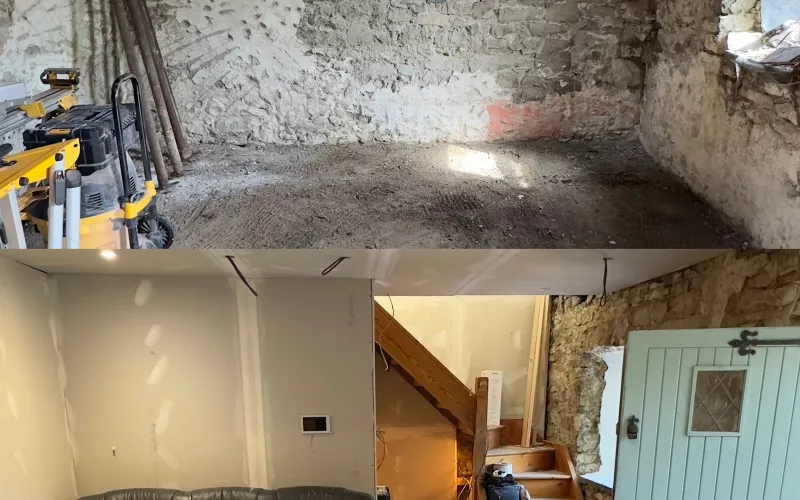
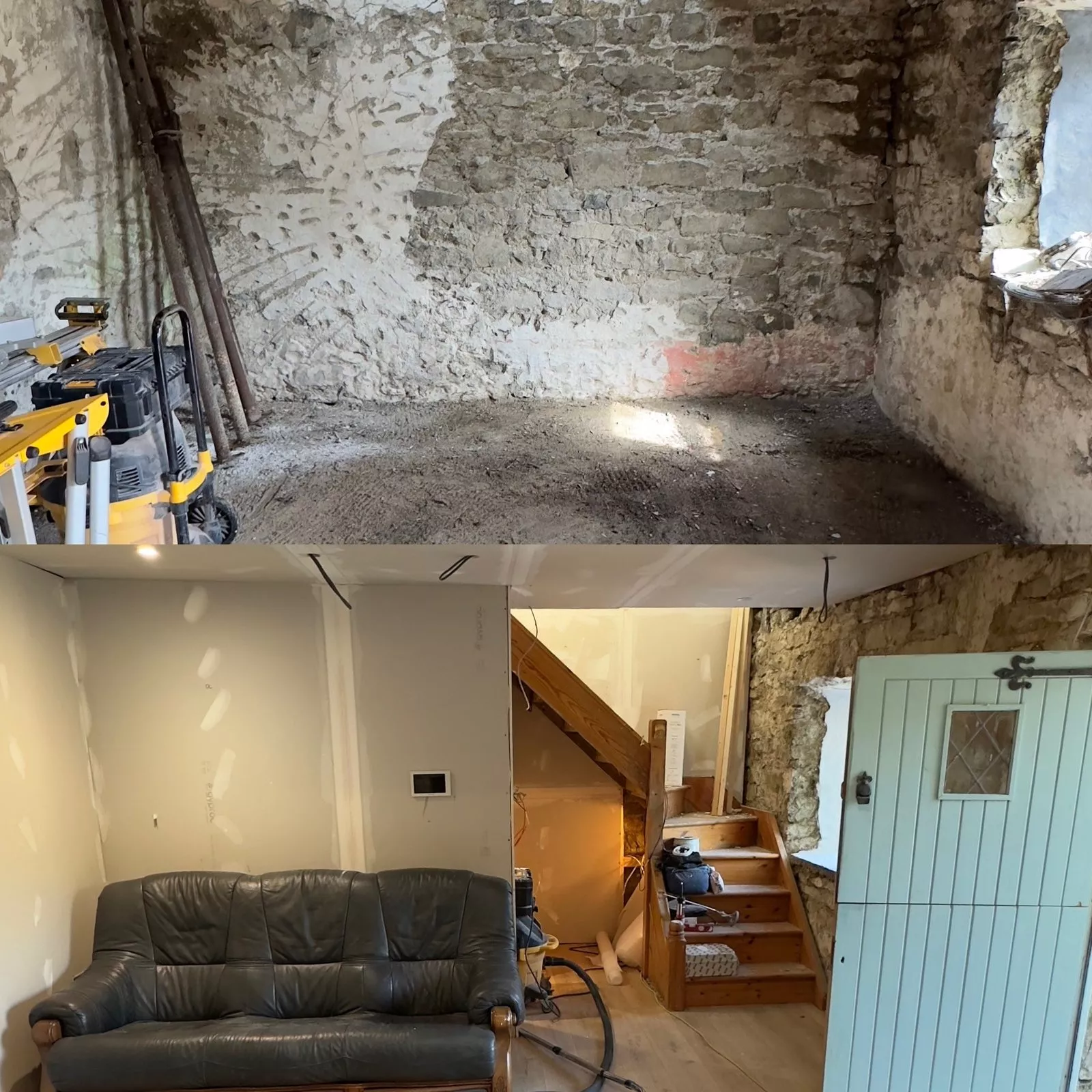
Ivy Cottage is the derelict stone cottage in Roscommon that our founder, Kieran McGuire, bought as a personal project and restored as a home; he posts it on Instagram as @myhomestead.ie, and the photos below are his own.


The shell was stripped back to stone, new timbers and insulation went into the roof, stud walls and a timber staircase framed out the rooms, the first fix cabling went in while everything was open, and then the floors went down. Insulation and cabling share the same fortnight on a cottage, which is why we tell every grant applicant to have the SEAI approvals and the wiring plan in hand on the same day. The cottage runs on Crestron now, heating included, with the lights, the audio, the CCTV and the alarm on the same system, and because it stands on its own well and septic tank the pump and the tank are on it too; the pump, it turned out, was feeding three farms, as our rural property automation page tells.


No grant was claimed on Ivy Cottage: Kieran chose to pay from his savings, and tracked every euro in the spreadsheet he has since given away as the tracker. The figures in this guide are the ones a Cork buyer can claim on the same kind of house.
What to decide while the walls are open
A heat pump grant buys the plant. Whether the cottage is warm when you walk in on a wet evening from Bandon depends on the controls: a zone for each room, a thermostat that knows nobody is home, and a schedule that follows the family rather than the clock. Our guide to heat pump controls covers the zoning, our solar panels guide for a Cork house covers the panels the grant pays for, and smart energy for a Cork self build shows the heating, the panels, a battery and the car charger working as one. The cables go in before the dry lining, so read what to wire at first fix first. Our Crestron installer Cork page shows one system in a small house, smart home cost in Ireland gives honest numbers, and every job starts with a survey and a design, as described on our process page.
Questions we are often asked
Which SEAI grants can I get on a stone cottage in Cork?
All of the home energy grants, as long as the cottage was built and occupied before 2011 for insulation, heating controls, windows and doors, and before 2021 for a heat pump or solar panels. The date is taken from when the electricity meter was installed.
Is the heat pump grant really €12,500?
Up to €12,500 on a house since 3 February 2026: €6,500 for the heat pump, €2,000 for radiators and pipework and the €4,000 renewable heating bonus, with €200 more for the technical assessment and €50 for the BER afterwards. An apartment gets less, and an air to air unit gets €3,500.
Should I wrap a stone cottage or dry line it?
The wrap carries the bigger grant, €8,000 against €4,500 on a detached house, and keeps the stone warm on the inside, but it changes the look of the cottage. On a pre 1940 solid wall, ask a One Stop Shop on the Traditional Homes Pilot before you decide, because the wrong material on a breathing wall traps damp.
Can I get the windows grant without doing the whole house?
Yes, since 2 March 2026: €4,000 for the windows of a detached house and €800 per door for up to two doors, on the individual grant route, provided the attic and walls are already adequately insulated.
Can the SEAI grants be combined with the Vacant Property Refurbishment Grant?
Yes, on separate works. The Department of Housing's August 2026 FAQ says the two may be combined provided the SEAI works are kept apart from the refurbishment grant works and nothing is claimed twice.
When does the Home Energy Upgrade Loan close?
Loans are available to 31 December 2026 unless the fund runs out first, AIB stops taking applications from 27 November, and an approved loan must be drawn down by 31 December. It needs an SEAI grant on the works and a 20% lift in the BER.
Sources, read on 14 November 2026: the SEAI's heat pump grants, wall insulation, attic insulation, heating controls and solar PV pages, its One Stop Shop and Warmer Homes Scheme pages, its news on the increased grant amounts, and its posts on the windows and doors grant and the Traditional Homes Pilot; the Minister's announcement of 27 January 2026; the SBCI page for the Home Energy Upgrade Loan Scheme; and the Department of Housing's refurbishment grant FAQs of August 2026 and grant page.
If you have a cottage in Cork that needs insulating from the stone out, and you want the heating, the lights and the pump to look after themselves on the nights you are not there, we would be glad to walk the house with you.
Book a consultation or call our Cork office on 021 202 8107.
- Log in to post comments