Wired lighting control runs every circuit back to dimmer modules in a central cabinet and suits a house that is being gutted or extended; wireless lighting control replaces the switches you already have and suits a finished home where nobody wants the walls opened. In Dublin renovations the best answer is often both: wired where the walls are open, wireless where they are not.
Our lighting design guide for self builders covers what to decide before first fix in a new house. This post is for everyone else: the owner of a redbrick in Rathmines, a semi in Terenure or a 1970s house in Castleknock who wants scenes, dimming and one button for all off, and is wondering how much disruption that means.
How wired lighting control works
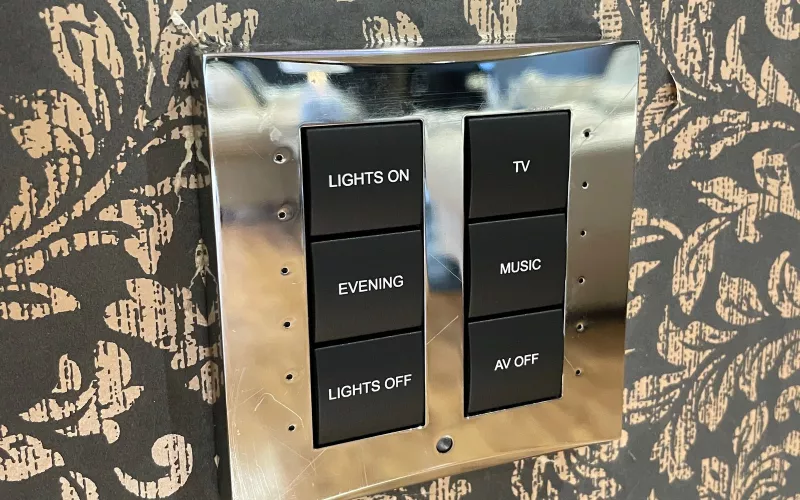
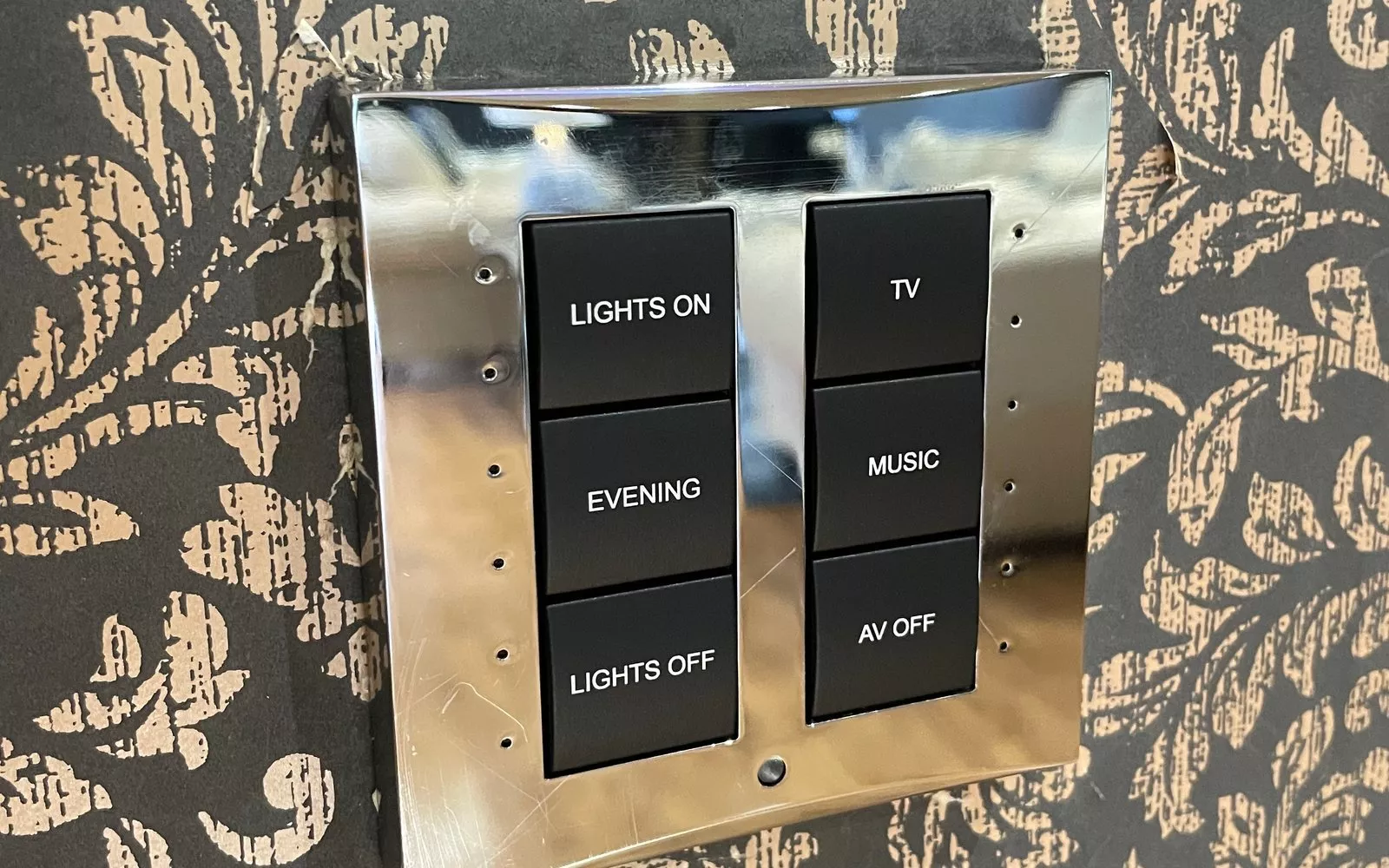
In a wired system, each lighting circuit is cabled back to a cabinet, usually in a utility room, under the stairs or in the attic. The cabinet holds dimmer and relay modules and a processor. The switches on the walls are replaced by keypads, which carry only a low voltage data cable, so a single slim keypad can control every light in a room and recall scenes such as evening, dinner or cleaning.
Because the dimmers are in one place, they run cool, they are easy to replace, and the whole house can be programmed and supported from one point. Wired is the most robust form of lighting control, and the one we recommend whenever the cabling can be done.
The cost is disruption. Every circuit needs a dedicated cable back to the cabinet, which in a finished Dublin house usually means lifting floors, chasing walls and redecorating.
How wireless lighting control works
A wireless system puts a smart dimmer or switch in the existing back box, where the old switch was. It uses the cable already there, so nothing has to be chased. The dimmers talk to each other and to a small processor by radio, and wireless keypads can be fixed anywhere you want control, even where no switch existed before.
Lutron's RadioRA 3 page describes components that communicate wirelessly, independently of Wi-Fi, and a system that brings keypad control and wire free window treatments to existing homes without opening walls. It scales to 400 devices with paired processors, which covers far more than a typical family house. That independence from Wi-Fi matters: the lights keep working if the broadband router is being changed or the Wi-Fi is slow.
Wired or wireless lighting control: how they compare
| Question | Wired | Wireless |
|---|---|---|
| Building work | New cable from each circuit to a central cabinet | Uses the existing switch wiring |
| Best time to install | Full renovation, extension or rewire | Any time, including a finished, decorated home |
| Where the dimmers sit | In a cabinet, out of sight | In the wall, behind each keypad or switch |
| Size of the house | Any size; the natural choice for large homes | Most homes, with repeaters in larger ones |
| Adding blinds and curtains later | Wired or wireless motors can both be added | Battery or wireless motors join easily |
| Disruption | Significant in a finished home | Usually a day or two, room by room |
The Dublin houses we see, and what suits each
Victorian and Edwardian redbricks
Solid walls, original plasterwork and decorative ceilings make chasing in a finished period house expensive and risky. Wireless dimmers in the existing boxes protect the features. If the house is being fully restored, though, it is the moment to go wired.
1930s to 1980s semis and detached houses
These are the houses most often extended. A common plan is wired lighting control in the new kitchen and family room, run while the walls are open, and wireless dimmers in the original rooms. Both parts appear as one system, on the same keypads and the same app.
Apartments
Concrete ceilings and shared walls make rewiring hard. Wireless is almost always the answer, and many apartments can be done in a day.
Homes with an older system that has failed
We often meet houses with a lighting system from the 2000s whose parts are no longer made. Our JCL FlexiDim replacement page explains how we replace an old system using the existing cabling, so a wired house usually stays wired.
Which brands we use
We install Lutron, Rako and Crestron lighting control, all of which offer wired and wireless options and can be mixed within one home. Our post Lutron or Rako? compares the two lighting specialists, and our Lutron installers in Dublin page covers that brand in more detail.
Planning lighting control for a Dublin renovation
If walls and ceilings are coming down anywhere in the house, decide on lighting control before the electrician starts first fix. The cabling for a wired system is cheap at that stage and impossible to add neatly afterwards. Our smart home wiring plan for a Dublin renovation sets out what to run, room by room, and our lighting control in Dublin page shows how we design and install it.
Questions we are often asked
Is wireless lighting control reliable?
Yes, when it is a professional system with its own radio network rather than one that relies on the home Wi-Fi. We design the layout and add repeaters where the walls are thick.
Can I mix wired and wireless lighting control in one house?
Yes. Most systems we install in renovated houses are a mix, controlled from the same keypads and app.
Will my existing light fittings work?
Usually, though some LED lamps and drivers do not dim smoothly. We check them during the survey and recommend replacements only where needed.
Do I need a neutral wire at the switch?
Some wireless dimmers need one and some do not. Many older Dublin houses have no neutral at the switch, so we choose dimmers to suit what is there.
How much does a survey cost?
A consultation and site survey is €440 plus VAT and covers up to four hours. Our smart home cost guide has more detail.
If you want lighting control in a Dublin home and are unsure how much disruption it means, we will survey the house and show you where wired, wireless or a mix makes sense.
Book a consultation or call our Dublin office on 01 906 9326.
- Log in to post comments