A smart home electrician understands both halves of the job: the mains wiring that the house depends on and the control system that sits on top of it. On a self build that matters, because most smart home problems we are called to fix started with an electrical decision made at first fix by someone who did not know what the control system needed. Neutrals missing at switch positions, dimmers that flicker with the chosen LEDs and a consumer unit with no room for the lighting panel are all cheap to get right on paper and expensive to fix in a finished house.
This guide is for people building their own home in and around Dublin, from an infill house in a suburban garden to a one off home in north county Dublin, Meath or Wicklow. It explains why the people designing your smart home should know the electrics, what to agree before the first cable goes in, and who is legally responsible for what.
Why the smart home and the electrics cannot be planned apart
A modern smart home is not a box you add at the end. Lighting control decides how the lighting circuits are wired. Motorised blinds need power at the window head. Heating controls switch the heat pump and the zone valves. Cameras, the intercom and the Wi-Fi access points need data cables in places a standard electrical layout never covers. Every one of those choices lands on the electrician's drawings sooner or later.
When the control system is designed by someone who has never wired a house, the electrician is handed a list of devices with no detail about how they connect. When the electrics are planned by someone who has never commissioned a control system, the wiring follows the old pattern of a switch by every door and a loop from light to light. Either way, the two only meet at second fix, and that is when the problems show.
Our founder, Kieran McGuire, is an electrician, and so are a few of our team. We think in circuits, cable routes and loads as well as scenes and apps, so the design we hand over is one an electrician can wire from without guessing.
Decisions a smart home electrician gets right at first fix
These are the points we check on every Dublin self build design before the walls are closed.
| Decision | What goes wrong if it is missed | What to agree |
|---|---|---|
| Neutral at every switch position | Many smart switches and dimmers will not work without one, so the choice of control is limited later | Bring a neutral to every switch box, even where a plain switch is planned |
| Central or local lighting control | Cables loop between lights and cannot be brought back to a lighting panel | Decide early; for central control, run each lighting circuit back to the panel location |
| LED fittings and dimmer type | Flicker, buzzing or lights that never fully dim | Choose the fittings and drivers with the dimming system, not separately |
| Space at the consumer unit | No room for the lighting panel, relays or surge protection | Plan the distribution board and the control panel side by side |
| Power for blinds, sensors and keypads | Chasing finished plaster to add a supply | Mark every motor, sensor and keypad on the drawings with its cable |
| Data and mains kept apart | Interference and cables in the wrong containment | Separate routes and boxes for Cat6 and mains cables |
None of these points cost much on a drawing. Each of them can cost days of rework once the plasterers have been.
Lighting: where the two trades meet most often
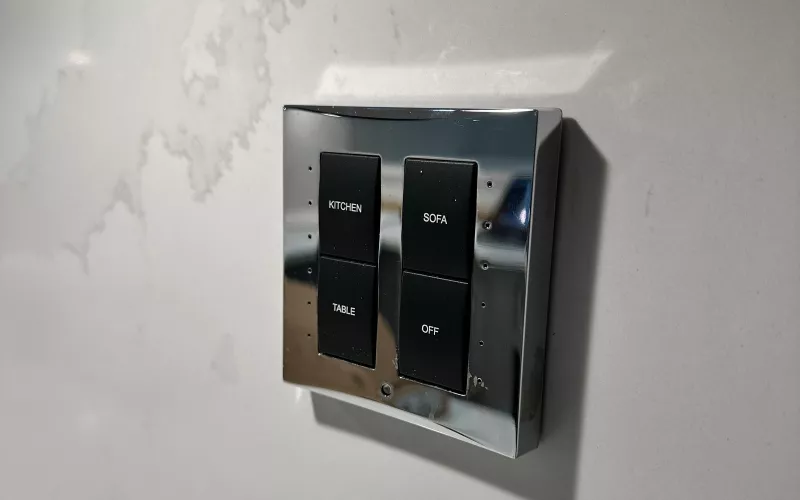
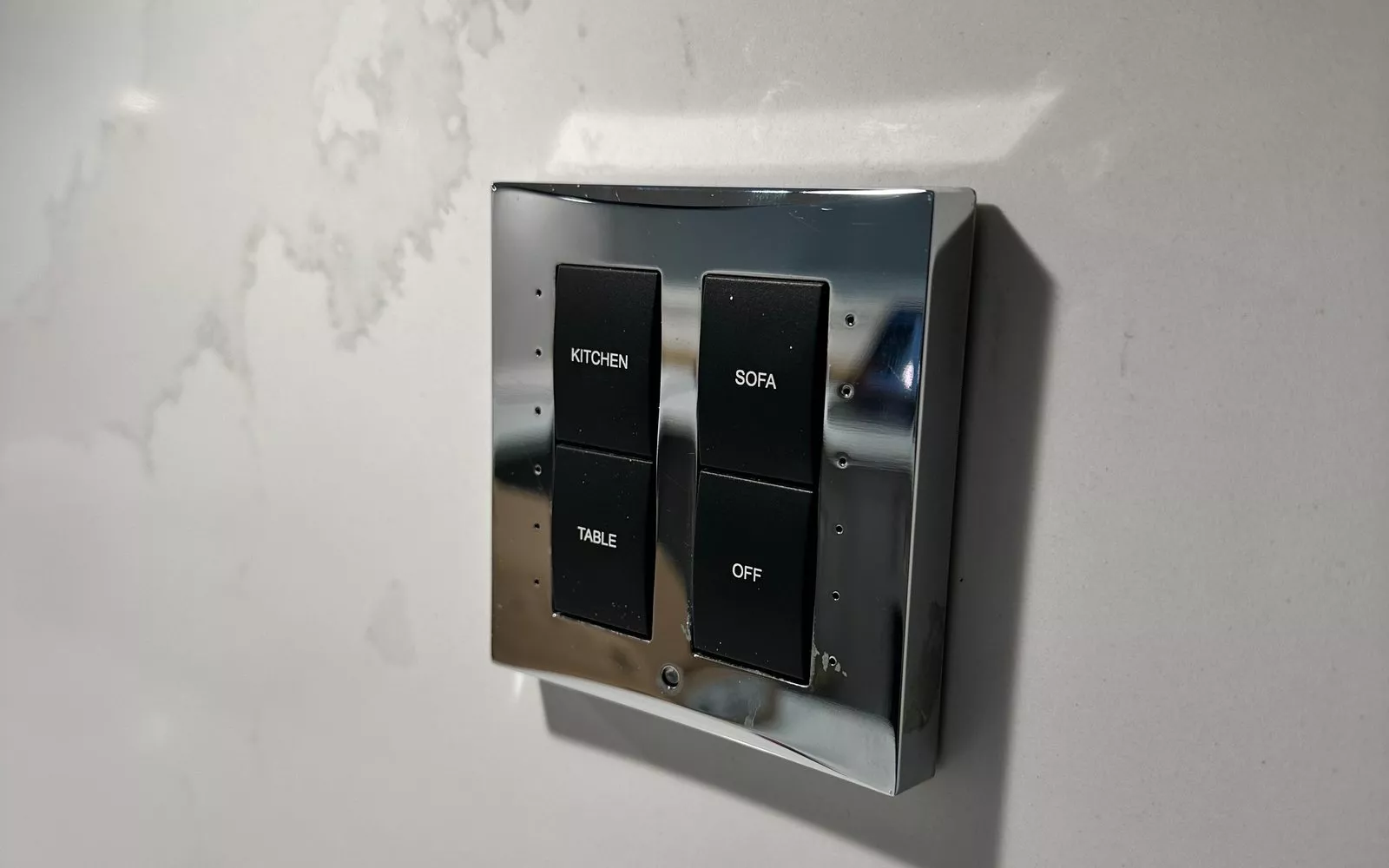
Lighting is where an electrician who knows control systems earns their keep. With a central system, each circuit runs back to a panel of dimmer and relay modules, and the wall keypads send commands rather than switching the load directly. With local control, smart dimmers sit in the switch boxes, which then need enough depth and a neutral. Both work well; mixing them up halfway through a build does not.
Our lighting design guide for self builders covers the scenes, circuits and keypad positions to settle before first fix, and our lighting control page for Dublin shows the systems we install. Whichever way you go, the lighting design and the electrical layout should be one document.
Who certifies the electrics, and why it matters to you
In Ireland, electrical work in your home must be carried out by a Registered Electrical Contractor. The Commission for Regulation of Utilities is clear on this in its guidance on electrical works in your home: always use a Registered Electrical Contractor, it is the law, and when they finish they must give you a Completion Certificate showing the work is safe and up to standard. Ask for that certificate for all the electrical work on your house, and check the contractor through Safe Electric before you sign.
A smart home installer does not replace that contractor. What a smart home electrician does is make sure the control system and the electrical installation fit together, so the contractor who certifies the house is wiring to a design that already accounts for the lighting panel, the motors and the data network. We work alongside your electrical contractor, or with the builder's, and give them drawings and a cable schedule they can follow.
What we hand your electrician
Our survey and design service produces a set of drawings for the whole smart home: every lighting circuit and keypad, every data point and access point, blind motors, speakers, cameras and the comms cabinet, plus a cable schedule that tells the electrician what to run, from where to where. Our consultation and design page explains the stages. A consultation or site survey is 440 euro plus VAT for up to 4 hours.
For the cabling itself, our first fix wiring guide lists what goes in at first fix room by room, and our heat pump controls guide shows how the heating wiring joins the rest of the system.
Questions we are often asked
Can my own electrician wire the smart home?
Yes, in most cases. Give them a proper design and cable schedule and a good electrician will wire it well. The problems start when they are asked to wire for a system nobody has designed yet.
Do I need a neutral at every light switch?
It is worth asking for one at every switch position. Many smart switches and dimmers need it, and adding it later means opening walls.
Who signs off the electrical installation?
The Registered Electrical Contractor who carried out the work, who must give you a Completion Certificate. Keep it with your house documents.
Is central lighting control worth it on a self build?
For a larger house it usually is, because the circuits come back to one place, keypads can do more than one thing and the system is easier to service. The decision has to be made before first fix.
When should we bring a smart home designer in?
Before the electrical tender, ideally at planning or early design stage, so the electrician prices the right job from the start.
The control system, the app and every camera lean on the home network, so plan the Wi-Fi with the electrics. Send us your floor plans and we will mark the access points, list the Cat6 runs back to one comms cabinet and send a priced kit list, free and with no obligation: our free Wi-Fi design for self builders explains how.
Book a consultation or call our Dublin office on 01 906 9326.
- Log in to post comments