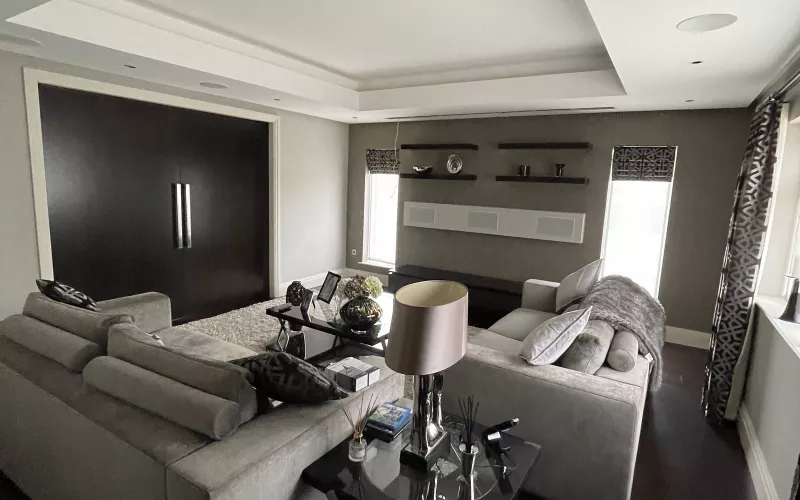
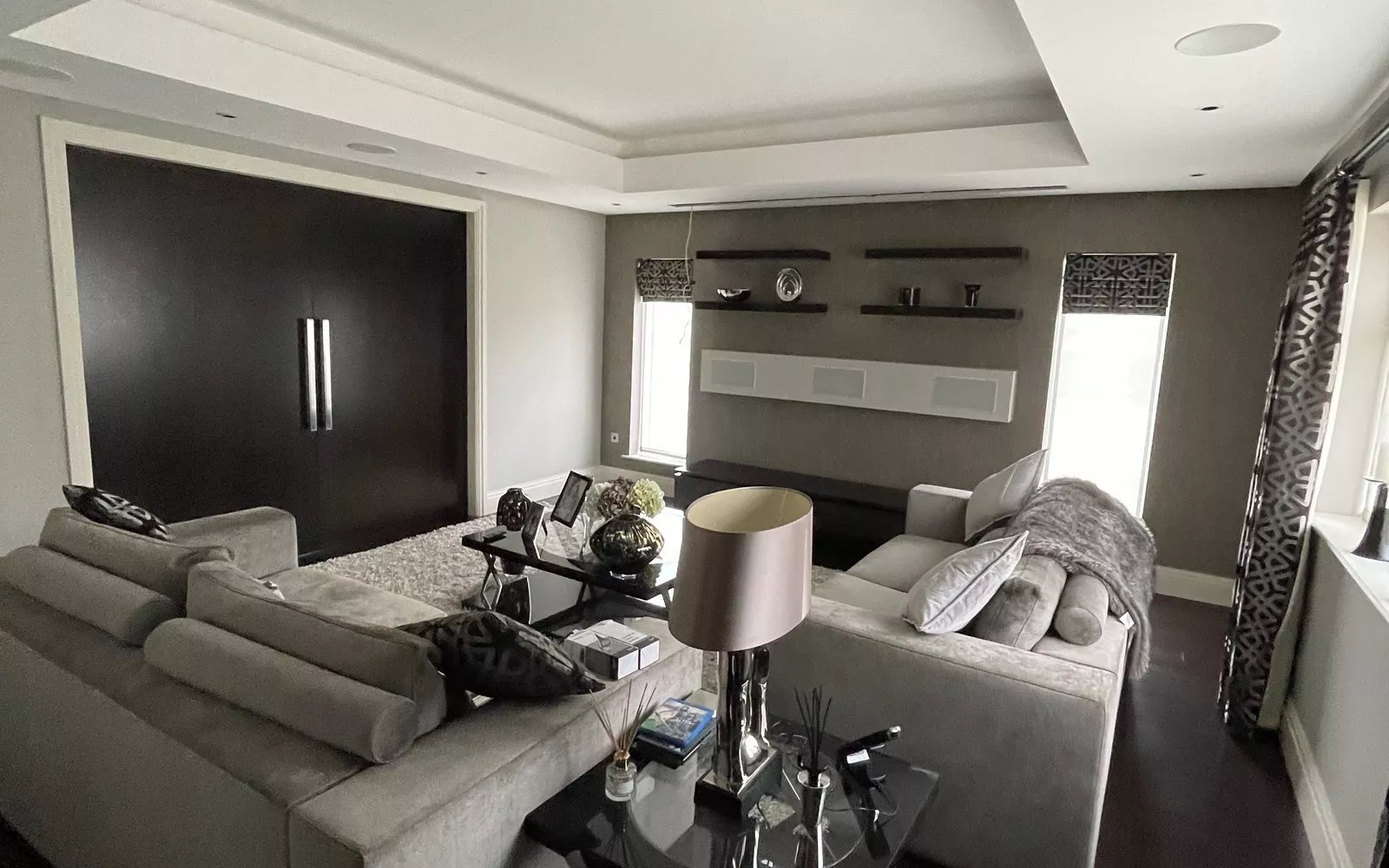
To hear Dolby Atmos in a Dublin living room, every link in the chain has to support it: the streaming app or disc, the TV, the HDMI connection and the speakers. A good soundbar gets you a sense of height with no building work, while an AV receiver with two or four ceiling speakers gives the real overhead effect most people are hoping for.
A common story: someone buys a new TV, subscribes to a service that advertises Dolby Atmos, adds a soundbar, and is disappointed. Nothing is broken. One link in the chain is missing, or the room is working against the speakers. This guide follows the signal from the app to your ears, then looks at the three ways of getting height sound into the kinds of living rooms we see across Dublin.
What Dolby Atmos is, in plain terms
Older surround formats send sound to fixed channels: left, centre, right and the surrounds. Dolby Atmos works differently. The Sonos guide to Dolby Atmos describes it as an object based audio format that incorporates overhead speakers for a sense of height, and says creators can place and move up to 128 sound objects. Your equipment then works out how to play those objects through whatever speakers you have.
That is why the same film can sound modest through a basic soundbar and remarkable through a properly set up room. The information is in the soundtrack; the question is whether your system can deliver it.
The Dolby Atmos chain, link by link
| Link | What it needs | Where it often goes wrong |
|---|---|---|
| Source | A film, series, game or music track mixed in Atmos, on a plan or disc that includes it | The streaming plan or the app on that device does not carry Atmos |
| TV or streaming box | Support for Atmos and the ability to pass it on | An older box or TV app sends plain stereo or surround instead |
| Connection | HDMI between the TV and the soundbar or receiver | An optical cable, which the Sonos guide says does not offer the bandwidth required |
| Soundbar or receiver | Atmos decoding | Settings left on a stereo or night mode |
| Speakers | Height speakers, upward firing drivers, or virtual height processing | A ceiling that is too high, sloped or absorbent for bounced sound |
When we take over a system that is not delivering, we check each of these in turn. It is usually a setting or a cable rather than the speakers.
Soundbar or AV receiver for Dolby Atmos?
A soundbar
A soundbar is one box under the TV, connected by a single HDMI cable. The better ones include upward firing drivers that bounce sound off the ceiling, and some add separate rear speakers and a subwoofer. Sonos notes that a soundbar can also simulate height without ceiling or upward firing speakers. For an apartment, a smaller living room or a home where nobody wants holes in the ceiling, a soundbar is a sensible choice.
An AV receiver with separate speakers
A receiver drives each speaker on its own: front, centre, surrounds, subwoofer and two or four height speakers in the ceiling. It costs more and takes planning, but the height effect is clearer and the sound fills a larger room. The receiver can live in a press or an equipment rack, out of sight, and be switched on by a single remote or a Crestron system in Dublin. As a Crestron Elite Partner, we can tie the cinema sound into lighting, blinds and the rest of the house.
Dublin living rooms and Dolby Atmos height speakers
The house matters as much as the equipment. A few patterns we see often:
- Victorian and Edwardian redbricks in places like Rathmines, Ranelagh and Drumcondra have tall ceilings, deep cornices and, often, a ceiling rose. Tall ceilings suit ceiling speakers, but the plasterwork may rule out cutting in the middle of the room. We place speakers clear of the features or use another route.
- 1930s to 1970s semis in suburbs such as Terenure, Glasnevin or Templeogue have lower, plainer ceilings with timber joists above. These are usually easy places to fit two or four ceiling speakers, especially during an extension or a rewire.
- Apartments in the city and the Docklands often sit under concrete, and management companies may not allow cutting. A soundbar with upward firing drivers, or slim speakers high on the wall, is the practical answer.
- New A rated homes have airtight layers in the ceiling that should not be punctured carelessly. Speaker positions are best agreed before the plasterboard goes up.
Where the ceiling speakers go
In most living rooms we fit two height speakers a little in front of the main seats, or four: two in front and two behind. They are placed to line up with the left and right speakers below rather than in the centre of the room. If you already have ceiling speakers for music, they are usually in the wrong place for Atmos, so a cinema system often needs its own pair. Our guide to how many ceiling speakers a Dublin room needs covers music speakers in more detail.
Renovating? Wire for it now
If the ceiling is coming down for an extension or a rewire, run speaker cable to the height positions and HDMI and data to the TV wall while you can, even if the speakers come later. It costs very little at this stage and saves a great deal of disruption afterwards. Our smart home wiring plan for a Dublin renovation lists what else to run.
Living room or cinema room?
A living room system shares the room with daylight, family life and furniture placed for conversation. If you want a dark room, a projector and seats arranged for the screen, a dedicated room is better; see our home cinema room build. For both, our home cinema installation in Dublin page explains how we work, and multi room audio in Dublin covers music in the other rooms.
Questions we are often asked
Why does my soundbar not show Dolby Atmos?
Usually because something earlier in the chain is not sending it: the app, the plan, the TV setting or an optical cable instead of HDMI. We check each link in turn.
Are two height speakers enough?
In a typical living room, yes. Four give a smoother effect across a wide sofa or a larger room.
Can I add Dolby Atmos to an existing surround system?
Often. If your receiver supports Atmos and has spare channels, adding two ceiling speakers may be all you need.
Will ceiling speakers be noticeable?
Very little. Round in ceiling speakers with thin painted grilles sit flush and blend into the ceiling.
How much does a survey cost?
A consultation and site survey is €440 plus VAT and covers up to four hours. See our smart home cost guide for more.
If you would like Dolby Atmos in your Dublin living room, we will look at the room, the ceiling and the equipment you already have, and tell you plainly whether a soundbar or ceiling speakers will serve you better.
Book a consultation or call our Dublin office on 01 906 9326.
- Log in to post comments