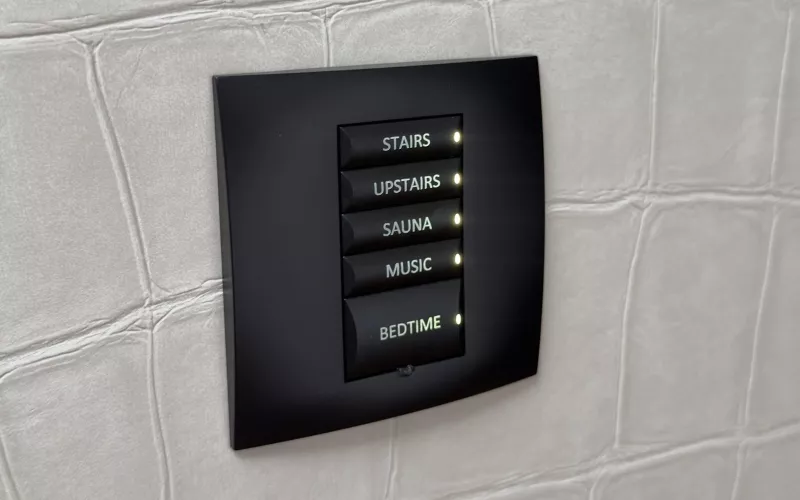
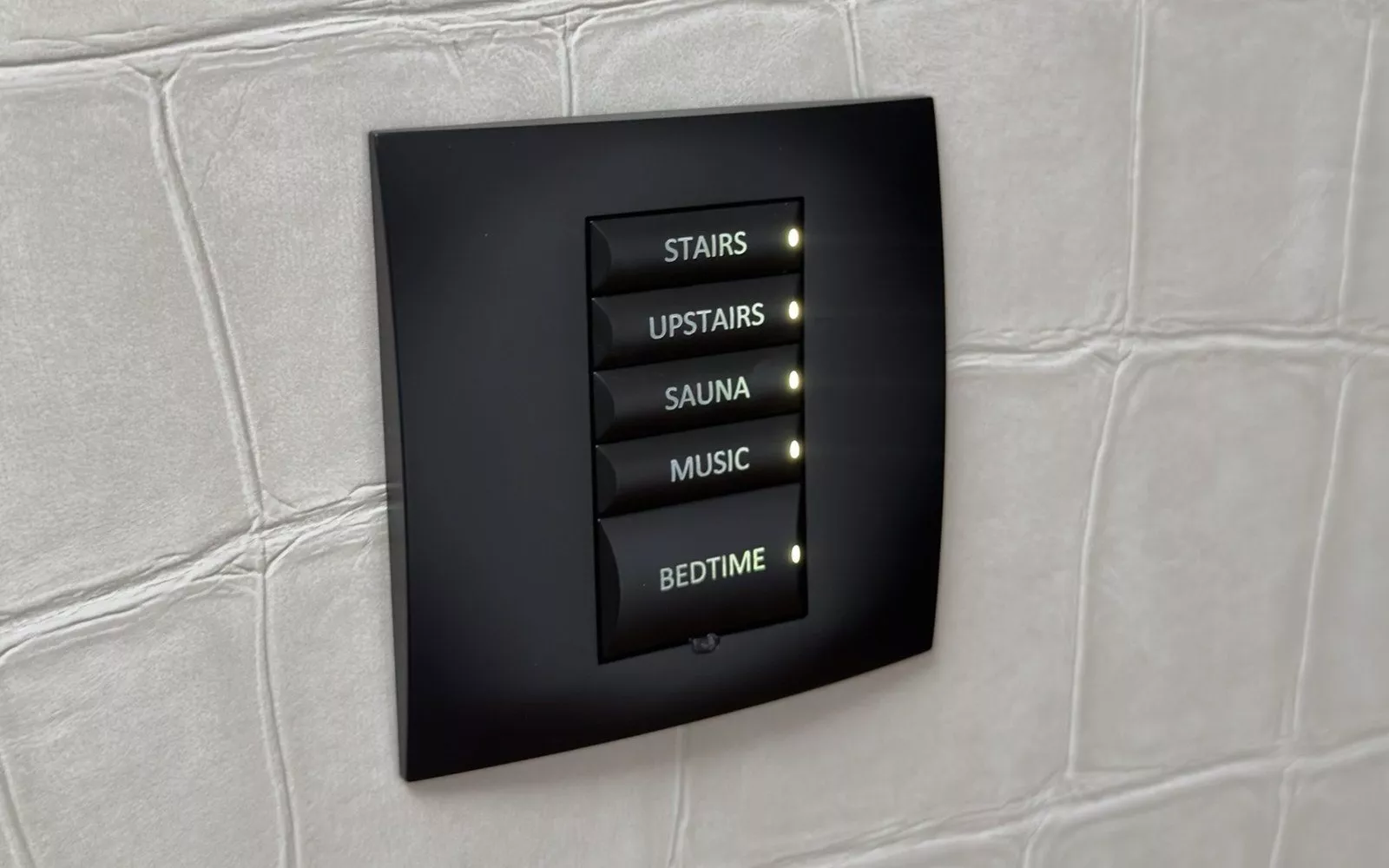
If part of your Cork home is being extended or stripped back, run cable for lighting control in that part now, because a wired system is the most dependable kind and the cabling is cheap while the walls are open. Rooms that are staying as they are can take wireless dimmers in the existing switch boxes, and the two can be joined into one system with the same keypads throughout.
Most of the lighting control we fit in Cork is not in a blank new build. It is in a farmhouse getting a big kitchen extension near Bandon, a 1980s bungalow in Douglas being opened up, or a period house in Blackrock where the back of the house is being rebuilt. In each case part of the house is a building site and part of it is someone's finished home. This post explains how to plan lighting control for exactly that situation.
The case for cabling lighting control in the new rooms
A wired lighting control system uses keypads that carry only a data cable, with the dimmers and relays gathered in a cabinet. That makes the keypads small and cool, the dimmers easy to service, and the system steady for many years. It needs two kinds of cable: the lighting circuits from the fittings back to the cabinet, and a data cable linking the keypads.
Rako's application sheet for its wired system shows how simple the data side can be. The basis of the network is a single run, or daisy chain, of CAT5 data cable, and the units can be connected in any order. Where the building makes a single run awkward, home run or star wiring can be used through a star unit, with up to 18 star runs. For an electrician on a Cork extension this is ordinary work, as long as the plan is ready before first fix.
Where wireless lighting control fits better
In the rooms that are not being touched, a wired system would mean lifting floors and chasing finished walls. A wireless system avoids that. Each old switch is replaced by a smart dimmer in the same back box, using the existing wiring, and the dimmers talk to each other by radio. Extra keypads can be added anywhere without new cable.
Wireless is also useful in places a cable cannot easily reach: a garden room, a converted outbuilding across the yard, or an upstairs room in a dormer where the eaves space is boarded and finished.
A typical Cork plan, room by room
| Part of the house | Method | What we fit |
|---|---|---|
| New kitchen and family room extension | Wired | Circuits back to the cabinet, scene keypads at each door |
| Hall, stairs and landing | Wired if the floors are up, otherwise wireless | A keypad by the front door with an all off button |
| Existing living room and bedrooms | Wireless | Smart dimmers in the old switch boxes |
| Garden lighting | Wired from the cabinet | Circuits on a timer or sunset schedule |
| Outbuilding or garden room | Wireless | Dimmers and a keypad linked to the main system |
What lighting control changes day to day
It is worth being clear about what you are buying. Lighting control replaces rows of switches with a few keypads that recall whole scenes: a bright setting for cooking, a softer one for dinner, a dim path to the bathroom at night. A single button by the front door turns off every light in the house as you leave. Outside lights can follow sunset rather than a timer that drifts with the seasons. In a large open plan extension, where one room might otherwise need a dozen switches, that is the difference people notice first.
Things that catch people out
- Deciding too late. Once the plasterer has finished, the chance to cable cheaply has gone. Agree the lighting control plan with your electrician before first fix.
- Space for the cabinet. A wired system needs a dry, ventilated spot for its modules, often a utility room, a press under the stairs or a corner of the plant room.
- Long rural houses. In a long single storey house or one with thick stone walls, wireless range can be stretched. A data cable run to a midpoint during the works lets us place a repeater exactly where it is needed.
- LED fittings. Not every LED fitting dims well. We check fittings during the survey so the lights do not flicker or buzz.
- Neutral wires. Some wireless dimmers need a neutral in the switch box. Older Cork houses often lack one, so we choose dimmers to suit.
Systems we install in Cork
We design and fit Rako, Lutron and Crestron lighting control, all of which can combine wired and wireless products in one house. We are a Crestron Elite Partner, so lighting can also be tied to blinds, heating, audio and security. See our Rako installers in Cork and Lutron installers in Cork pages for each brand, and Lutron or Rako? for how they compare.
If your project is a renovation, our smart home wiring guide for a Cork renovation or extension covers everything else worth running before you plaster. Our lighting control in Cork page explains how we design a system, and our Cork team covers the city and county; see our Cork page.
Questions we are often asked
Can wired and wireless lighting control work as one system?
Yes. With the right platform, wired and wireless parts share the same keypads, scenes and app, and you will not notice which is which.
What cable does my electrician need to run?
The lighting circuits back to the cabinet, plus a data cable to each keypad position. We give your electrician a drawing and a cable schedule before first fix.
Can I add lighting control to the rest of the house later?
Yes. Wireless dimmers can be added room by room whenever suits you, without new wiring.
Does wireless lighting control need my Wi-Fi?
No. Professional systems run their own radio network, so the lights work even if the broadband is down.
How much does a survey cost?
Our survey and consultation costs €440 plus VAT for up to four hours on site, and the smart home cost guide sets out what systems typically cost.
If you are extending or renovating a Cork home and want lighting control that fits both the new and the old parts, we will plan it with you and your electrician before first fix.
Book a consultation or call our Cork office on 021 202 8107.
- Log in to post comments