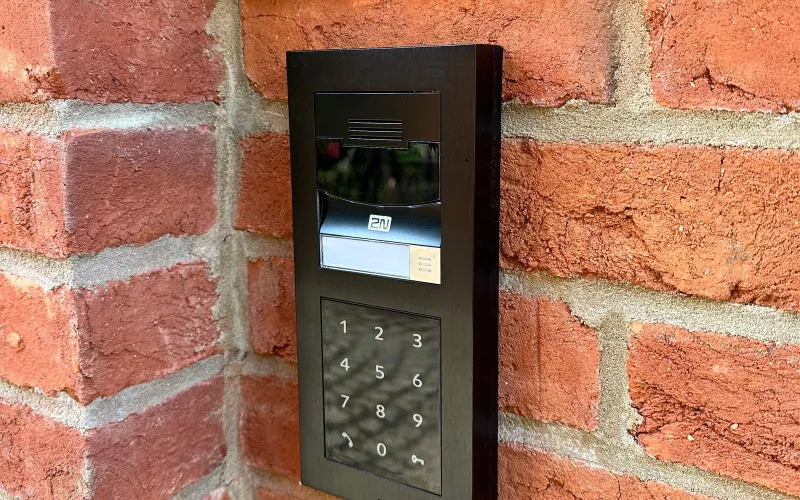
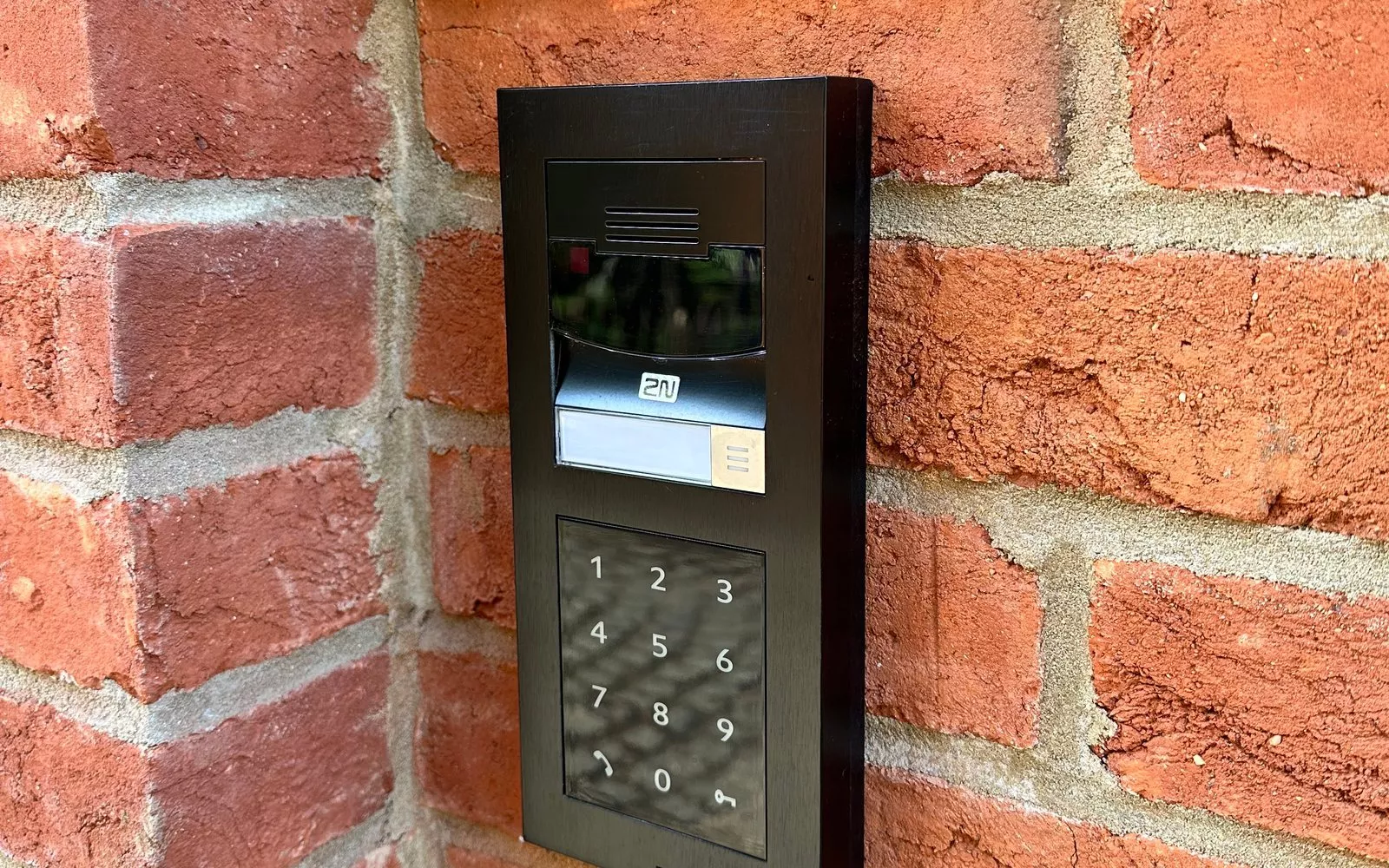
Keyless entry on a self build works best when it is decided before the front door is ordered, because the best smart locks are built into the door and need power and a cable brought to the frame. Plan the door, the lock, the video doorbell and the cabling together, and you get a front door that opens from a code, a fob or your phone, still takes a key, and looks as if nothing was added afterwards. This guide covers the choices, the wiring and who does what.
It is written for people building their own home in and around Dublin, from an infill house in Clontarf or Rathfarnham to a one off home in north county Dublin, where the front door is often a large, made to order doorset that takes months to arrive.
Retrofit smart locks or a lock built into the door?
There are two broad kinds of smart lock, and the choice decides what you need to tell your door supplier.
The first is a battery lock that fits over or replaces the cylinder on an ordinary door. These are designed for existing homes, need no wiring and can be added at any time. They suit a side door, a garage door or a rental, but on the main entrance of a new house they can look like an afterthought, and the batteries need changing.
The second is a motorised lock built into the door itself, usually a multipoint lock that throws its bolts and hooks electrically. It sits inside the door leaf, so nothing shows except a slim handle, a reader or a keypad. It needs a permanent power supply and usually a control cable, carried from the frame into the door through a concealed cable transfer on the hinge side. That transfer, the lock and the routing inside the door have to be part of the door order. Most door makers can supply this, but few will offer it unless you ask.
On a self build we nearly always recommend the second for the front door and, where it matters, the back or utility door, with battery locks kept for doors where a cable cannot reach.
Keyless entry: ways to open the door
| Method | Suits | What to plan |
|---|---|---|
| Keypad code | Family, cleaners, trades on a set day | A cable to the keypad position, and codes you can change or limit by time |
| Fob or card | Children and older relatives who do not want a phone app | A reader at the door, mounted where it is easy to reach |
| Fingerprint reader | The household itself | Usually built into the handle or the keypad, so it is part of the door order |
| Phone app or remote release | Letting someone in while you are away | A wired network connection to the lock controller or intercom, not a weak Wi-Fi link |
| Mechanical key | Every door, always | A cylinder that still works if the power, the network or the app fails |
Whatever you choose, ask for a mechanical key override and make sure the door can always be opened from the inside with the handle or a thumb turn. A front door that needs an app to get out is not a door anyone should live with.
A video doorbell that is wired, not wireless
A battery video doorbell that connects over Wi-Fi is a sensible fix for an older house. On a new build it is the weak option: the front door is often the furthest point from the router, foil faced insulation and block walls stop the signal, and the battery runs flat at the worst moment.
Instead, run a Cat6 cable from the comms cabinet to the doorbell or video intercom position. A single cable can carry both power and data to a door station that supports it, and the picture is steadier than over Wi-Fi. Run another Cat6 cable to each place inside where you might want to answer the door, such as a screen in the kitchen or beside the bed, even if you start with your phone. The same door station can then release the smart lock, so you see who is there and let them in from one screen.
If your site has an electric gate, plan the gate intercom at the same time. Our guide to electric gate wiring for Dublin self builds covers the ducts and cables to the pillars.
What to tell the door maker and the electrician
- Which doors get a motorised lock, and which make and model, so the door is prepared and routed for it.
- A cable transfer on the hinge side of each motorised door, and where the cable will come out of the frame.
- Where the keypad, reader or door station will sit, so the cladding, render or brick can be finished around it.
- A cable from each door to the comms cabinet, plus a power supply for the lock with a battery backup, so the door still locks and unlocks during a short power cut.
- A door contact for the alarm, so the alarm knows the door is shut as well as locked. Our security wiring guide for self builders explains the rest of the alarm cabling.
Our founder, Kieran McGuire, is an electrician, and a few of the team are too, so the cable schedule we produce is written the way your electrician needs it: every position, every cable type and where each run finishes. Our survey and design service brings the doors, the alarm, the intercom and the network into one set of drawings.
Who is allowed to install access control in Ireland
Keyless entry is regulated here. Under the Private Security Services Act 2004, section 2, as revised, an installer of security equipment includes anyone who, as a business, installs, maintains or services devices designed to control access to premises by means such as numerical codes, biometrics, card management or electronic key management. That is the access control licence category of the Private Security Authority.
As we read it, a keypad, fob or fingerprint entry system fitted by a business falls into that category. 1Install is PSA licensed for intruder alarms and CCTV. Whoever installs and commissions your access control, whether that is the door supplier, a security company or anyone else, should hold the PSA access control licence, so check them on the PSA's public register before you agree anything. We design the system, run and test the cabling and connect the door station, the alarm and the lock to the rest of the smart home.
Making the front door part of the smart home
Once the lock, the doorbell and the alarm are on the network, they can work together. Unlocking the door after dark can turn on the hall and porch lights, a video doorbell call can appear on the TV or a touch panel, and a single "leaving" button can lock the doors, set the alarm and switch off the lights. 1Install is a Crestron Elite Partner, and our founder holds every Crestron certification; our Crestron page for Dublin and our home automation page show the systems we programme. We can also keep it simple: a good lock and a wired doorbell need no automation system at all.
A design consultation or site survey costs 440 euro plus VAT and covers up to 4 hours, which is usually enough to plan the doors, the alarm and the network for a typical one off house.
Questions we are often asked
When should I decide on keyless entry?
Before the external doors are ordered. A lock built into the door has to be part of the door order, and the cable to the frame has to go in at first fix.
Can I add a smart lock later?
Yes, a battery lock that fits the cylinder can be added at any time. A motorised lock built into the door is far harder to add once the door is made and hung.
What happens to keyless entry in a power cut?
A lock powered from a supply with a battery backup keeps working through a short cut, and a mechanical key override covers anything longer. Ask for both.
Is a wired video doorbell better than a battery one?
On a new build, yes. A Cat6 cable gives a reliable connection, and with a door station that takes its power over the same cable, nothing needs charging.
Does the installer need a PSA licence?
For access control fitted by a business, such as a keypad, fob or fingerprint system, yes. Check the PSA's public register for the access control licence.
The doorbell, the lock and the app all depend on the network reaching the front door. Send us your floor plans and we will mark the Wi-Fi access points, list the Cat6 runs to one comms cabinet and send a priced kit list, free and with no obligation; our free Wi-Fi design offer for self builders explains what to send.
Book a consultation or call our Dublin office on 01 906 9326.
- Log in to post comments