Fibre broadband reaches a new house through a duct, and on a self build that duct is your job, not the network operator's. Get the duct, the entry point and the route to the comms cabinet right during groundworks and first fix, and the connection on the day is quick; get them wrong and you are digging up a finished driveway or living with a router stuck on the hall table. This guide sets out what to plan, what to tell your groundworker and electrician, and what to have ready before the broadband engineer arrives.
It is written for people building their own home in and around Dublin, from an infill house in a back garden in Clontarf or Rathfarnham to a one off home in Fingal, Meath or north Wicklow. Most of these sites sit close to an existing pole or footpath chamber, which makes the job simpler, but only if the duct is in the ground before the drive is laid.
Why fibre broadband needs planning on a self build
In a housing estate the developer puts the ducts in for every house. On a one off build nobody does it unless you ask. The network operator brings the fibre to the edge of your site and pulls a cable through to the house, but it expects a clear duct waiting for it. open eir puts it plainly on its single dwellings page: your contractor should lay ducting so a fibre cable can run from the curtilage to your home, and it is best done at build stage to avoid delays at installation.
The broadband line is also the start of everything else in a smart home. The router feeds the comms cabinet, the cabinet feeds the Wi-Fi access points, cameras, intercom, TV points and the control system. If the fibre comes in at the wrong side of the house, every one of those systems pays for it in longer runs or an extra box on a wall.
The duct from the boundary to the house
open eir publishes a short guide for property owners, Guidelines for installing new ducting, and it is worth giving a copy to whoever digs your trenches. The points that matter most on a Dublin site, as we read them on the day this was written:
- Use a duct with an internal diameter of at least 32 mm for most installations; a long run needs a bigger duct.
- Dig the trench at least 400 mm below ground level and lay warning tape along the full length at half depth before backfilling.
- Where the duct crosses the driveway, lay it deeper or protect it so the weight of a car cannot crush it.
- Keep the route at least 300 mm from other services, run it as straight as you can and avoid joins; where you must join it, use a proper sleeve or an access box.
- Leave a draw rope in the duct from end to end, with at least a metre spare at each end, and cap the house end so nothing gets in.
- If there is no external termination box, finish the duct on the wall 600 mm above ground level, at an entry point that suits the router, with a twin socket beside it.
That last point is the one most often missed. The broadband engineer brings the fibre through the wall where your duct ends. If the duct ends at the back door, that is where the router goes.
Choosing the entry point and the comms cabinet together
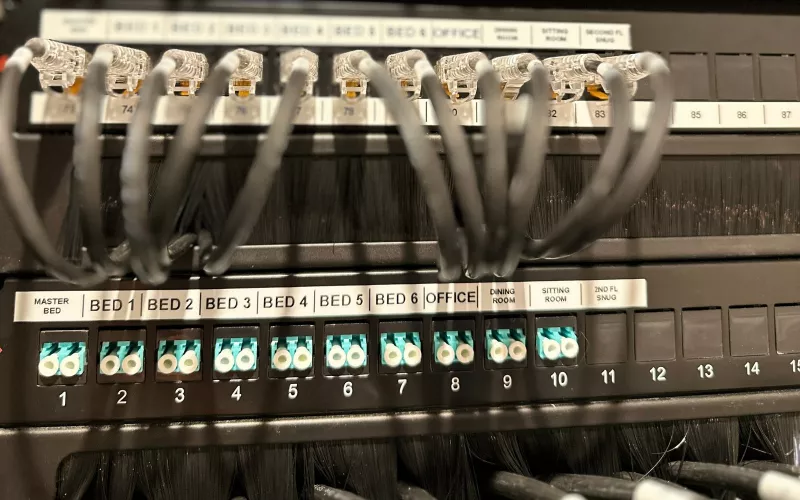
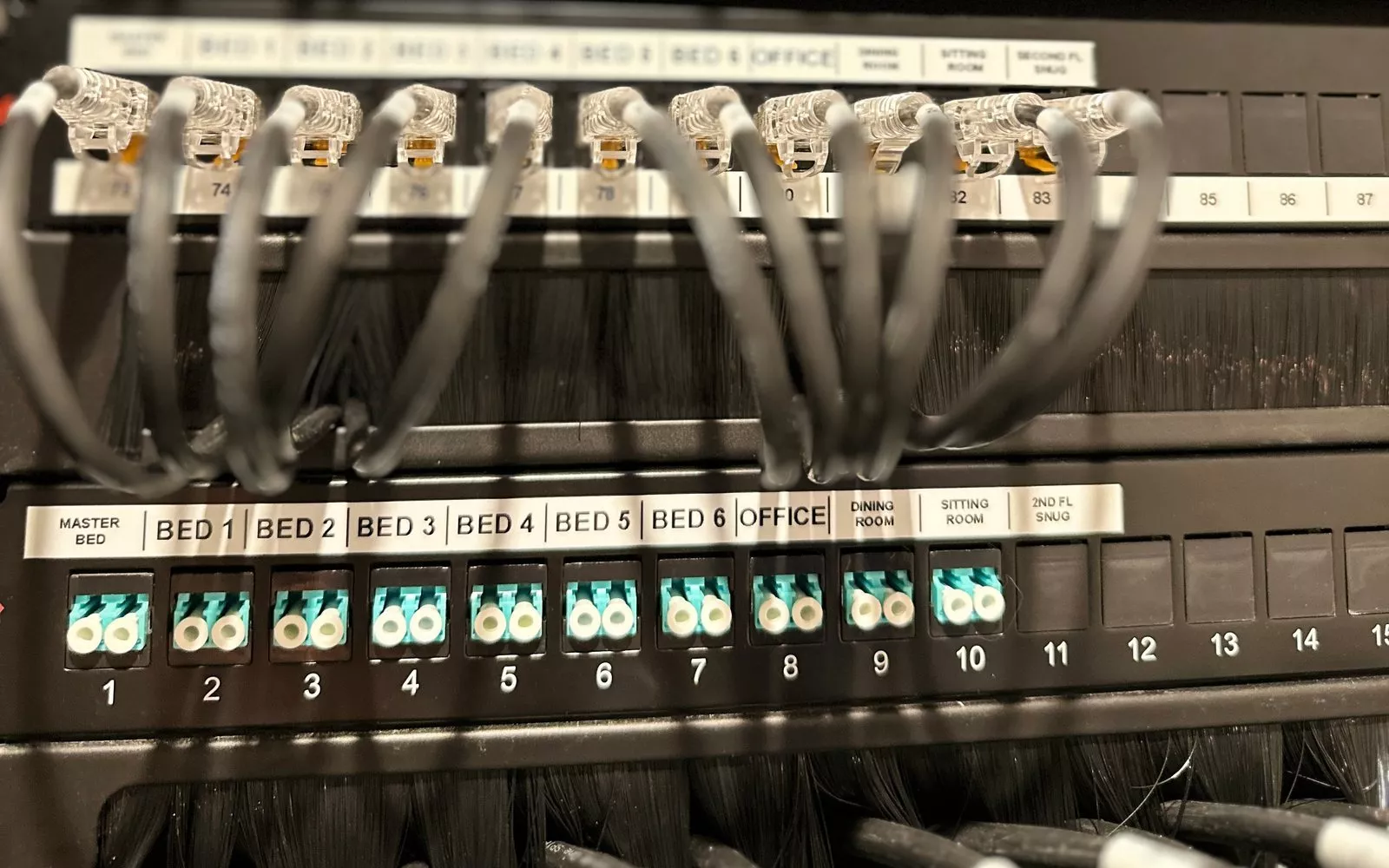
We plan the entry point and the comms cabinet as one decision. The ideal is a short, straight path from where the duct meets the wall to a cabinet in a utility room, a plant room or under the stairs, somewhere dry, ventilated and reachable, near the middle of the house so the Cat6 runs to each room stay short.
| Item | When | What to agree |
|---|---|---|
| Duct from the boundary | Groundworks, before the drive | Route, depth, draw rope, protection under the drive |
| Entry point on the wall | Before the walls are finished | Height, the side of the house nearest the comms cabinet, a sealed sleeve through the wall |
| Route inside to the comms cabinet | First fix | A conduit or clear path from the entry point to the cabinet, kept airtight where it passes the membrane |
| Power at the entry point and the cabinet | First fix | A twin socket beside the router position and dedicated sockets at the cabinet |
| Cat6 to every room | First fix | Data points for TVs, the office, access points and cameras, all back to the cabinet |
| Order the line | Once you have an Eircode | Check the address with open eir and National Broadband Ireland and book the connection |
If the duct has to arrive on a wall far from the best spot for the cabinet, run a conduit inside from the entry point to the cabinet so the router can live in the cabinet with everything else. Our first fix wiring guide covers the rest of the cabling that goes in at the same time.
Keeping the airtightness test happy
Every cable or duct that passes through the outside wall or the airtight layer is a possible leak. Agree with your builder how the broadband duct and any conduit will be sealed where they pass the membrane, with a proper grommet or airtight tape, before the air test. It is a small detail that is easy to forget when the broadband is the last service to be connected.
Wi-Fi and the rest of the network
A fast fibre line only helps if the signal gets around the house. Block walls, insulated slabs and modern glazing all stop Wi-Fi, which is why we wire ceiling access points back to the cabinet rather than relying on the router alone. Our guide to mesh, extenders and access points for Dublin homes explains the difference, and our Wi-Fi and networks page shows what we install.
The same cabinet takes the TV and media cabling, so plan it with our TV wiring guide for Dublin self builds to hand.
Who does what
Your groundworker lays the duct, your electrician puts in the sockets and the inside conduit, and the network operator connects the line. We design the whole network and the comms cabinet, and we can install and commission it. Our founder, Kieran McGuire, is an electrician, and so are a few of our team, so the drawings we give your electrician show the sockets, the conduit and the data points exactly where they need to be. Read more about why that matters in our smart home electrician guide.
Our survey and design service produces the drawings and the cable schedule. A consultation or site survey is 440 euro plus VAT for up to 4 hours.
Questions we are often asked
When should the broadband duct go in?
During the groundworks, while the trenches for the other services are open and before the drive is laid. Putting it in later means digging up finished ground.
Do I need an Eircode before I can order fibre broadband?
Yes. The operators check availability by Eircode, so a new house usually has to wait until its Eircode appears. The duct can go in long before that.
Can the fibre come in underground through the slab?
It can, but it is harder to seal and to repair. Most self builds are better with the duct rising on the outside wall at the entry point and a sealed sleeve through the wall.
Where should the router go?
In the comms cabinet, with the switch and the patch panels, not on a hall table. Plan the entry point and an inside conduit so the line reaches the cabinet.
Will one router give me Wi-Fi in every room?
Rarely in a new, well insulated house. Wired ceiling access points give steady coverage, and the cables for them go in at first fix.
While the plans are open, let us design the Wi-Fi too. Send us your floor plans and we will mark the access point positions, list the Cat6 runs back to the comms cabinet and send a priced kit list, free and with no obligation: our free Wi-Fi design for self builders explains how to send them.
Book a consultation or call our Dublin office on 01 906 9326.
- Log in to post comments