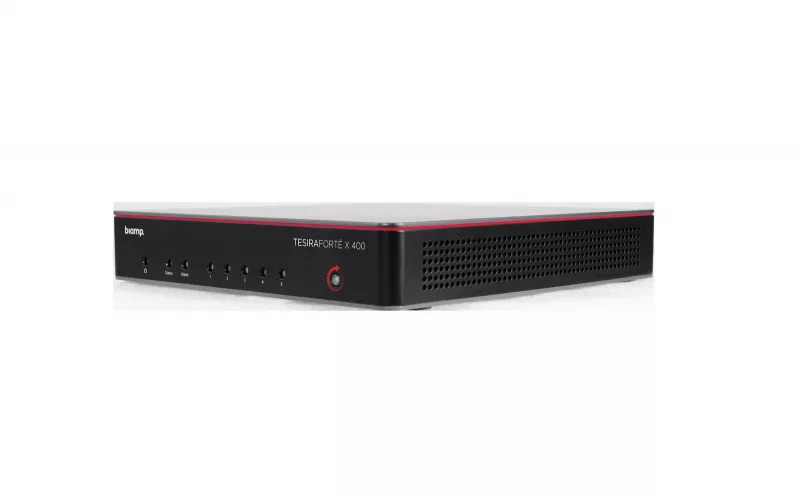

Biamp voice reinforcement without any wearable or handheld microphone is now running in a teaching room at Emory College of Arts and Sciences in Atlanta, according to a Biamp press release dated 29 September 2026, using Parlé Voice Lift on existing Parlé TCM Beamtracking ceiling microphones and TesiraFORTÉ X processors. For universities, colleges and schools in Dublin and Cork, it shows how a campus that already has Biamp ceiling microphones for hybrid teaching might add voice lift to large rooms without buying a new set of microphones.
Product image: Biamp.
- Source: Biamp's own press release of 29 September 2026 on Emory College of Arts and Sciences, part of Emory University in Atlanta, Georgia.
- Products named: Parlé Voice Lift, Parlé TCM Beamtracking ceiling microphones, and TesiraFORTÉ X processors, with TesiraFORTÉ X 400 and X 800 units among the Biamp systems on campus.
- The pilot room was Anthropology Room 303, and Biamp says it required no new microphone infrastructure.
- The college serves more than 5,000 undergraduate, graduate and doctoral students, according to Biamp.
- Biamp is now helping Emory evaluate more rooms, including a large administrative meeting room used by university leadership.
The Emory pilot in brief
Emory College of Arts and Sciences had a head start. Biamp reports that more than 120 of its teaching spaces were already fitted with Parlé TCM Beamtracking ceiling microphones and TesiraFORTÉ X processors, and that roughly 140 learning spaces across the campus use Biamp systems, with about 300 of those ceiling microphones in total. Parlé Voice Lift uses that same equipment to reinforce the instructor's voice as they move throughout the presentation area.
The reason for the project is a complaint many campus AV teams may recognise. Griffin Fisher, who manages Classroom Technology Services at the college, said rechargeable and disposable batteries each caused different issues, and that those challenges had kept the college from introducing traditional voice lift in a lot of spaces. On classroom technology generally, he was clear: "We really do want solutions that just work."
Joe Andrulis, Executive Vice President of Corporate Development at Biamp, said the pilot gave natural reinforcement that raises presenter confidence while staying almost invisible to staff and students. Biamp adds that its equipment at Emory also handles conferencing, lecture capture and hybrid learning. The full details are in Biamp's Emory College press release.
Where Biamp voice reinforcement fits on Dublin and Cork campuses
Think of the large rooms on a typical third level campus: tiered lecture theatres, science labs where the lecturer walks between benches, exam halls used for talks, and the main hall in a secondary school. In each, the people furthest from the speaker struggle, and a radio microphone only helps if someone has kept its batteries charged.
Biamp's own guidance helps narrow down which rooms are candidates. Its support articles say voice lift gives the most benefit where the furthest listener is about 35 to 40 feet, or 10.7 to 12.2 metres, or more from the talker, because a normal speaking voice is 15 to 20 dB quieter at that distance. In a small tutorial room, Biamp says, the lift may not be noticeable. That points Dublin and Cork institutions towards their bigger theatres and halls rather than every classroom.
It also matters what is already in the ceiling. A university or college that added Parlé ceiling microphones and a TesiraFORTÉ X for hybrid lectures may be closer to voice lift than it thinks, since Biamp describes Parlé Voice Lift as an update to Parlé ceiling microphones and Tesira processing, and states that Tesira 5.6 or later is needed. We looked at Biamp's room bundles in an earlier article on Devio UCX and BMA 360D bundles.
Features Biamp highlights
Hands free speech. Presenters and students speak normally, and ceiling microphones carry their voices to the rest of the room.
Locked beams. Biamp says microphone beams can be aimed and locked to particular zones to maximise pickup and avoid loudspeaker feedback, and that this can be adjusted for multi use rooms. Its knowledge base lists beam locking support on the TCM-X, TCM-XA and TTM-X microphones.
Frequency shifting. Feedback is controlled by frequency shifting, which Biamp's support pages say is available in TesiraFORTÉ X.
Faster set up. Biamp includes a Mix Minus Calculator, a Dynamic Processing Library and a Matrix Mixer Import, which together, it says, cut hours of crosspoint and gain work to minutes.
Processor sizing. Biamp's FAQ says that once a design goes beyond seven microphones by seven loudspeaker zones, at least two DSPs are needed, and that a TesiraFORTÉ X 400 and X 800 combination is usually the more cost effective route.
A planning checklist for Irish universities, colleges and schools
Biamp's Parlé Voice Lift overview sets out what it calls the pillars of a successful system. Before committing a budget, work through these points:
- Measure the noise floor. Biamp wants 43 dBA (NC 30) or lower with ventilation running.
- Measure reverberation. The room should be below 500 ms; Biamp counts under 300 ms as ideal.
- Check the loudspeaker layout. Biamp says a typical single zone ceiling system is insufficient; you need discrete zones with their own amplification and processing so volume can rise progressively with distance from the talker.
- Check microphone height and reach. TCM-X microphones should be no higher than 3 metres above finished floor, with talkers within 3 to 5 metres depending on room acoustics.
- Confirm software. Tesira 5.6 or later is required.
- Allow time for commissioning. Biamp notes that roughly 6 dB separates failure from success, so ringing out the room needs care.
Older campus buildings with stone, glass and high ceilings may fail the reverberation test until acoustic panels go in, so it is worth measuring before ordering anything.
Bringing it together with conferencing and hybrid teaching
The same ceiling microphones that feed voice lift can also feed lecture capture and remote participants, which is exactly the mix Biamp describes at Emory. Planning them together avoids paying twice. 1Install designs, supplies and installs meeting rooms, Teams Rooms and video conferencing systems, and works with education clients on teaching and training spaces. See our audio conferencing page, our Teams Rooms service in Dublin and in Cork, and how we work from survey to handover.
Questions we are often asked
What is Biamp Parlé Voice Lift?
It is a Biamp feature that uses Parlé ceiling microphones and Tesira processing to reinforce a speaker's voice through the room's loudspeakers, with nothing for the speaker to wear or hold.
Did Emory have to buy new microphones for voice lift?
No. Biamp says the pilot used Parlé TCM Beamtracking microphones and TesiraFORTÉ X processors that were already installed.
Can students be heard when they ask questions?
Yes. Biamp says participants can speak at a comfortable, conversational level from wherever they sit and be heard clearly.
What version of Tesira does Parlé Voice Lift need?
Tesira 5.6 or later, according to Biamp's product page.
Which rooms on a campus suit voice lift best?
Large rooms. Biamp's guidance points to spaces where listeners are 10.7 metres or more from the talker, with low background noise and reverberation under 500 ms.
Book a consultation or call Dublin on 01 906 9326 or Cork on 021 202 8107.
- Log in to post comments