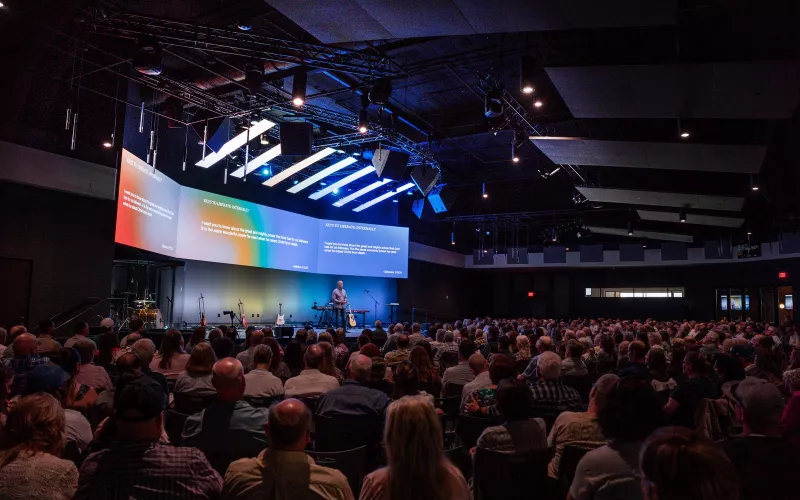
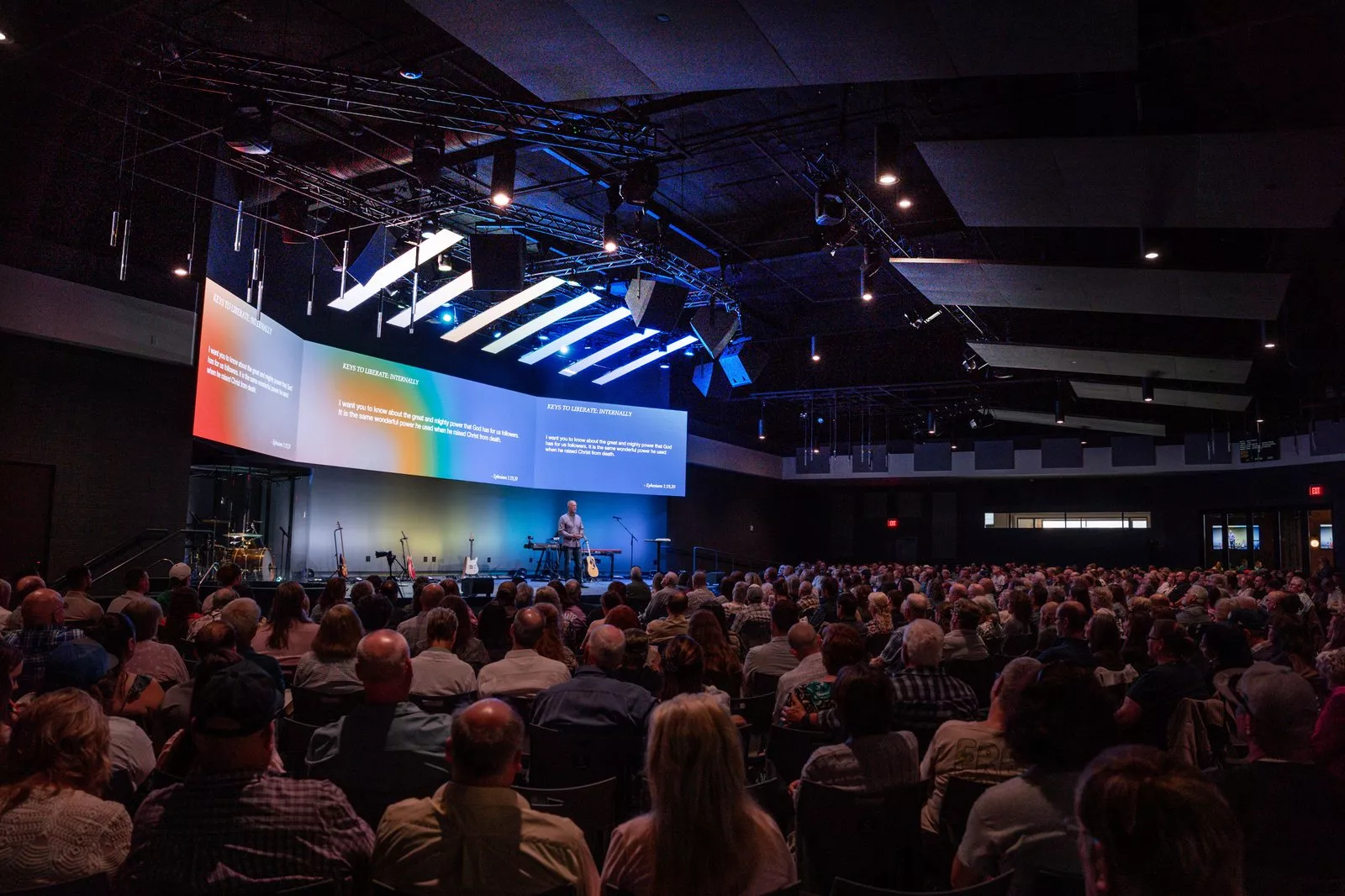
Biamp reported on 3 September 2026 that River Valley Church, in Grants Pass, Oregon, USA, now worships in a former casino that never opened, with sound from Community LVH-906/APB and LVH-909/APB steerable horns and the VenuePolar design plugin. Biamp church audio projects like this one matter to Dublin and Cork congregations and venue owners because they show how a hard, glassy building can be made clear for speech by predicting coverage first and hanging loudspeakers second.
Image: Biamp.
- Date: Biamp's press release about River Valley Church went out on 3 September 2026 from Beaverton, Oregon.
- Building: a new 38,000 square foot casino in Grants Pass, Oregon, that had not opened, now an 800 seat flagship church campus.
- Main loudspeakers: four Community LVH-906/APB and two LVH-909/APB steerable venue horns, Biamp says.
- Support: Community IP8-1122/66B and IC6-1082/96B point source boxes, IS8-218B subwoofers, and ALC-404D, ALC-1604D and ALC-3202D amplified loudspeaker controllers.
- Design: integrator Arrow+Jay worked with Biamp's design team using the VenuePolar plugin within EASE Focus 3.
Inside the Grants Pass conversion
According to Biamp's press release, River Valley Church took over an unopened casino in Grants Pass and turned it into an 800 seat worship facility. In metric terms the floor area is about 3,500 square metres.
Biamp's fuller River Valley Church case study fills in the background: the building is now the main campus for a church that meets across several sites. The architectural brief called for a room that felt open and inviting from the moment people walked in. That meant large areas of glass and reflective finishes towards the back of the sanctuary, which look good but bounce sound around and make words harder to follow.
The integrator, Arrow+Jay, ran the job from concept and feasibility through to commissioning and training the church's own staff. Biamp lists a long set of limits the team had to design around:
- low available mounting height for loudspeakers
- sightlines that could not be blocked
- no option to add delay fills further back in the room
- a need for strong gain before feedback on stage
- extensive glass throughout the sanctuary
Biamp says that with those limits, neither a traditional line array nor a standard point source layout was right.
What went in. The answer was six Community LVH steerable venue horns, four of the LVH-906/APB and two of the LVH-909/APB. Biamp says their beam steering let the team aim sound tightly at the seats and away from the glass rear wall. Point source models fill in elsewhere in the building, and IS8-218B subwoofers handle the bass needed for contemporary worship and events.
The stage trick. The FIR steering includes what Biamp calls an avoidance zone aimed at the stage, so very little energy from the house loudspeakers reaches the platform. The company links this to strong gain before feedback, so worship leaders and musicians can perform without interference from the house system. Executive Pastor Michael Bahn summed up the change simply in the release: "The difference is night and day."
Who in Dublin and Cork should pay attention
If your church or venue in Dublin or Cork is moving into a building that started life as something else, the same issues Biamp describes in Oregon can appear. A former retail unit, a business park building, an old cinema or a modern community centre with a glazed atrium could all raise them.
Growing congregations moving from a rented school hall into permanent premises will meet hard surfaces and fixed ceiling heights for the first time.
Arts and event venues that put the mixing desk at the back of the room should note Biamp's point that River Valley's rear mix position still hears a clean, balanced sound.
Parish and community halls that host talks one day and live music the next need clear speech without losing the low end, which is why the Oregon system pairs steerable horns with dedicated subwoofers.
A planning checklist taken from the case study
Biamp's write up is a product story, but the sequence it describes works as a checklist for any converted building in Ireland:
- Map the reflections. Mark every glass wall, hard floor and bare ceiling before talking about equipment.
- Agree the mounting limits. Find out early where loudspeakers can and cannot hang, given screens, lighting rigs and the views people need.
- Decide whether delays are possible. If not, the front system must reach the back row by itself, as at River Valley.
- Predict before buying. Biamp says VenuePolar works out the number of LVH cabinets, the splay between them and their aiming angles, then applies equalisation and builds speaker files for the ALC amplifiers.
- Protect the stage. Ask how the design keeps house sound off the platform so microphones stay stable.
- Plan for training and growth. Arrow+Jay trained the church's staff, and Biamp describes the platform as scalable as the ministry expands.
Biamp also runs a loudspeaker design service through its applications engineers, covering houses of worship, auditoria and similar venues. Its website says the service is open to dealers, distributors and end users worldwide, so a design prediction is something a church committee can ask for at tender stage.
One caution: Biamp reports that this sanctuary needed fewer loudspeakers than first expected. That result belongs to this room. A smaller Irish hall may need a different product altogether, and Biamp does not claim otherwise.
Where Biamp church audio fits in Irish converted buildings
The lesson is not that every church needs steerable horns. It is that the shape and finish of the building should drive the design. A survey, a coverage model and an agreed list of mounting points will save money and arguments, whatever brand is chosen. See how we run a project for the stages involved.
1Install designs, supplies and installs audio and AV systems, alongside meeting rooms, Teams Rooms and video conferencing systems. Church and venue buildings often include offices and meeting spaces that need audio conferencing, and foyer screens that suit digital signage. For Biamp's meeting room products, read our earlier post on Biamp Devio UCX and BMA 360D bundles. For meeting spaces, you can also start with our quote builder.
Questions we are often asked
Where is River Valley Church?
Grants Pass, Oregon, in the USA. Biamp describes the building as an unopened 38,000 square foot casino converted into an 800 seat worship facility.
Who installed the Biamp system at River Valley Church?
Arrow+Jay, a systems integration firm, working with the Biamp design team, according to Biamp's release and case study.
What does VenuePolar actually do?
It designs custom, asymmetric coverage patterns for the Community LVH-900 inside EASE Focus 3, Biamp says, and then creates equalised speaker files for Biamp ALC amplifiers.
How did the church stop feedback on stage?
By steering sound away from it. Biamp says an avoidance zone targeting the stage was built into the FIR steering, keeping the main system's energy off the platform.
Does the case study say how much the system cost?
No. Neither the press release nor the case study gives a project cost, and Biamp says only that budget was one of the requirements.
Book a consultation or call Dublin on 01 906 9326 or Cork on 021 202 8107.
- Log in to post comments