
A home cinema LED wall is a screen built from self lit LEDs, so there is no projector, no beam across the room and no screen waiting to be lit. Every pixel switches fully off for black, which is why high end homes are choosing LED walls over projectors: the picture keeps its depth and contrast, even with the lights on.
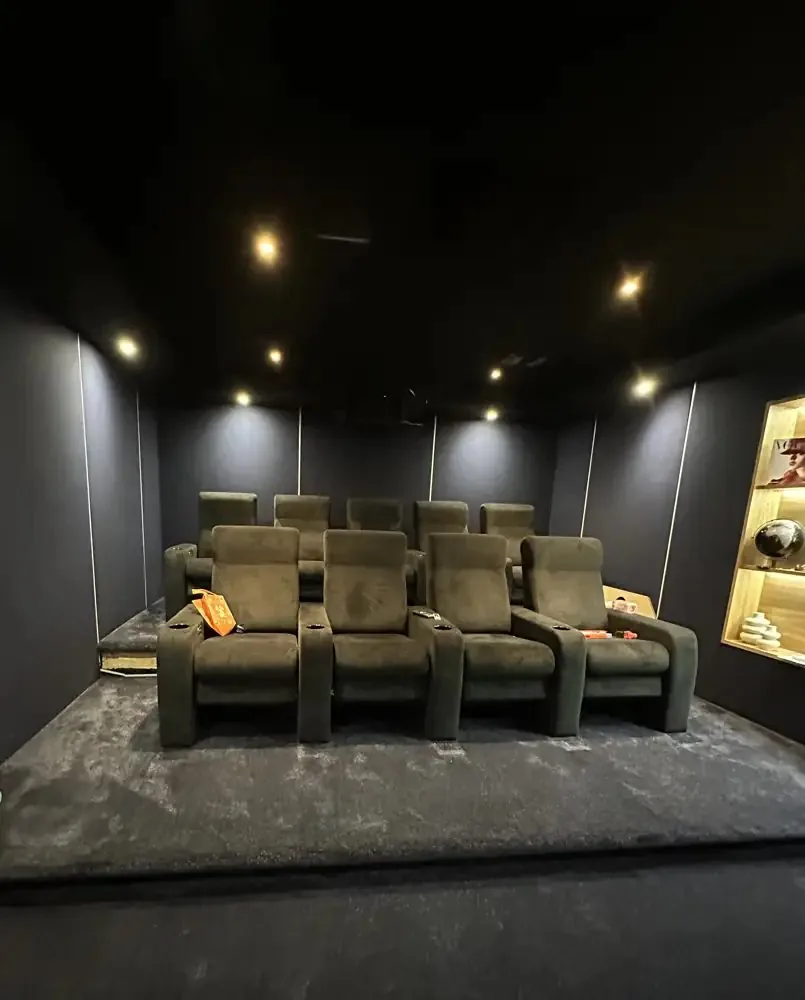 We design and install LED walls for dedicated cinemas, media rooms and living spaces. 1Install is the only installer in Ireland approved by Hisense for its LED walls, and we install Samsung and Philips walls too. This page explains how an LED wall compares with a projector, what it asks of the room, and how we plan one into a house.
Why the black is better on an LED wall
A projector can only add light. Where the picture should be black, the screen shows whatever light is already in the room, plus a little from the projector, so black is really the darkest grey the room allows. As Projector Central puts it, when room light hits a conventional screen it washes out black levels and reduces contrast. That is why a projector looks its best in a blacked out room with dark walls.
An LED wall works the other way round. Each pixel makes its own light and switches off completely for black, and the panels have a deep black surface. You get inky shadows right beside bright highlights in the same frame, and that contrast is what makes a dark scene look real. In a lit room any screen picks up some reflection, but an LED wall holds its contrast far better than a projected image.
Home cinema LED wall or projector?
| LED wall | Projector and screen | |
|---|---|---|
| Black level | True black: the pixels switch off | Set by the screen and the light in the room |
| Watching with lights on | Keeps its contrast and colour | Washes out unless the room is dark |
| Brightness | Far more than a cinema needs, calibrated down | Enough for a dark room |
| Front speakers | Around the wall: it is not acoustically transparent | Can sit behind an acoustically transparent screen |
| Noise | Silent when passively cooled; some panels use fans | A projector fan in the room |
| Heat | A new heat source at the front of the room | Mostly from the projector |
| Size | Built from panels to fit the wall | Very large images for the money |
| Cost | Higher than just about any projector | Lower for the same size |
When a projector still makes sense
LED is not the answer for every room. In a dedicated cinema with no daylight, dark walls and a very large screen, a good projector still gives a superb picture for much less money. Barco, which makes both, says in its guide to choosing projection or LED that projection is recommended where the cinema is a darkened room, and that LED is still more expensive than just about any projector. Projection also lets the left, centre and right speakers sit behind an acoustically transparent screen, the ideal spot for dialogue. We design both, and we will tell you which suits your room and budget. Our home cinema page and the cinema room we built show how we approach a full cinema, and our pages on home cinema installation in Dublin and home cinema installation in Cork cover the rest of what we do from our two offices.
Planning a home cinema LED wall
Seating distance and pixel pitch
Homes need a finer pixel pitch than most offices, because the front row sits close. A 2026 guide for installers from LED Wall Central suggests 0.9 to 1.2 mm for seats 8 to 12 feet, about 2.4 to 3.7 metres, from the wall. For a 4K picture that means a wall roughly 3.5 to 4.6 metres wide, so a cinema LED wall is planned with the room, not added afterwards.
Speakers around the picture
Sound cannot pass through an LED wall, so the left, centre and right speakers go beside, below or above it, or into a stretched acoustic fabric wall that frames the screen. We design the speaker layout and the wall together, so the dialogue stays anchored to the picture.
Brightness, heat and power
An LED wall can run far brighter than a dark cinema needs. The cinema reference is around 48 nits, and the same LED Wall Central guide notes that a dark home cinema rarely needs more than 100 to 200 nits peak, even for HDR, so we calibrate the wall down to suit the room. Even turned down, a large wall is a steady electrical load and a new source of heat at the front of the room, so we plan dedicated circuits and ventilation with your electrician and mechanical engineer.
Structure, access and finish
With an LED wall, the wall itself becomes the screen, so it must be flat and strong enough to carry the frame, with room for service access in a tight cinema. We agree the build up with your builder early, then trim the wall so it looks built in rather than hung.
Control
The LED wall, the sound, the lights and the blinds run from one remote or touch panel, with scenes that dim the room and start the film together. As a Crestron Elite Partner, we tie it into the rest of your home automation, whichever system you choose.
LED walls for living rooms and media rooms
An LED wall is not only for a blacked out cinema. Because it keeps its contrast with the lights on, it suits a living room or media room with big windows, where a projector would wash out. Hisense, whose LED walls we are approved to install, also makes a 136 inch MicroLED screen for the home, the 136MX, and Samsung has designed versions of The Wall for luxury homes. We can frame the wall in joinery or cover it with a motorised curtain when it is off. For an example of a cinema within a larger house, see the country home with a cinema, pool house and tennis court.
Questions we are often asked
Is an LED wall better than a projector for a home cinema?
For black level, brightness and watching with the lights on, yes: every pixel switches off for black, and the picture holds up in a lit room. A projector still gives a very large picture for much less money in a dark, dedicated room, and lets the speakers sit behind the screen. We help you weigh the two for your room and budget.
How far should we sit from an LED wall?
That depends on the pixel pitch. A common rule allows about 3 metres for every millimetre of pitch, and cinema seats are close, so homes use fine pitches of around 0.9 to 1.2 mm. We set the pitch from your seating plan.
Can the speakers go behind an LED wall?
No. An LED wall is solid, so the front speakers go around it or into a fabric wall that frames it. With careful placement and calibration, dialogue still sounds as if it comes from the screen.
Does an LED wall make any noise?
Some panels use fans, which you can hear in quiet scenes. For cinemas we choose passively cooled panels where we can, and keep the processors and power supplies in a ventilated equipment rack away from the seats.
How long will a home LED wall last?
LED panels are rated in hours to half brightness, typically 100,000 hours. Watched for 5 hours a day, that is more than 50 years.
Can we start with a projector and move to LED later?
Yes, if the room is planned for it. We can leave power, data and a strong, flat wall ready, so an LED wall can replace the screen later without rebuilding the room. For an LED wall in a business, see our LED wall installation page.
Book a consultation or call Dublin on 01 906 9326 or Cork on 021 202 8107.