Self build broadband in rural Cork usually comes down to two things you control long before the house is finished: a duct big enough for the length of your drive, and an address the network operators can find. Plan both early and the fibre line can be pulled through on the day it is booked; leave them late and a family can be living in a new house on mobile data for months. This guide covers the duct, the Eircode, and the cabling from the front wall to the comms cabinet.
It is written for people building their own home in and around Cork, often on a site well back from the road in places like Carrigaline, Mallow, Bandon or the farmland around Midleton, where a single duct may run a hundred metres or more before it reaches the house.
Sizing the duct for a long drive
Whoever brings fibre to your door pulls their cable through a duct you provide. open eir's ducting guidelines for property owners are clear that length changes the job. The points that matter on a long Cork site, as checked on the day we wrote this:
- For a run of up to 100 metres the guidelines ask for a 50 mm duct, and up to 200 metres a 100 mm duct.
- Fit access boxes at sharp bends and roughly every 50 to 200 metres on a long run, so the cable can be pulled in stages.
- Where the duct turns a corner, use slow preformed bends rather than tight elbows.
- Drill small drainage holes in the underside at the lowest point of the trench, over a sand or gravel sump, so water does not sit in the duct.
- Bed the duct in sand and keep sharp stones away from it.
- Take the duct beyond your boundary to the nearest pole or access box, or leave enough coiled safely outside the boundary for the operator to reach it.
Where the duct is larger than the wall entry needs, the guidelines suggest an access box near the house with a smaller duct from there to the wall. It is worth agreeing all of this with your groundworker before the trenches for water, power and drainage are filled, because the broadband duct can usually share the dig.
Why the Eircode decides when you can order
A new house cannot be checked or ordered for broadband until it has an Eircode, and that is the step that catches many self builders out. According to the Eircode guide to getting an Eircode, you do not apply for one: new properties captured by An Post GeoDirectory are given Eircodes in regular updates, and a property needs at least two lines of postal address, a principal post town and map coordinates before it can be added. The same page notes that it can take some time to gather that information for a new build.
Once the Eircode appears, check it with open eir and with National Broadband Ireland, since many rural Cork addresses are in the national rollout rather than on an existing network. open eir's new builds page adds a useful warning: an Eircode does not guarantee fibre at that address, and if yours is not recognised you can send its single dwelling form so it can check whether you are inside its plans. Start this as soon as the house has an address, not the week you move in.
A stage by stage plan for self build broadband
| Stage | What to do | Who |
|---|---|---|
| Planning and design | Mark the duct route, the entry point and the comms cabinet on the drawings | You, your designer and us |
| Groundworks | Lay the sized duct with a draw rope, access boxes and drainage, sharing trenches where possible | Groundworker |
| Walls up | Form a sealed sleeve at the entry point on the side of the house nearest the cabinet | Builder |
| First fix | Conduit from the entry point to the cabinet, sockets at both, Cat6 from the cabinet to each room and outbuilding | Electrician, to our drawings |
| Eircode issued | Check the address with open eir and National Broadband Ireland and book the line | You |
| Second fix | Fit the router, switch and access points in the comms cabinet and test every point | Us |
Cabling from the front wall to the comms cabinet
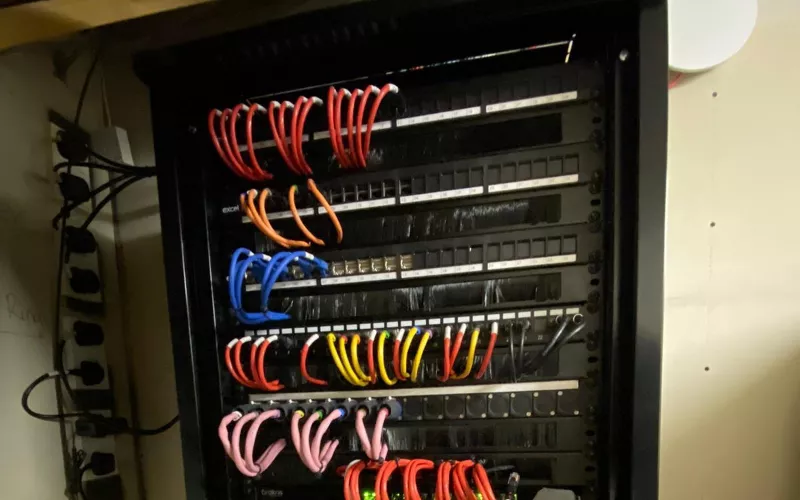
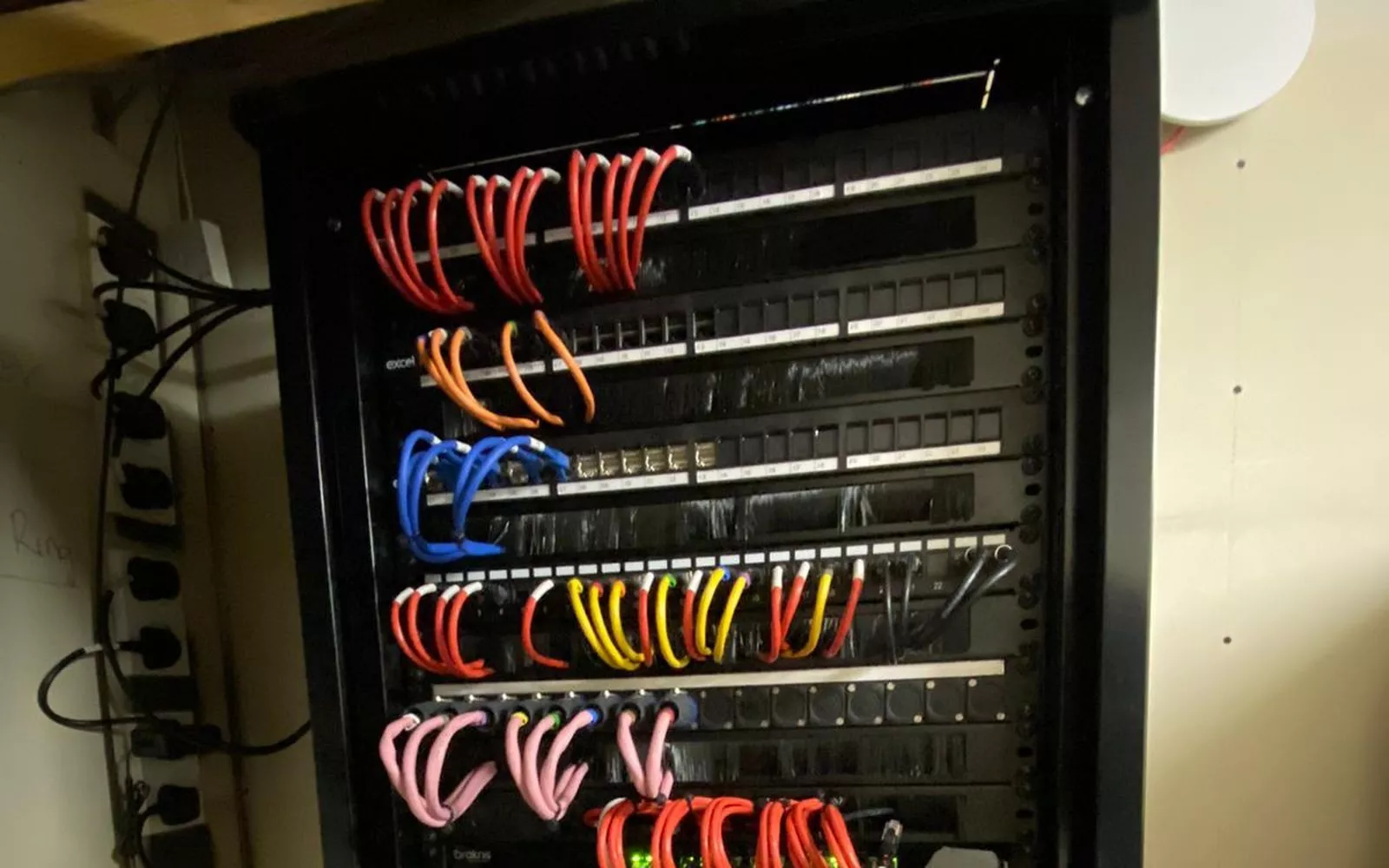
On a long single storey Cork house, the fibre often arrives at one gable while the best spot for the comms cabinet is near the middle. Do not let the entry point decide where the router lives. Run a conduit inside from the entry point to the cabinet at first fix, so the line, the router, the network switch and the patch panels all sit in one ventilated, reachable place. From there, Cat6 runs out to every TV, desk, ceiling access point and camera.
Outbuildings need thought too. A garage, home office or garden room more than about 90 metres of cable from the cabinet is beyond what a single Cat6 run should carry, so plan a fibre or a second switch for it, as we explain in our video intercom and gates guide for Cork self builds. Our mesh Wi-Fi guide for Cork homes covers getting the signal around the house once the line is in.
Power cuts and the broadband line
Rural lines and storms go together. If the alarm, the gate intercom or the cameras depend on the internet, put the router and switch on a small UPS in the comms cabinet and ask your electrician for a dedicated circuit there. Our guide to choosing a self build electrician in Cork covers planning circuits like this early.
How we help
We design the whole network, from the duct entry to the last access point, and install and commission the comms cabinet. Kieran McGuire, who founded 1Install, is an electrician, as are several of our team, so the drawings we give your electrician and groundworker are ones they can build from. Our survey and design service produces those drawings and a cable schedule, and our Wi-Fi and networks page shows the systems we fit. Our site survey or design consultation costs 440 euro plus VAT and covers up to 4 hours.
Questions we are often asked
How big should the broadband duct be on a long drive?
open eir's guidelines ask for 50 mm up to 100 metres and 100 mm up to 200 metres, with access boxes on long runs. Check the latest guidance with your operator before you dig.
Can I order self build broadband before the house has an Eircode?
Not usually, because the operators check and book by Eircode. Lay the duct anyway, so the connection can go ahead as soon as the Eircode is issued.
Can the broadband duct share a trench with the electricity cable?
It can share the dig, but open eir asks for the duct to be kept at least 300 mm from other services. Ask your groundworker and electrician to agree the spacing.
What if my site is not in any fibre plan yet?
Lay the duct anyway, cabled back to the comms cabinet, and use a fixed wireless or mobile router there in the meantime. When fibre arrives, the change is simple.
Before the electrician prices the job, send us your floor plans and we will design the Wi-Fi for free: access point positions, the Cat6 runs back to the comms cabinet and a priced kit list, with no obligation. Our free Wi-Fi design for self builders explains what to send.
Book a consultation or call our Cork office on 021 202 8107.
- Log in to post comments